
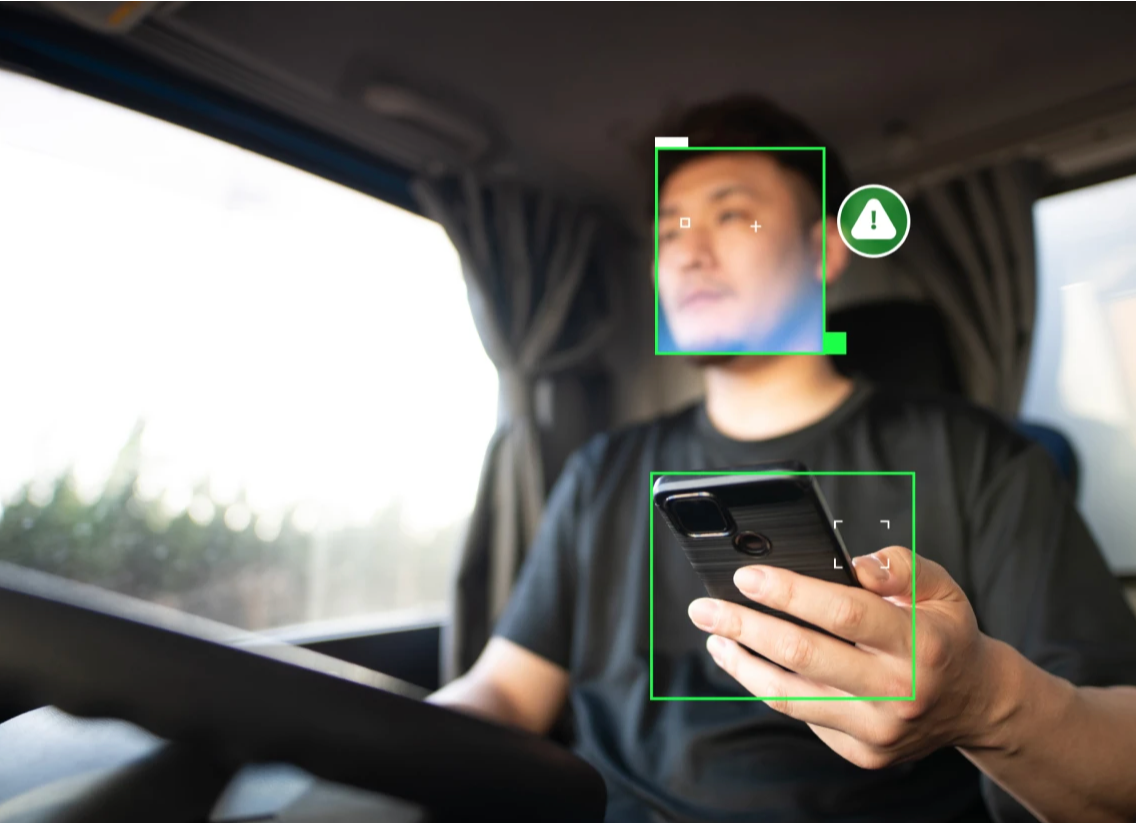
According to the Korea Road Traffic Authority, from 2021 to 2023, there were 5,688 traffic accidents caused by drowsy driving—an average of about five per day. These accidents claimed the lives of 152 people.
These numbers alone may not give you a clear sense of the situation. What matters is how deadly these accidents are. The fatality rate for drowsy driving accidents is 2.7 deaths per 100 accidents, which is roughly doublethe average for all traffic accidents (1.4 deaths). This is because when a driver falls asleep, they fail to recognize the danger and collide without braking. In fact, over the past three years, drowsy driving accounted for 71.5% offatal highway accidents, making it by far the leading cause.
Not only drowsiness but also failure to watch the road ahead and cell phone use—a significant number of accidents stem from the driver’s conditionin this way.
However, most vehicle safety systems monitor the outside of the vehicle. Both lane departure warnings and forward collision warnings detect the road and the vehicle ahead. Yet, the driver—who is actually the source of the accident—is often not monitored by any system.
A system that monitors the driver is the DMS.
This article summarizes what a Driver Monitoring System (DMS) is, the current state of domestic and international regulations, and what transportation companies should consider when evaluating its implementation.
What Is DMS? — An AI Camera Focused on the Driver
DMSstands forDriver Monitoring System.As the name suggests, it is a system in which an AI camera is directed at the driver—rather than the road—to monitor the driver’s condition in real time.
The key point is that it doesn’t simply “record” or “detect”; rather, it monitors risky behavior in real time and alerts the driver immediately. While a standard dashcam stores footage for manual review after an accident, DMS operates differently. The AI camera constantly monitors the driver’s face, eyes, gaze, posture, and hand movements while driving to detect whether their eyes are closed, their gaze has strayed from the road, or they are holding a cell phone. As soon as risky behavior is detected, it sends a warning to the driver to correct it immediately.
In other words, DMS is a system where “detection → notification → correction” occurs in real time. The key is not just detecting danger, but intervening at that very moment to prevent it from leading to an accident.
How Does It Recognize? — Where Does the Assessment Take Place?
Ultimately, the performance of a DMS depends on “how accurately and quickly it detects hazardous conditions.” There are two different approaches to this.
One method involves sending captured video footage to a server for analysis. The other involves AI making judgments directly within the vehicle. The latter does not require sending footage elsewhere and waiting for results; instead, the AI camera assesses risks on the spot and issues an immediate warning without delay. Since drowsiness is a matter of split-second timing, this immediacy is crucial for preventing actual accidents.
Furthermore, the in-vehicle processing method allows for the selective recording and transmission of only hazardous situations—rather than sending all footage externally—which reduces unnecessary exposure of video data and offers advantages in terms of driver privacy. This is why, when evaluating a DMS, it is essential to verify “where the assessment takes place.”
H3. What Is Monitored and What Triggers Alerts?
The following are typical risky behaviors that DMS monitors in real time and alerts drivers to, along with why they are dangerous.
- Drowsy driving — The system detects signs such as eyes closing, slower blinking, and the head drooping. This is the most fatal type of traffic accident, and drivers are often unaware that they are even drowsy.
- Failure to Keep Eyes on the Road — This occurs when the driver’s gaze strays from the road ahead. Even a few seconds of distraction can lead to rear-end collisions or lane departures.
- Cell Phone Use — Detects phone calls or screen manipulation while driving. This is a high-risk behavior that simultaneously diverts the driver’s gaze, attention, and one hand.
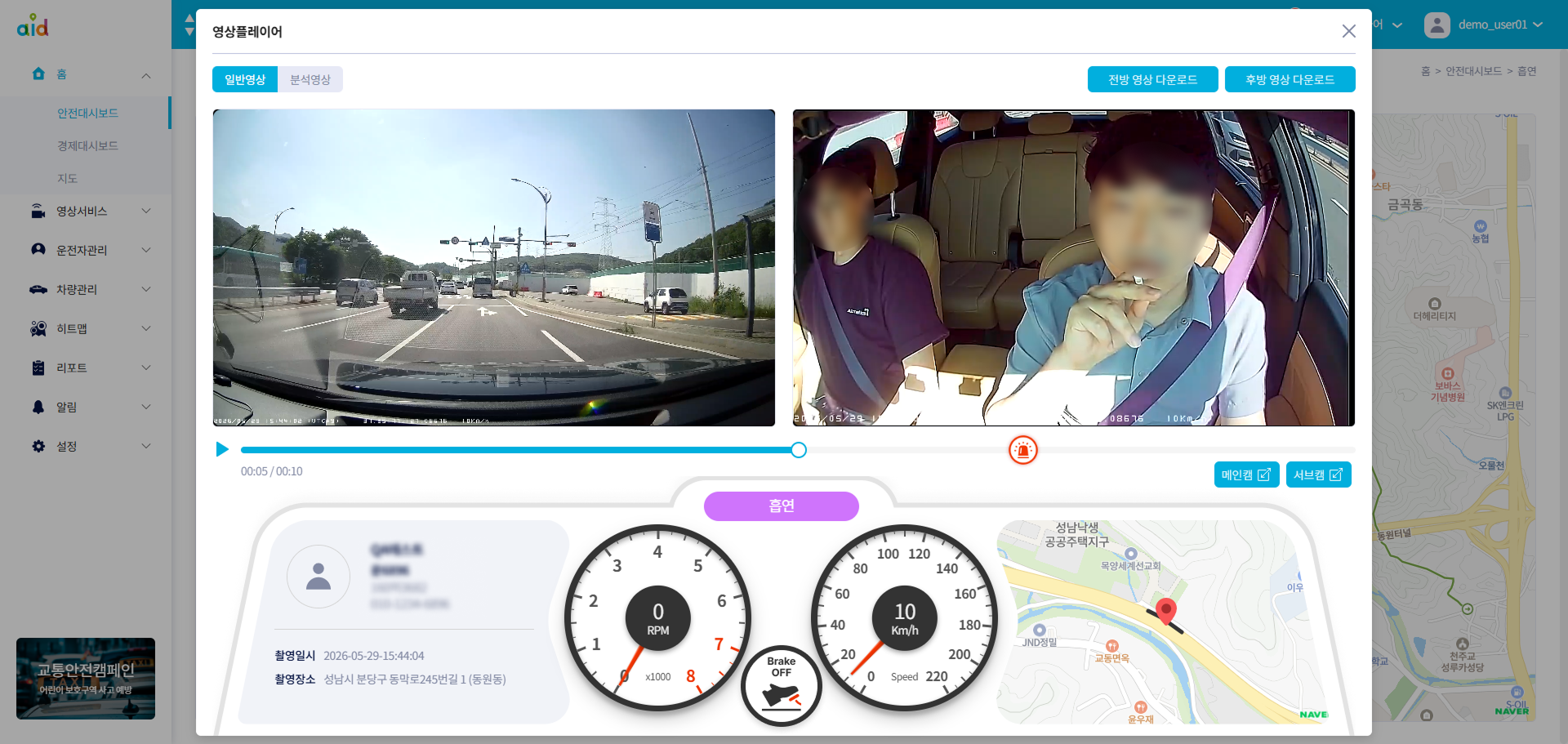
- Smoking — This involves the use of hands and distracts the driver; it is also subject to regulation from the perspective of in-vehicle safety and hygiene.
- Failure to wear a seatbelt — A key factor determining the severity of injuries in the event of an accident; seatbelt usage is monitored in real time.
When a risk is detected, a voice warningis immediately delivered to the driver to prompt corrective action, and the event is simultaneously recorded as data.
How is this different from ADAS?
It is easy to confuse this with ADAS. The two have opposite perspectives.
- ADAS — The camera faces outward. It recognizes the driving environment, such as lanes, the vehicleahead, and pedestrians.
- DMS — The camera faces the driver. It detects the driver’s condition, such as drowsiness or failure to look ahead.
The differences in detection ranges between ADAS and DMS, as well as why legally mandated devices (DTG and ADAS) cannot monitor the driver, are covered in detail in the article “What’s the Difference Between ADAS and AI Safe Driving Solutions?”
Where Do Domestic and International Regulations Stand? — Mandatory Abroad, Still Evolving in Korea
The reason we need to understand DMS now is due to regulatory trends.
Overseas — Already Mandatory
Through the General Safety Regulation (GSR), the European Union has mandated Driver Drowsiness and Attention Warning (DDAW) systems in new vehicles starting July 2024. Following this, Attention Distraction Warning (ADDW) systems—which alert drivers when their gaze strays from the road for a certain period of time—are alsobeing phased in.
In other words, in Europe, driver-monitoring devices are no longer optional—they’ve become standard. The global automotive and parts markets are also following this trend.
H3. South Korea — Not Yet Mandatory, But
In South Korea, the installation of Driver Monitoring Systems (DMS) on commercial vehicles is not yet mandatory. This differs from the situation with Lane Departure Warning Systems (part of the ADAS suite), which are already required by law.
From the perspective of transportation companies, this actually presents an opportunity. By proactively adopting the system while it is not yet mandatory, they can establish accident reduction and safety management systems before regulations are enacted. Given that overseas regulations have already set the direction, the expansion of adoption in Korea can be seen as merely a matter of time.
5 Things Transportation Companies Should Check Before Implementing DMS
This is where the practical work begins. Not all DMS systems are created equal. To ensure they function effectively in real-world transportation operations, the following five points must be verified:
① Does it work in nighttime and low-light conditions?
Transportation vehicles often operate during the early morning and at night. If the system cannot recognize the driver’s face and eye condition in dark conditions, the DMS serves no purpose. You must verify its recognition performance in real-world operating environments, such as low-light conditions, backlighting, and when the driver is wearing a mask.
② Scope of Detection Items
You must verify whether the system detects only drowsiness or also detects inattention to the road ahead, cell phone use, smoking, and failure to wear a seatbelt. Since accidents are rarely caused by a single factor, the broader the range of detected behaviors, the wider the scope of actual accident prevention.
③ Does It Also Monitor the External Environment (ADAS)?
A DMS that monitors only the driver is only half the solution. To detect situations where a vehicle drifts out of its lane due to drowsiness, both the driver’s condition (DMS) and the driving environment (ADAS) must be monitored together. If a single device can recognize both internal and external factors simultaneously, the number of devices and costs are reduced.
④ Does it end with a warning, or does it lead to management?
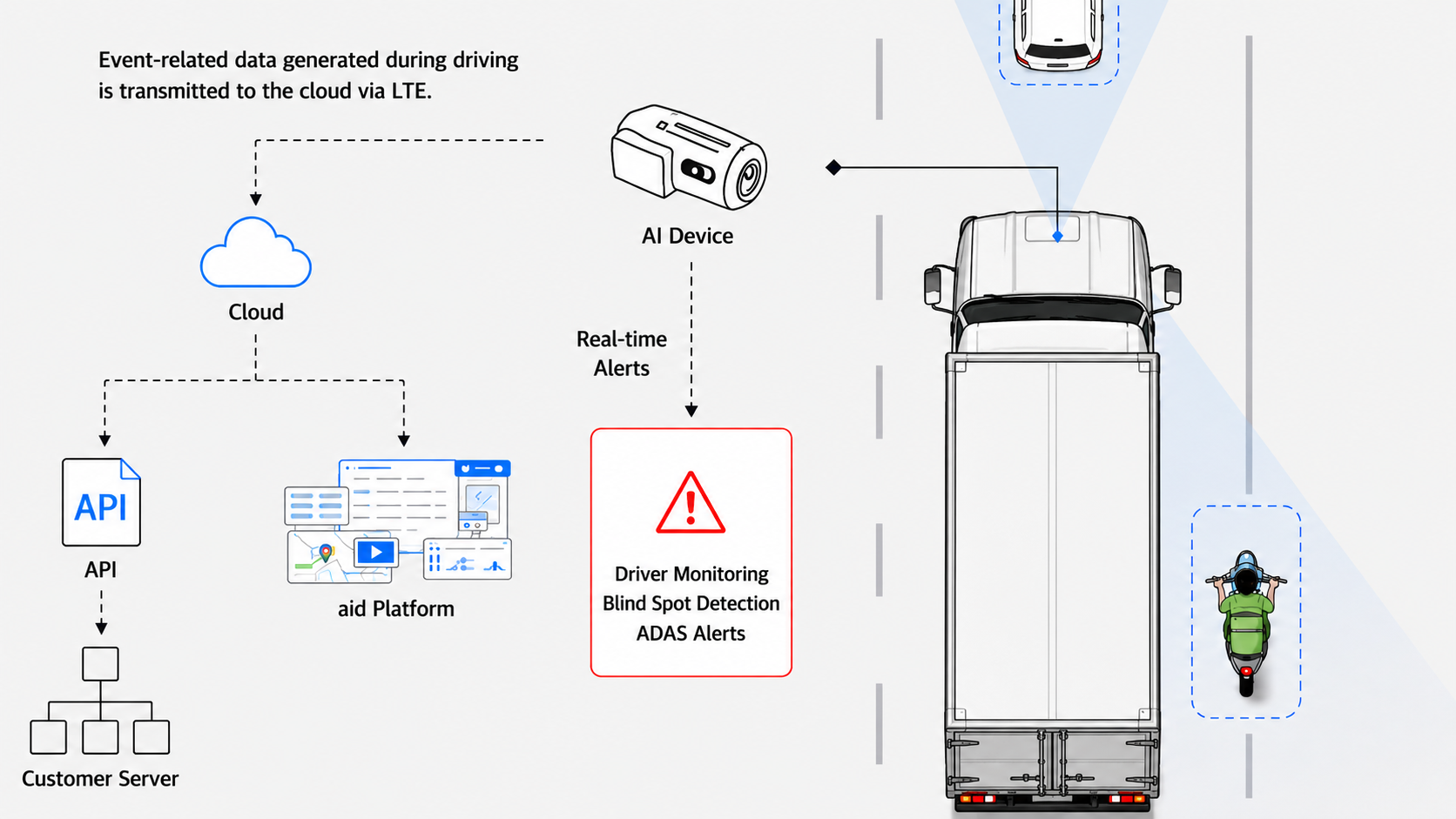
If a DMS merely emits an audible warning to the driver and stops there, the company has no way of knowing when or how many times the warning sounded. Only when the detected data is transmitted to a monitoring platform and aggregated and analyzed by drivercan high-risk drivers be identified and referred for training. For transportation companies, this link to management is just as important as individual detection performance.
⑤ Are there proven results?
Rather than relying on the detection items listed in a catalog, it is essential to verify how much risky behavior has actually decreased in real-world driving conditions. The presence of pilot projects conducted by credible institutions or actual implementation data serves as the criteria for evaluation.
Is DMS Alone Sufficient? — Cameras and Solutions Are Different
DMS is the starting point for accident prevention, not a complete solution in and of itself.
There are many products on the market that offer only DMS functionality—they simply install a camera module that detects the driver’s condition. However, what transportation companies actually want is not merely “driver detection,” but “reducing accidents and managing that process.”
To achieve this, the following must work in conjunction with the DMS:
- Driving Environment Recognition (ADAS) — Integrated assessment of driver condition and road conditions
- Real-time Alerts — Immediately notifying the driver during dangerous moments
- Monitoring Platform — Accumulates and analyzes detection data by driver and by vehicle
- Scoring and Training Integration — Identifying and managing drivers with risky driving patterns
A.I.Matics, a Vision AI specialist with over 20 years of experience, offers an AI safe driving solution that simultaneously processes DMS (Driver Monitoring System) and ADAS (Advanced Driver Assistance Systems) on a single AI device and transmits the detected data to the aid monitoring platform, enabling driver-specific management. In other words, it goes beyond simply being a “camera that monitors drivers” to function as a “system that reduces and manages accidents.”
Proven Effectiveness — Korea Transportation Safety Authority Pilot Project
A pilot project confirmed the actual changes that occurred once driver monitoring began.
Measurement Conditions: Korea Transportation Safety Authority (KOTSA) Route Bus Pilot Project · June–December 2024 · 13 transportation companies · 500 vehicles · 1,615 drivers · Based on 1,000 km of driving distance
| Risky Driving Behaviors | Before Implementation | After Implementation | Reduction Rate |
|---|---|---|---|
| Drowsy Driving | 1.54 times | 0.005 incidents | 99.7% decrease |
| Failure to keep eyes on the road | 0.024 incidents | 0.002 times | 93.4% decrease |
| Running a Red Light | 12.75 times | 1.58 times | 87.6% decrease |
| Smoking | 0.54 times | 0.32 times | 41.4% decrease |
In particular , a 99.7% reduction in drowsy driving and a 93.4% reduction in failure to monitor the road ahead—the primary detection categories for DMS—were confirmed. These results were achieved by monitoring drivers in real time and issuing warnings the moment a violation occurred.
Summary — Safety Systems Now Watch the Driver
To sum it up in one sentence:
Most accidents are caused by the driver, yet most safety systems monitor the outside of the vehicle. DMS is a system that monitors the driver. It is already mandatory overseas, and South Korea is following suit. However, simply installing a DMS camera is not the same as reducing accidents and managing risk—detection, warning, and monitoring must all work together.
Monitoring the driver is no longer a special feature but is becoming the foundation of safety management. Now, while it is not yet mandatory in Korea, is the opportunity to proactively establish a system.
👉Get a diagnostic assessment of your company’s driver detection and management system
Frequently Asked Questions (FAQ)
Q. What is the difference between DMS and ADAS?
A. They focus on opposite directions. ADAS (Advanced Driver Assistance Systems) uses AI cameras pointed outward to recognize the driving environment, such as lanes, the vehicle ahead, and pedestrians. DMS (Driver Monitoring System) uses an AI camera pointed at the driver to detect the driver’s condition—such as drowsiness, failure to look ahead, cell phone use, smoking, or failure to wear a seatbelt. To comprehensively prevent accidents, both systems must work together.
Q. Is DMS mandatory in Korea?
A. The installation of DMS is not yet mandatory for commercial vehicles in South Korea . While ADAS systems such as lane departure warning systems are already required by law, DMS is an exception. However, the European Union has mandated Driver Drowsiness and Attention Warning (DDAW) systems in new vehicles starting July 2024, and the global trend is moving in the same direction. As the adoption of DMS is expected to expand in Korea as well, it may be advantageous to install it proactively before it becomes mandatory.
Q. My car already has a dashcam. Do I need a separate DMS?
A. A standard dashcam only recordsvideo; it does not detect or warn the driver in real time if they are drowsy or not paying attention to the road ahead . It is intended for reviewing footage after an accident has occurred. DMS serves a different purpose in that it recognizes dangerous situations in real time and issues a warning before an accident occurs. The two are not substitutes for one another.
Q. Isn’t it enough to just detect drowsiness?
A. Drowsiness is a prime example of a hazardous condition, but it is not the only one. Distracted driving, cell phone use, and not wearing a seatbelt are also risk factors that can lead to accidents. If detection is limited to drowsiness alone, the remaining risks will still fall through the cracks. It is important to verify the scope of detection criteria when implementing the system.
Q. Won’t drivers object, feeling like they’re being monitored?
A. That’s a reaction that might arise in the early stages of implementation. The key is to operate the system as a coaching tool rather than a punishment mechanism. Acceptance increases when risks are communicated in advance and the system is designed to include score-based feedback along with a recognition and reward system for improvement. Additionally, DMS data works to the advantage of conscientious drivers, as it allows them to objectively prove their safe driving practices in the event of an accident or a complaint.
Q. Will accidents decrease simply by installing DMS cameras?
A. Installing cameras and reducing accidents are two different things. Actual accident reduction occurs when detected hazards are immediately flagged to the driver as warnings, and that data is accumulated in the monitoring platform to inform driver-specific management and training. When evaluating a DMS, it’s essential to examine not only detection performance but also this integrated management framework.
The drowsy driving statistics in this article are based on data from the Korea Road Traffic Authority; the data on accident reduction effects is based on the results of the Korea Transportation Safety Authority’s route bus pilot project; and the trends in overseas regulations are based on publicly available materials related to the European Union’s General Safety Regulation (GSR). Domestic and international regulatory requirements may vary depending on the timing and vehicle type, so individual verification is necessary.

