
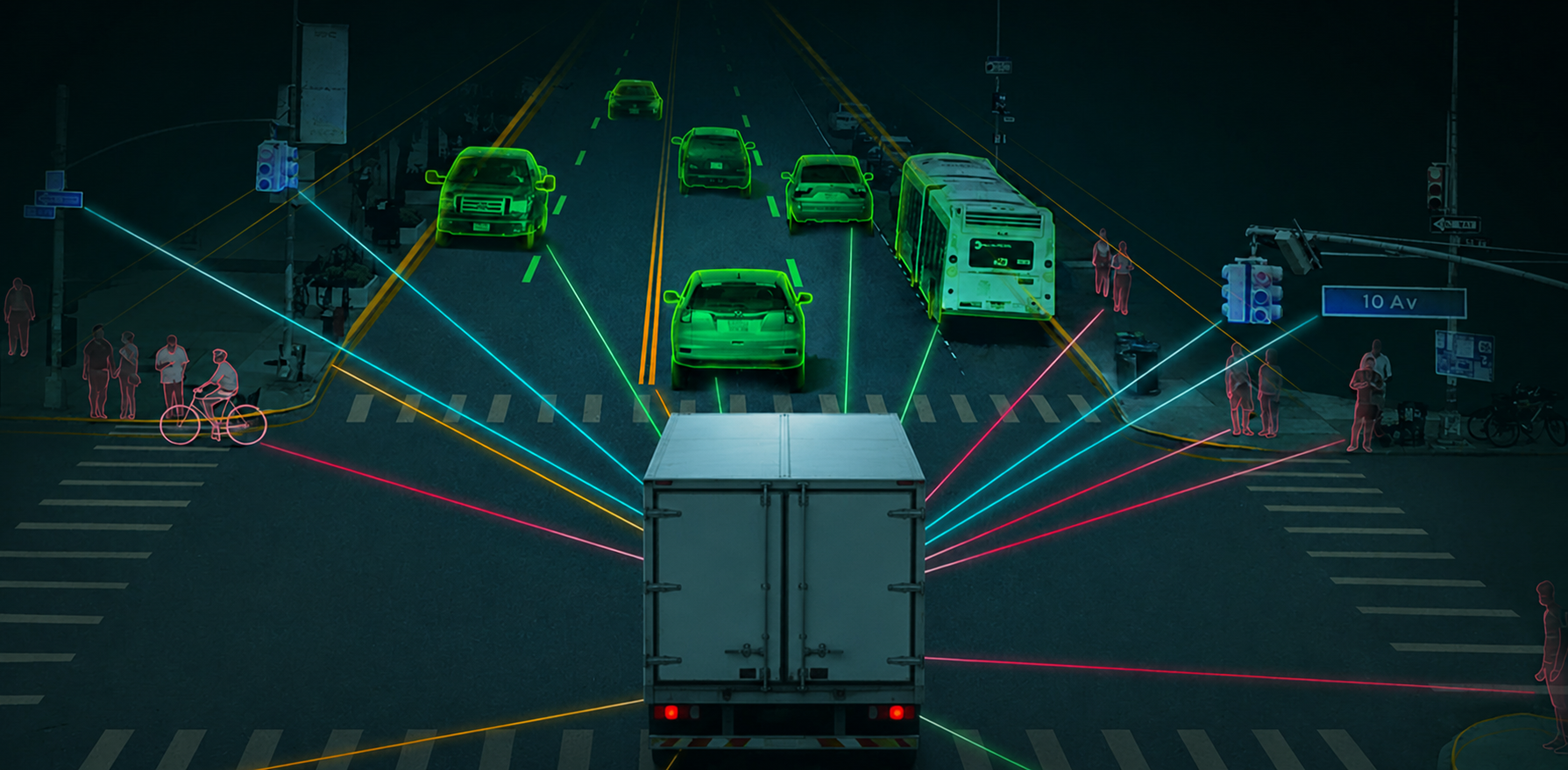
There’s a phrase often heard from safety managers at transportation companies.
"We’ve installed all the legally required safety devices. So why aren’t accidents decreasing?"
There is a clear answer to this question.
It’s because DTGs don’t issue warnings, and ADAS doesn’t record data.
Commercial large vehicles are already required by law to be equipped with two devices: the Digital Tachograph (DTG) and the Lane Departure Warning System (LDWS) . However , these two systems perform different functions and each only does half the job.
- The DTG recordsdriving data. However, it does not alert the driver during dangerous moments . The fact that the driver was speeding is only confirmed later through the recorded data.
- The Lane Departure Warning System (LDWS) alertsthe driver when the vehicle crosses a lane line. However, the company has no record of when or how many times that warning sounded .
And most importantly— neither of them monitors the driver.
This article summarizes four key areas where transportation companies, even those already equipped with legally required devices, are still falling short.
First, a recap—the two devices already installed in our vehicles
Commercial large vehicles are already equipped with two devices mandated by law.
H3. DTG (Digital Tachograph) — A recording device
This device recordsthe vehicle’s operating information. It receives and stores speed, acceleration, and steering data from the vehicle’s sensors and submits this data periodically.
Eleven types ofrisky driving behaviors are recorded: speeding, prolonged speeding, sudden acceleration, sudden deceleration, sudden starts, sudden stops, sudden left turns, sudden right turns, sudden lane changes, sudden U-turns, and continuous driving.
The key point is that this is a “recording” device. The moment a driver accelerates rapidly, the DTG does not issue any warning. It simply records the event. It is not a device designed to prevent accidents, but rather one used for post-incident review.
The mandatory submission requirements and inspection methods for DTGs are detailed in our company’s inspection guide,specifically regarding the monthly submission obligation for DTGs on large trucks.
ADAS (Advanced Driver Assistance System) — A Warning System
Advanced Driver Assistance System. It detects the area in front of the vehicleand alerts the driver to potential hazards. The two most common examples are:
- LDWS (Lane Departure Warning System) — Alerts the driver when the vehicle drifts out of its lane
- AEBS (Automatic Emergency Braking System) — Detects the risk of a collision with a vehicle ahead and issues a warning or applies the brakes
Pursuantto Article 55-2 of the Traffic Safety Act, commercial large vehicles must be equipped with a Lane Departure Warning System; failure to do so results in a fine (effective January 2020; up to 1.5 million won for repeat violations).
The key point is that these systems “assist the driver.” Their role is limited to alerting the driver to danger; they do not report that information to the company.
H3. And things neither of them does
That covers the legally required devices. DTG records data, and ADAS issues warnings.
However, neither system monitors the driver. Whether the driver is dozing off, looking at a cell phone, or closing their eyes—neither device checks for any of these behaviors.
So what is an AI safe driving solution?
It is not a legally required device. You won’t be fined for not installing it. That’s why the question posed in this article is valid : “I’ve already installed all the legally required devices—why do I need this one too?”
The AI Safe Driving Solution uses AI video recognition to simultaneously monitor both the vehicle’s exterior and interior (the driver). It immediately alerts the driver in dangerous situations and automatically records the event, transmitting it to a monitoring platform.
In other words, a single device simultaneously performs the “recording” function of a DTG and the “warning” function of ADAS, while also adding driver detection and data for administrators—features not provided by legally required devices.
In the case of AI-Matic, the AI device handles detection and warnings, while the aid platform handles recording, analysis, and management.
From here on, I’ll break down the differences between these three into four points.
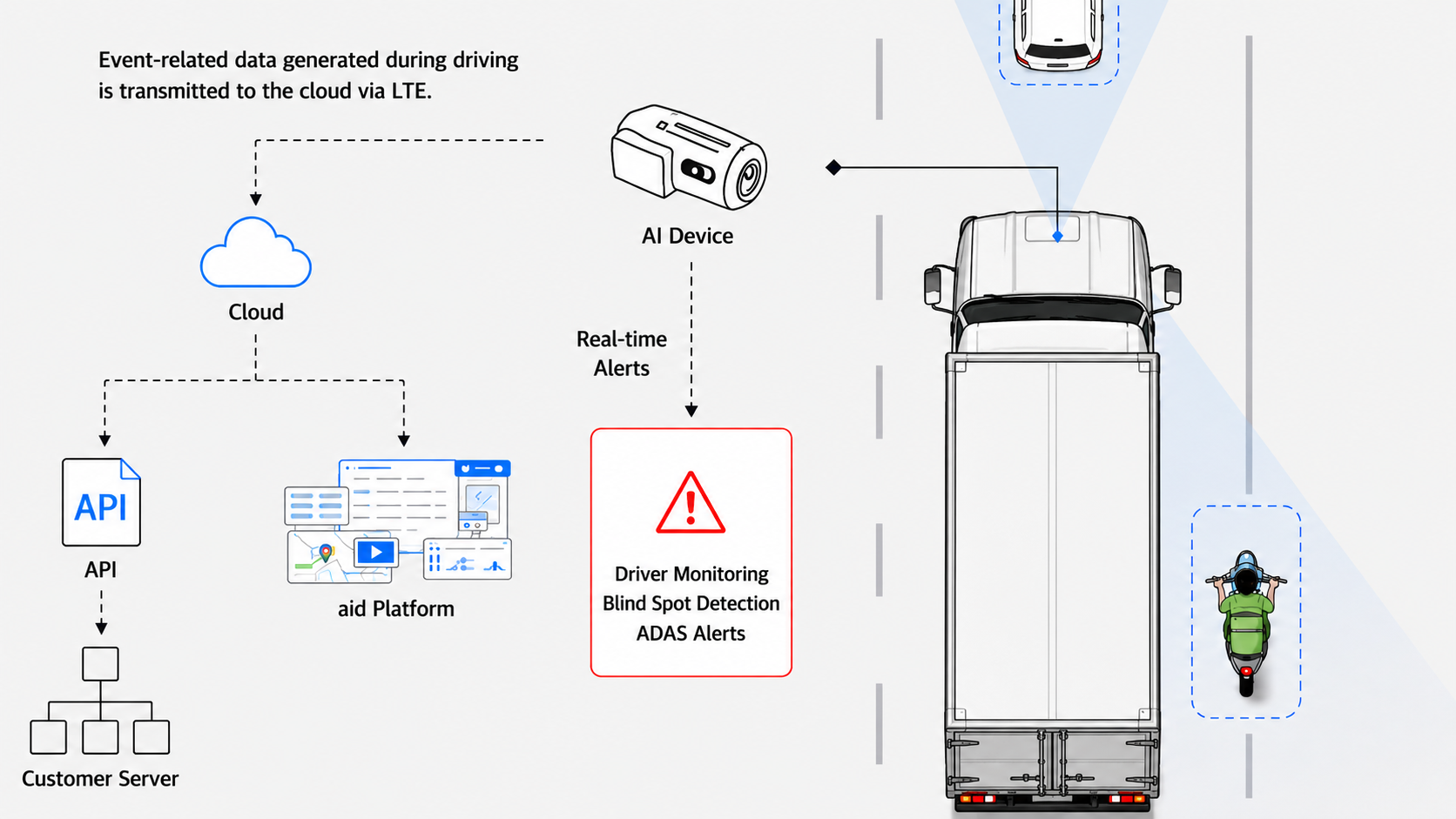
Difference #1: Different Roles — Recording Devices and Warning Devices Are Different Things
This is the most common misconception among transportation companies: the belief that “since we’ve installed two devices, safety management is being handled.”
However, when you break down the roles of the two devices, this is what you find.
| DTG | ADAS | AI Safe Driving Solution | |
|---|---|---|---|
| Role | Recording | Warning | Detection · Warning · Recording · Management |
| Does it alert the driver during dangerous moments? | ✕ | O | O |
| Is that information retained by the company? | O (Trip Log) | ✕ | O (Automatic Event Saving) |
| Does it monitor the driver? | ✕ | ✕ | O |
| Does the administrator monitor in real time? | ✕ (Submitted after the fact) | ✕ | O (Platform) |
DTG records incidents but cannot prevent them. Even if speeding records accumulate, nothing happens at the exact moment the speeding occurs. It only confirms after an accident that “it was, as expected, due to speeding.”
ADAS issues warnings but leaves no record. The company has no way of knowing how many times the lane departure warning sounded yesterday or which driver triggered it. Even if an accident occurs, there is no evidence to prove that “we were monitoring the situation.”
It records but cannot prevent, and it warns but leaves no trace. This is the primary reason why accidents continue to occur even with all the legally required devices in place.
Difference #2: No One Is Watching the Driver — Drowsy Driving Is the Number One Cause of Accidents
The second difference is even more critical.
Lane departure warning systems do not detect drowsiness
The legal definition of a lane departure warning system is as follows:
A device that recognizes the lane of the vehicle in motion and issues an alert when the vehicle drifts out of its lane due to drowsy driving or other reasons beyond the driver’s control
The stated purpose of the system is to prevent drowsy driving. Local governments even subsidize installation costs under the name “Lane Departure Warning System for Preventing Drowsy Driving.”
However, this device does not detect drowsiness itself.
It sounds an alarm only after the vehicle has already crossed the lane marking. The time between when the driver begins to doze off and when the vehicle crosses the line remains a gap. If the driver collides with the car ahead or fails to notice a pedestrian during that time, the alarm won’t even have a chance to sound.
It’s a system that addresses the result, not the cause.
In contrast, a system that monitors the driver detects the moment the driver’s eyes close. It intervenes before the vehicle crosses the lane.
25 Major Causes of Traffic Accidents: How Many Does Our Car Address?
Based on the 25 major causes of traffic accidents, the scope covered by each device is as follows.
| Device | Accident Factors Addressed | Number |
|---|---|---|
| DTG (Recording Only) | Speeding · Chronic speeding · Sudden acceleration · Sudden deceleration · Sudden start · Sudden stop · Sudden left turn · Sudden right turn · Sudden passing · Sudden U-turn · Continuous driving | 11 |
| ADAS (Warnings Only) | Failure to Maintain Safe Following Distance · Lane Departure · Frequent Lane Changes · Rear-End Collision | 4 |
| AI Safe Driving Solution (Detection, Warning, Recording) | All 15 of the above + drowsy driving · failure to watch the road ahead · cell phone use · smoking · failure to wear a seatbelt · running a red light · crossing the center line · violations in school zones · failure to yield to pedestrians · sudden lane changes | 25 |
Please note the following when reading the table. The 11 items in the DTG column mean “recorded,” not “warned at that moment.” Even for the same item, DTG provides post-event recording, while the AI Safe Driving Solution offers real-time warnings plus recording.
Furthermore, among the 10 items handled exclusively by the AI Safe Driving Solution, the first five (drowsy driving, failure to watch the road ahead, cell phone use, smoking, and failure to wear a seat belt) share a common characteristic.
All of them can only be detected by observing the driver.
Yet the number one cause of accidents lies precisely there.
These are the 2023 traffic accident statistics by traffic violation from the National Police Agency’s Traffic Accident Analysis System (TAAS).
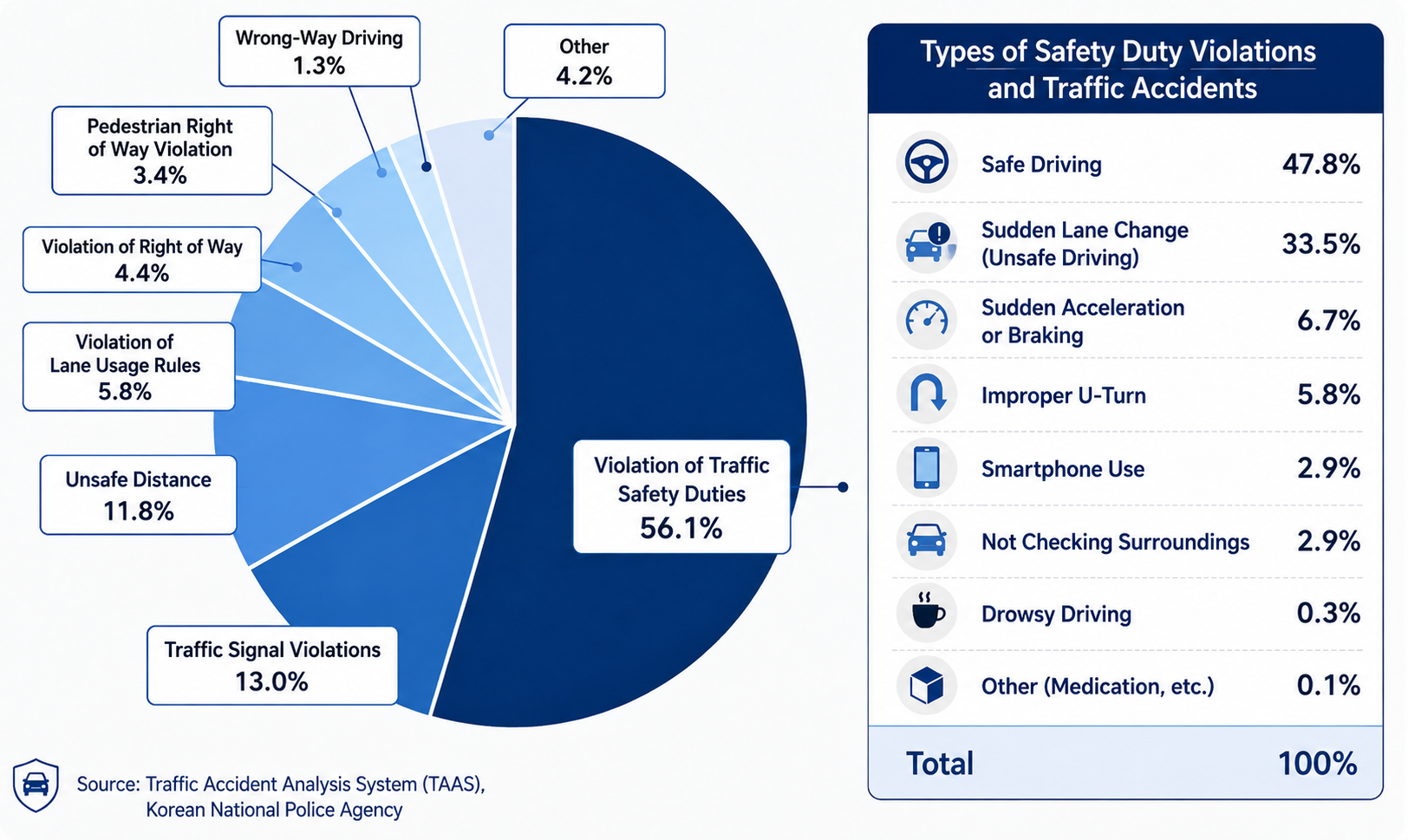
When we break down “failure to comply with safety obligations”—which accounts for an overwhelming 56.1% of accidents—by type, the results are as follows.
| Types of Failure to Comply with Safety Obligations | Relevance to Traffic Accidents |
|---|---|
| Drowsy Driving | 47.8% |
| Sudden Lane Change (Reckless Driving) | 33.5% |
| Sudden acceleration or sudden braking | 6.7% |
| Abrupt left or right turns | 5.8% |
| Cell Phone Use | 2.9% |
| Failure to watch the road ahead | 2.9% |
| Smoking | 2.3% |
| Other (medication use) | 0.1% |
Drowsy driving: 47.8%. It is by far the leading cause of accidents.
And if you look at the table above again— neither DTG nor ADAS includes a category for drowsy driving.
The law mandated lane departure warning systems to prevent drowsy driving, but those systems cannot detect drowsiness. Even with all the legally required devices in place, the leading cause of accidentsmay still be something that no one is monitoring.
Difference ③: Do warnings reach the company?
The third difference is the most practical from the perspective of transportation companies.
ADAS warnings disappear inside the vehicle
When ADAS detects a hazard, it emits an audible warning to the driver. And that’s where it ends.
- The company has no way of knowing when or how many times the warning sounded.
- It cannot identify which drivers are repeatedly engaging in risky behavior.
- Even if an accident occurs , there is no record showing that the company managed the situation.
In other words, ADAS is a device installed in the vehicle, not a management tool used by the company.
DTG records are for submission, not for management
So what about the DTG records? Data is stored in the DTG. However, that data is intended for regulatory submissions, not for managing drivers.
- Even if a speeding record is logged, it’s impossible to know why the driver did it. It’s impossible to tell whether the driver was dozing off, looking at a cell phone, or rushing to meet a dispatch deadline.
- Since the data is aggregated after the fact , it’s impossible to intervene in the moment.
- Without video footage, it’s difficult to use the data as evidence when disputing the cause of an accident .
Even if there are 100 instances of sudden acceleration, without knowing the cause , it’s impossible to determine what training is needed.
AI Safe Driving Solutions Deliver Data to Managers
AI safe driving solutions automatically classify and store detected events, then transmit them to the monitoring platform. Administrators can check the following from their offices:
- Safe Driving Monitoring — Real-time verification of which vehicles exhibited which risky behaviors
- Driver-Specific Scoring — Objectively identify drivers exhibiting risky patterns
- Automatic Accident Detection — Automatically detects accidents by analyzing video footage (no need to wait for driver reports)
- Location Monitoring — Check real-time vehicle locations and routes
- Fuel-Efficient Driving Analysis — Identify fuel waste caused by idling, sudden acceleration, and other factors
A warning sound only changes the moment, but data changes habits.
How many devices should you install?
This difference also affects implementation costs.
If you add devices one by one to expand the detection range, you’ll end up installing a separate DTG, a separate front-facing camera, and a separate blind-spot camera on a single vehicle. Both installation costs and the number of components to troubleshoot in case of a malfunction increase proportionally to the number of devices.
An AI safe driving solution uses a single device to simultaneously analyze footage from multiple cameras. A single device monitors the road ahead, the driver, and blind spots at the same time. According to AI-Matics, this approach has been shown to reduce hardware costs by approximately 80 %.
Another benefit is reduced communication costs. The method of uploading all recorded footage to a server for analysis consumes a large amount of data. In contrast, when the device independently assesses risks, it only needs to transmit footage of actual hazardous situations.
Basis for Communication Cost Savings (Based on the Korea Transportation Safety Authority’s Hazardous Materials Vehicle Monitoring Pilot Project): Conventional sensor-based terminals sent 1,017 alerts indicating “possible accidents,” but most were not actual accidents. The system where AI makes its own judgments sent only 12 such alerts. As false alarms decreased, video transmission costs dropped from 48,510 won to 572 won.
Difference ④ What the company gains when an accident occurs
The fourth difference concerns the company’s position following an accident.
Proof of Compliance with Safety Management Obligations
Amid a trend toward stricter laws regarding safety management obligations—such as the Act on the Punishment of Serious Accidents and the Occupational Safety and Health Act—whether the company fulfilled its safety management obligations becomes a key factor in determining liability when an accident occurs.
What matters here is not **“whether the safety devices were installed,” but “whether they were actually in operation and whether records of their operation were maintained.”**
- Was risky behavior being monitored?
- Are there records of actions taken in response to warning signs?
- Is there a history of training and supervision for each driver?
It is difficult to answer these questions based on statutory devices alone. ADAS systems only issue warnings and do not keep records, while DTGs do keep records but lack video footage, making it impossible to prove the cause.
Let’s assume a drowsy driving accident occurred. The DTG would have recorded a sudden deceleration, and a lane departure warning would likely have sounded. However, there is no record anywhere of the fact that “the driver was drowsy” or that “the company had previously issued warnings and taken action.”
In contrast, AI-based safe driving solutions accumulate data onthe timing of drowsiness detection, warning history, and management actions, providing a basis for reducing administrative penalties and addressing legal liability.
Actual Changes Observed When Drivers Were Monitored
These are the results showing a reduction in risky driving behaviors, as confirmed in the Korea Transportation Safety Authority’s route bus pilot project.
Measurement conditions: June–December 2024 · 13 transportation companies · 500 vehicles · 1,615 drivers · Based on 1,000 km of driving distance
| Risky Driving Behaviors | Before Implementation | After Implementation | Reduction Rate |
|---|---|---|---|
| Drowsy Driving | 1.54 times | 0.005 incidents | 99.7% decrease |
| Failure to watch the road ahead | 0.024 incidents | 0.002 times | 93.4% decrease |
| Running a Red Light | 12.75 times | 1.58 times | 87.6% decrease |
| Crossing the center line | 5.60 times | 2.97 times | 46.9% decrease |
| Smoking | 0.54 times | 0.32 times | 41.4% decrease |
| Failure to Maintain a Safe Distance | 20.3 times | 13.8 times | 32.1% decrease |
| Pedestrian Collision Warning | 169.7 times | 128.4 times | 24.4% decrease |
There is a point worth noting here. The items with the highest reduction rates (drowsy driving: 99.7%, failure to maintain a safe following distance: 93.4%, smoking: 41.4%) are all issues not addressed by existing mandatory safety features.
Conversely, the failure to maintain a safe following distance—an issue ADAS was already warning drivers about—saw only a 32.1% reduction. This is because it was an area where alerts were already being issued.
This meansthe greatest changes occurred when we began to see what no one had been noticing before.
Summary — DTG doesn’t warn, and ADAS doesn’t record
| Category | DTG | ADAS | AI Safe Driving Solution |
|---|---|---|---|
| Role | Recording | Warning | Detection · Warning · Recording · Management |
| Legal Obligations | O | O | ✕ (Not mandatory) |
| Accident Factors Covered | 11 (Recorded) | 4 (Warnings) | 25 (Detection, Warning, Recording) |
| Real-time driver intervention | ✕ | O (Front-only) | O |
| Drowsy Driving | ✕ | ✕ | O |
| Is it recorded by the company? | O (For submission) | ✕ | O (For management purposes; includes video) |
| Safety Management Documentation | Limited | ✕ | O |
To summarize in a single line:
DTG records but cannot prevent accidents, while ADAS warns but leaves no record. And neither system monitors the driver. Failure to fulfill safety obligations accounts for 56.1% of traffic accident causes, and of that, 47.8% is due to drowsy driving— yet even in vehicles equipped with all legally required devices, no one is monitoring that 47.8%.
👉Get a diagnostic assessment of the accident factor detection range for our company’s vehicles
Frequently Asked Questions (FAQ)
Q. Doesn’t having a DTG ensure that dangerous driving is managed?
A. A DTG is a recording device. It records data on 11 types of risky driving behaviors, such as speeding and sudden acceleration, but it does not warn the driver at the exact moment the risk occurs. It is a device for post-incident review, not for preventing accidents. Furthermore, since there is no video footage, it is impossible to determine why the driver behaved that way(whether due to drowsiness or cell phone use), making it difficult to decide what training is needed.
Q. Doesn’t the Lane Departure Warning System (LDWS) detect drowsy driving?
A. No. The Lane Departure Warning System (LDWS) detects whena vehicle has strayed from its lane. It does not detect drowsiness itself. Although it was introduced with the stated purpose of preventing drowsy driving, it actually activates only after the vehicle has already crossed a lane line. The period from when the driver begins to doze off until the vehicle crosses the lane line is not detected. To detect drowsiness itself, the camera would need to be pointed at the driver.
Q. How do ADAS and DMS differ?
A. They face in opposite directions. ADAS (Advanced Driver Assistance System) uses a camera facing outward (forward) to recognize the driving environment, such as lane markings, the vehicle ahead, and pedestrians. DMS (Driver Monitoring System) uses a camera facing the driverto detect the driver’s condition, such as drowsiness, failure to look ahead, cell phone use, smoking, and failure to wear a seatbelt. AI safe driving solutions perform both of these functions simultaneously in a single device.
Q. Is it necessary to install additional equipment even though I’ve already installed all the legally required devices?
A. Meeting legal requirements and accident prevention and management are two separate issues. DTG only records data and does not issue warnings, while ADAS only issues warnings and does not record data. Even when combined, they address only 15of the 25 traffic accident factors, while the remaining 10 (drowsy driving, failure to watch the road ahead, cell phone use, smoking, running red lights, etc.) go unmonitored. Drowsy driving—the number one cause of accidents—is among them.
Q. Does the AI safe driving solution replace DTG and ADAS?
A. In terms of detection scope, it includes all 11 factors covered by DTG and all 4 covered by ADAS, plus 10 additional factors. However, since DTG is a legally mandated device, compliance with legal requirements must be verified separately. AI-Matix is expanding its solution to integrate DTG functionality and automatic e-TAS submission. You can confirm the legal requirements for individual vehicles and the scope of integration through consultation.
Q. Won’t drivers object to feeling like they’re being monitored?
A. This is a common reaction during the initial implementation phase. The common thread among successful cases is that they designed a system that combines score-based feedback, recognition of improvements, and a reward structure. Driver acceptance increases when the system is operated not as a tool to catch risky behavior, but as a tool to coach improvement. In fact, the 99.7% reduction in drowsy driving observed in the Korea Transportation Safety Authority’s pilot project was due to real-time warnings leading to behavioral corrections among drivers.
Q. Has the effectiveness of AI-based safe driving solutions been verified?
A. In the Korea Transportation Safety Authority’s route bus pilot project (June–December 2024, involving 13 transportation companies, 500 vehicles, and 1,615 drivers), based on a driving distance of 1,000 km, drowsy driving decreased by 99.7%, 93.4% in failure to maintain forward attention, and 87.6% in traffic signal violations per 1,000 km driven. Detailed data and case studies for specific vehicle models are available upon request.
The traffic accident statistics in this article are based on 2023 data from the National Police Agency’s Traffic Accident Analysis System (TAAS), while the data on reduction effects is based on the results of the Korea Transportation Safety Authority’s route bus pilot project. Installation requirements and timelines vary depending on the vehicle model and date of manufacture, so individual verification is necessary.

