
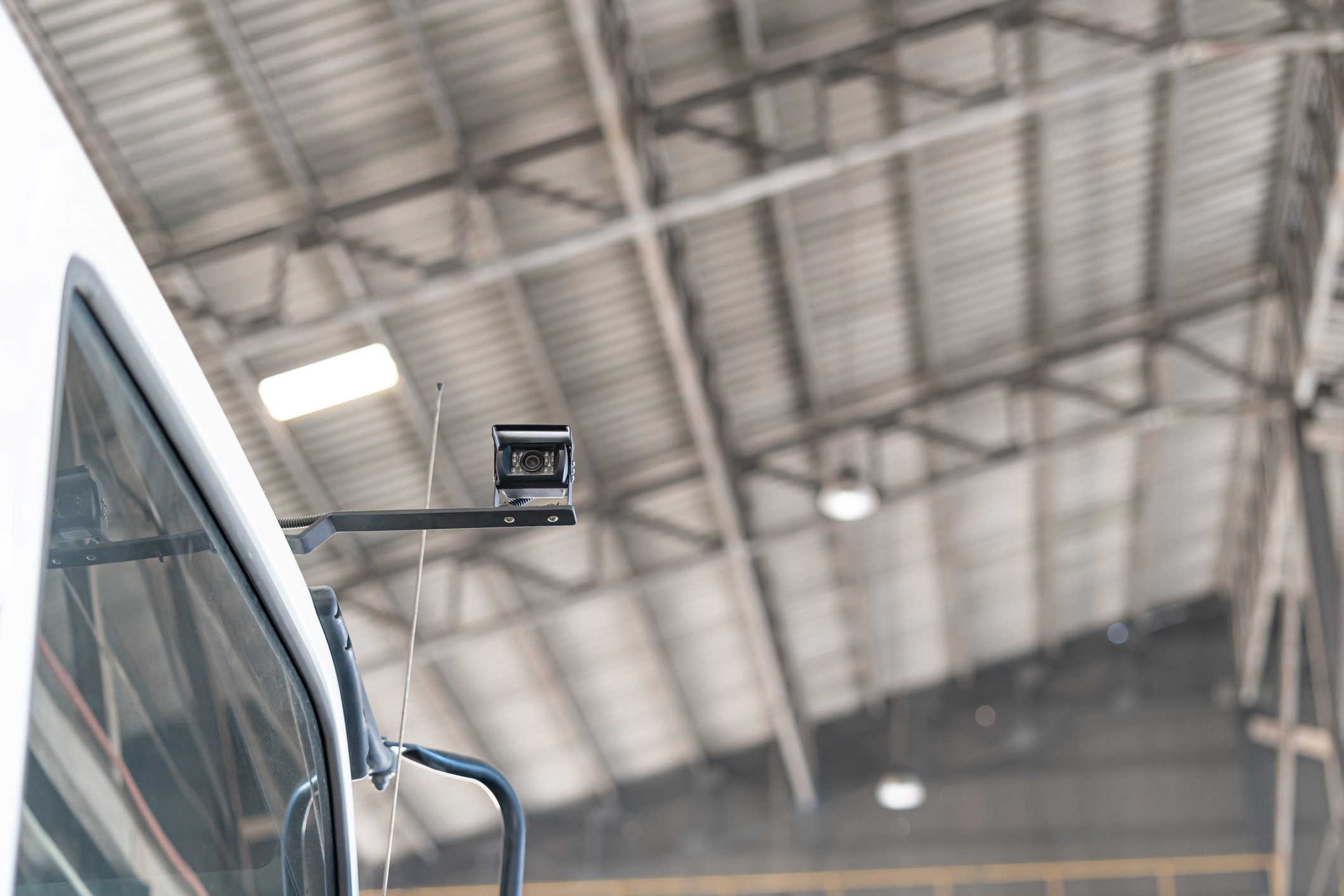
Why do accidents keep happening with blind spot cameras?
Cameras are increasingly being installed to counteract truck blind spots. Blind spot cameras are recognized as the most basic safety device because they allow you to see areas that you can't see from the driver's seat, but the reality is that truck accidents still happen.
The reason is simple: "seeing" and "detecting and reacting to danger in time" are two completely different things.
Cameras show blind spots, but it's still up to the driver to decide if the moment is dangerous and react immediately. It's the smallest delay or miss that leads to an accident.
In this article, we'll compare the difference between simple blind spot cameras and AI-powered blind spot detection from an accident prevention and operations management perspective, and see what difference it makes in real-world deployments.
Why truck blind spot accidents are more deadly than you think
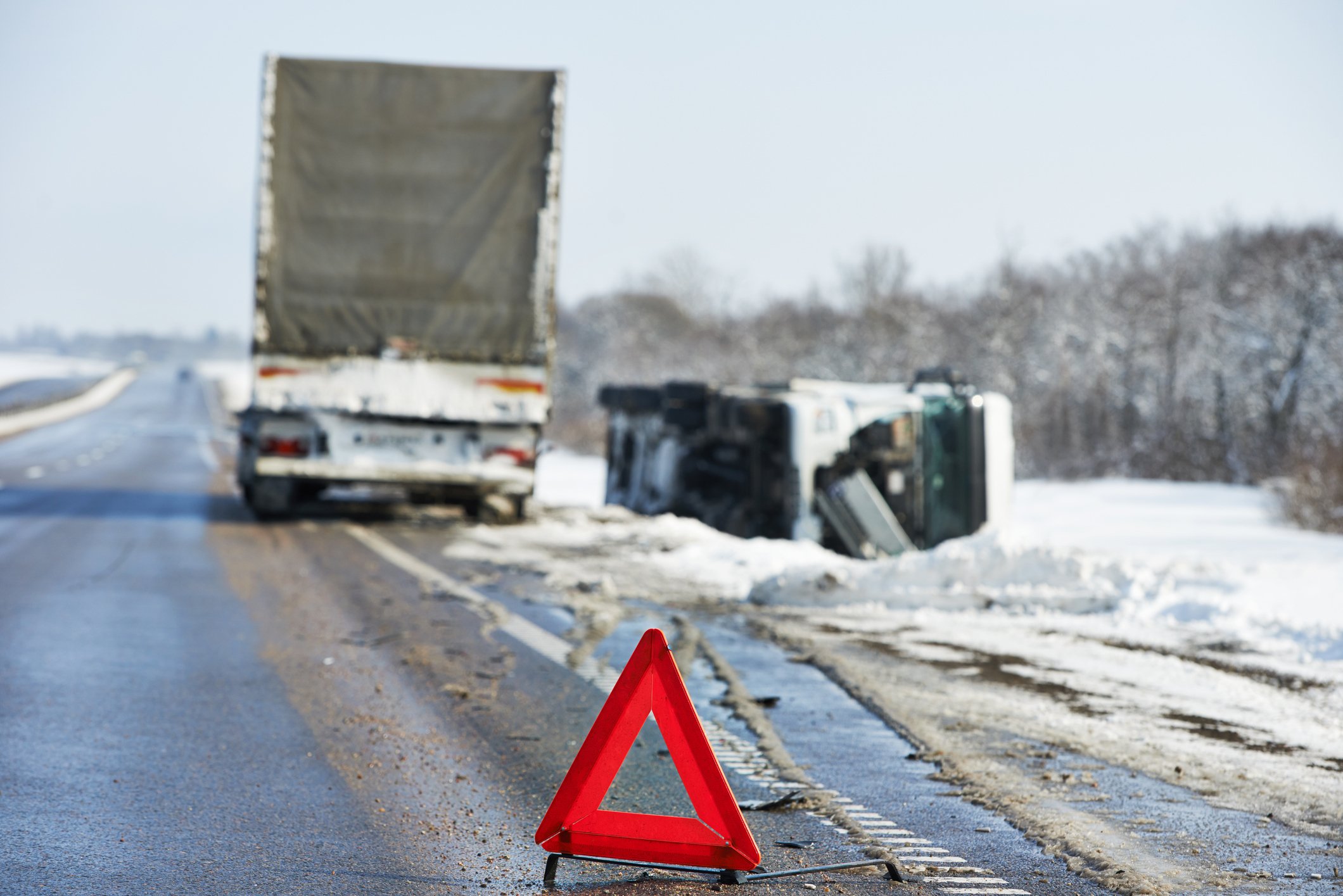
Truck blind spot accidents are different from simple collisions. The size, height, and wide blind spots of these vehicles make it more likely that a single incident will lead to more damage. Especially in situations like turning left or right, changing lanes, or backing up, it's harder for drivers to be fully aware of their surroundings, and a small delay in judgment can quickly lead to a major accident.
In fact, accidents involving large trucks are often fatal when they result in collisions with pedestrians or two-wheelers. According to the Samsung Fire Traffic Safety and Culture Research Center, the fatality rate of right-turning pedestrian accidents involving large trucks is 28 times higher than that of passenger vehicles. This means that truck blind spot accidents are not just "something that happens often," but a type of accident that is very likely to be fatal once it happens.
The impact of an accident doesn't end at the scene - the loss of life can lead to civil damages, higher insurance premiums, and increased trucking deductible contributions, not to mention vehicle repairs and insurance coverage. Add to that a loss of customer confidence, internal safety management liability issues, and criminal liability reviews for drivers and business owners.
It can also lead to legal risks, such as under the Fatal Accidents Act or theOccupational Safety and Health Act, especially if the company's safety management is deemed insufficient. We discussed the criteria for the application of the OSH Act to cargo transportation in detail in OSH Act, cargo transportation is covered.
In the end, a truck blind spot accident is not just an accident, but a systemic risk that involves cost, reliability, and legal liability.
4 reasons why blind spot cameras are not enough
Blind spot cameras certainly have a role to play as a basic safety aid, but when it comes to actual accident prevention and operational management, their limitations are clear. These limitations can be summarized in four main ways.
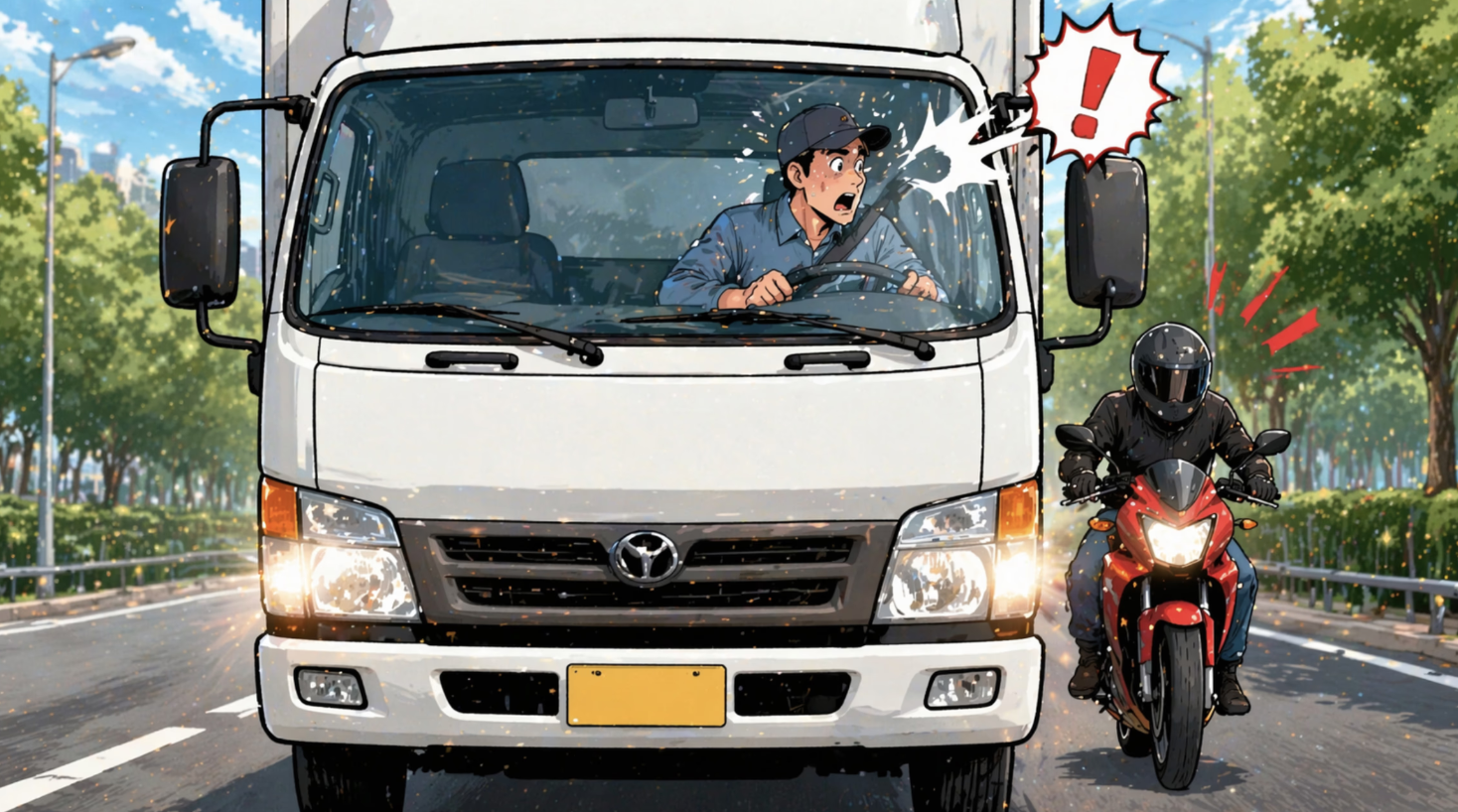
It's hard for drivers to see everything at the same time
While driving a cargo vehicle, the driver must simultaneously look ahead, check lanes, check mirrors, and react to nearby vehicles. Especially in environments with many variables, such as intersections, city streets, and logistics center entrances and exits, the driver's cognitive load becomes even greater.
It's not practical to keep an eye on a separate monitor to check for blind spots. Even if a screen exists, it's meaningless if the driver doesn't see it in the moment, which leads to a loss of focus at critical moments, which leads to accident risk.
Human judgment of hazards
Blind spot cameras show you what's going on around you, but they don't tell you if it's dangerous or not. You' re still responsible for judging risk.
Pedestrians approaching, motorcycles cutting in, vehicles backing up, etc. may not be immediately recognized as a hazard even though they are visible in the video. Especially in fast-moving situations, there is a time lag between 'seeing' and 'recognizing' the hazard. This short delay in judgment is enough to lead to an accident.
③ Post-accident verification is possible, but pre-accident prevention is weak
Simple dashcams or camera equipment are effective for recording "what happened". They can help you see what happened after the fact and analyze the cause.
But from a "how do we stop accidents before they happen" perspective, they have limited capabilities. This is because they are designed for after an accident, not before.
As a driver, what is really important is to reduce accidents in the first place, not to interpret them after they happen. In that sense, simple video recording-centered equipment is relatively weak in preventive functions.
④ No operational data is left for managers
Simple camera systems also have limitations from a management perspective. It is difficult to systematically record who repeatedly drives dangerously, which sections have frequent events, and what measures were taken. Because the data is unstructured, it's also difficult to analyze risk patterns or create driver-specific management strategies.
As a result, managers are stuck reacting to incidents after they happen, rather than "preventing" them. This is not the kind of operation that organizations expect from a safety management solution.
You don't need cameras that just show, you need AI that detects and alerts you to risks.
As we've seen, the real problem with truck blind spot accidents isn't just that they're "invisible." More importantly, they're not recognized in time.
What's needed now is not just a camera that shows you the blind spot, but a system that judges the danger itself and alerts you before you miss it.
Blind spot cameras: A device that shows
A blind spot camera is a device that shows you a view of your surroundings that you can't see from the driver's seat. It's more of a recording device that allows you to see areas that are hard to see directly, such as the sides and rear, and it's a way for you to view the footage after an accident to help you understand what happened.
Another advantage is that it is relatively familiar and simple to install and use. It can be easily retrofitted to existing vehicles, and drivers can use it without any training.
But they also have their limitations. The ability to identify hazards on their own, or to alert the driver to situations they might have missed, is often limited. The driver is still the one looking at the screen and making the judgment, and the level of accident prevention is highly dependent on the driver's cognitive abilities and split-second reaction.
AI safety management solutions: equipment that judges and warns immediately
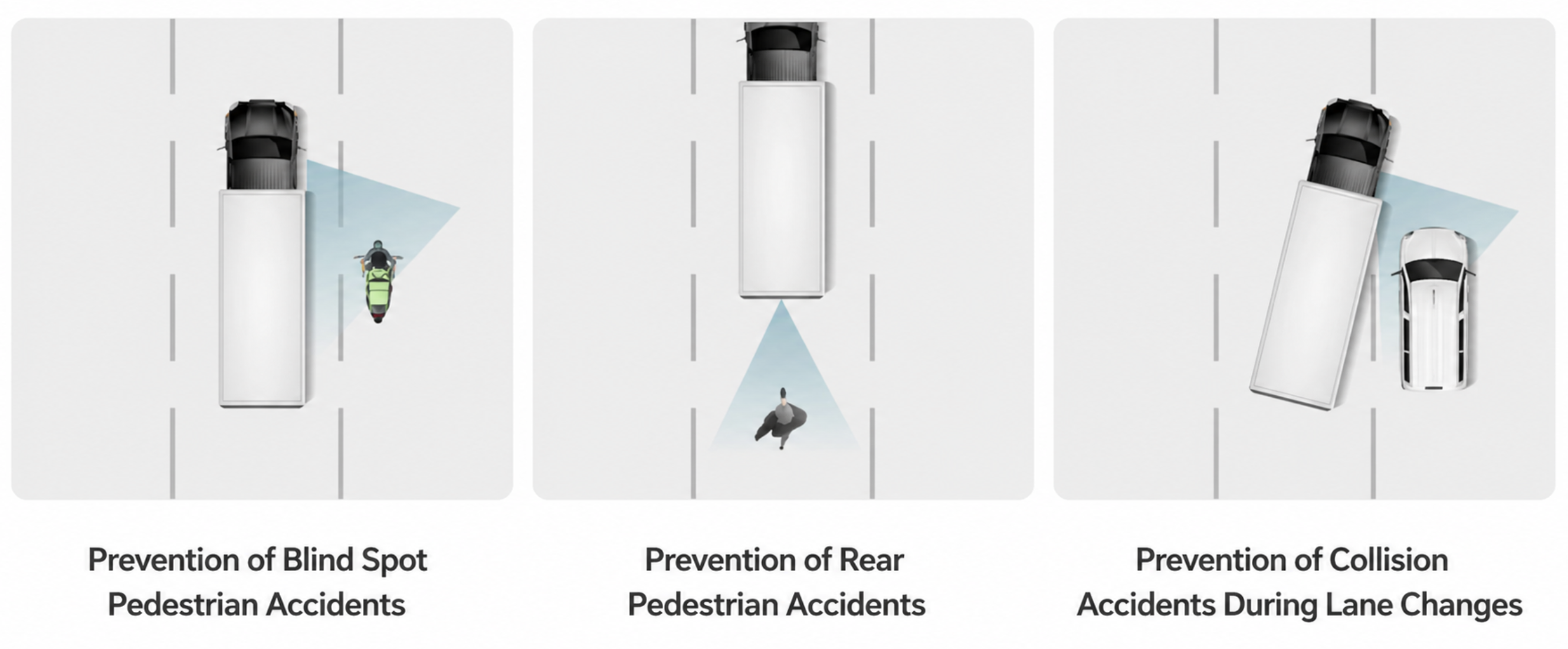
AI-powered safety management solutions take a different approach. They recognize their surroundings in real time - vehicles, pedestrians, signals, lanes, and more - and go beyond "what they see" to determine if it's a dangerous situation.
For example, AI detects when a pedestrian approaches from a blind spot, a two-wheeler cuts in, or a lane departure or proximity hazard occurs, and immediately alerts the driver. Dangerous events are automatically saved and, if necessary, sent to managers, who are connected to quickly see what's happening on the ground and take follow-up action.
In other words, it's not just about providing video, it's about a flow from hazard detection → immediate warning → automatic recording → manager response.
Blind spot camera vs AI safety management solution features comparison
| Item | Blind Spot Camera | AI Safety Management Solution |
|---|---|---|
| Video Provision | ○ | ○ |
| Automatic Risk Detection | ✕ | ○ |
| Real-time Driver Alerts | ✕ | ○ |
| Automatic Risk Event Logging | ✕ | ○ |
| Driver-level Data Management | ✕ | ○ |
| Manager Alerts & Response Integration | ✕ | ○ |
The standard for truck safety management is shifting from "can I see it" to "can I make sure I don't miss it".
AID, a solution to reduce truck accidents with AI-based blind spot detection
A.I.Matics' aidis an AI safety management solution that uses AI cameras installed in the vehicle to detectdriver risky behavior and road hazards (such as pedestrians, motorcycles, and approaching vehicles in blind spots) in real time, alert the driver as soon as a hazard occurs, and automatically recordall events on the manager platform. It provides a structure that goes beyond driver assistance to accident prevention and operational management.
1. On-device AI that recognizes risks in real time
The core of AID is on-device AI. A.I.Matics recognizes various situations around the vehicle in real time based on its own AI technology (aimNet) that combines object recognition, driver status monitoring, tracking, lane and distance judgment, etc. Importantly, all of these judgments are made directly on the equipment inside the vehicle, bypassing servers.
Without the delay of waiting for server transmissions, you can immediately recognize dangerous situations and react immediately. This real-time nature is crucial in the trucking environment, where a few seconds can make the difference between an accident or not.
2. A multi-channel system that recognizes blind spot hazards in three dimensions
AID doesn't just recognize "there's a person, there's a vehicle." It detects vehicles, motorcycles, pedestrians, and bicyclesseparately, and analyzes the relationship between the object's position, direction of travel, approach speed, and distance from the vehicle to determine "is this situation actually dangerous?"
In the driving environment recognition dimension, it also supports safe driving by recognizing traffic lights (red light, stop), signs (no turn, one-way, school zone), lanes, and even the gap between cars in front of you.
This is inherently different from simple screen impressions. By selecting only the moments that need to be alerted, it doesn't overwhelm drivers with unnecessary notifications, while not missing important hazards.
Case Study - 150 Ready Mixed Concrete Vehicles at Sampyo Industry
Sampyo Industries, a leading Korean construction materials company, adopted AID to reduce the risk of blind spot accidents in its ready-mix concrete transportation environment. In particular, the model was customized to detect pedestrians with partial head and shoulder visibilityby learning the actual driving environment data of ready-mix concrete vehicles. After verifying its performance with 10 POCs, it was expanded to 150 vehicles in June 2023, and the collaboration is currently being expanded to SP Nature-Sampyo heavy equipment.
"Our previous system only controlled vehicles, but there were no accident prevention or driver management functions. We needed a tool that could manage blind spots and forward accident prevention." - Sampyo Industry Ready Mixed Concrete Logistics Operations Team
Learn more about Sampyo's case study →
3. Risk detection → Driver warning → Automatic recording → Manager response
When a risk is detected, AID immediately alerts the driver. The purpose is to change the driver's behavior immediately, not just notify them.
At the same time, the event is automatically saved and can be viewed at any time via the cloud. Managers are notified when a risk event occurs, allowing them to quickly check the situation on site and take the necessary action.
It's about creating a proactive management structure to reduce accidents, rather than reacting to them after they happen.
4. Beyond accident prevention, accumulate data to prove safety management
AID goes beyond simple warning equipment to build a data-driven safety management system. Through driver scoring, risk behavior analysis, and driving reports, you can structurally check the following.
- Which drivers repeatedly engage in risky behaviors
- Which segments have the highest number of risky events
- What remedial actions have been taken
These data are not just for internal management; they serve as "supporting data" to objectively document training history, management records, and improvement activities. In an environment where safety management accountability is becoming more important, it is becoming more important to ask "what efforts were made to reduce accidents" than "did we have an accident?" AID is the solution that connects the dots.
The numbers speak for themselves - the accident prevention impact of AI technology
The effectiveness of AI-powered blind spot detection is backed by empirical data from third-party organizations.
In the large vehicle demonstration released by the Korea Transportation Safety Authority in 2025, a total of 90 vehicles, including 75 cargo vehicles in the southern and northern regions of Gyeonggi Province and 15 city buses in Busan, were equipped with blind spot detection devices and the before and after data were compared.
The results showed that the number of turn signal activations per 100 km of driving increased by an average of 13.5%in the period after the hazard warning was provided, which the agency interpreted as drivers being more conscious of their blind spots and more willing to check their surroundings.
The same demonstration also showed an average 6.7% increase in brake application rates in response to blind spot pedestrian detection, indicating a shift beyond checking the situation on the screen to actually physically reacting to avoid the danger.
What the two results show together is clear. While simple cameras only show what's happening, AI-powered detection systems change the driver's perception and behavior itself.
In the end, it's not the amount of information that matters when it comes to reducing truck accidents, it's how quickly drivers recognize the danger and act on it.
Conclusion - When it comes to truck blind spots, it's more about "detection" than "cameras"
Truck blind spot cameras are certainly a helpful piece of equipment. They provide a view of areas that are difficult for drivers to see, and their role as a record of what happened after an accident is valuable.
But in terms of actually reducing accidents, they have clear limitations. That's because they lack the ability to see the danger first and intervene before it's missed.
AI-powered detection solutions take a different approach. They recognize hazards and alert drivers in real time, automatically recording events and leading to managerial analysis. They go beyond simple equipment and provide a bridge to accident prevention and operational management.
If what freight forwarders really want to reduce are accident costs, insurance losses, management gaps, and growing legal risks, it's time to start judging based on whether AI is actually detecting risks, not whetherequipment is present or absent.
Which approach is right for our fleet?
Different fleets face different blind spot risks depending on the type of vehicle, route, and size of operation. Whether it's ready-mixed concrete, construction materials, general cargo, or logistics, the detection capabilities and operational methods required can also vary.
Start with the adoption criteria to see how it applies to different freight transportation environments.
👉 Get a free consultation on fleet-specific adoption criteria

