

From the moment a trucking accident occurs, time is of the essence. The first 30 minutes after an accident can often set the course for future compensation, liability, and enforcement.
This article is a step-by-step, chronologicalguide of what to doin the event of an accident for freight forwarders and safety management personnel to refer to immediately. It's designed for quick reference when an accident has already occurred, and each step covers key points that are easy to miss.
Key takeaways
- 0-15 minutes immediately after the incident: Saving lives and reporting are priorities
- 15 minutes to 1 hour: Internal company reporting and insurance company filing
- 1-24 hours: Collecting information from the accident scene and interviewing drivers
- 24 hours to 1 week: Administrative reporting and insurance processing in full swing
- After: Analyzing the accident and reviewing the system to prevent recurrence
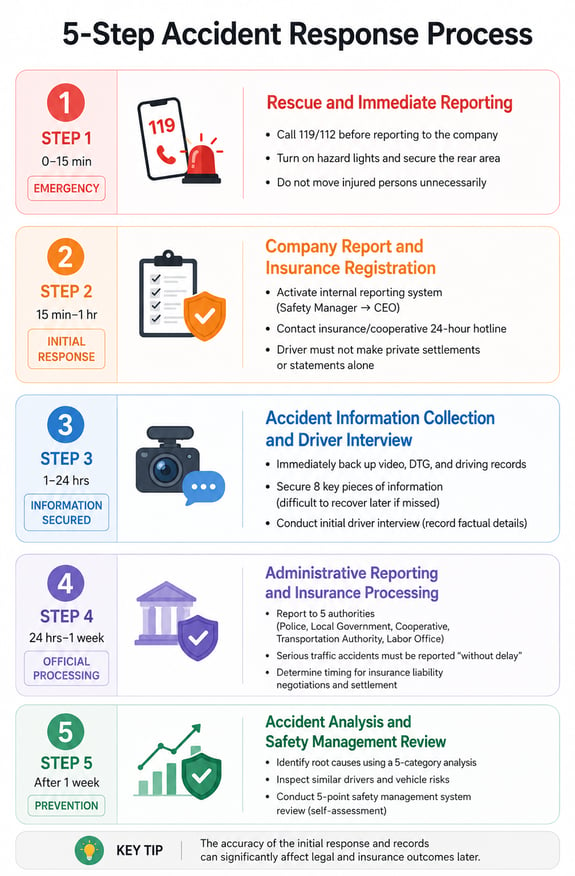
Phase 1: 0-15 minutes after the accident - Saving lives and reporting immediately
All actions during this time are prioritized to save lives, followed by official reporting. Company reporting or insurance processing comes after this stage.
What drivers should do immediately
| Order | Action | Caution |
|---|---|---|
| 1 | Activate hazard lights, move vehicle to a safe location (if possible) | Prioritize secondary accident prevention |
| 2 | Check for injuries and call 911 | Do not move the injured at your own risk |
| 3 | Rear safety measures (install a tripod) | On expressways, stay 100 meters behind |
| 4 | Call the police at 112 | Required in case of human casualties or suspected gross negligence of the 12th degree |
| 5 | Get the other party's information | License plate number, insurance company, contact information |
What business owners and managers need to know immediately
As soon as you receive a report of an accident from a driver, you need to quickly determine
- Whether and how many people were injured
- The location and time of the accident
- The extent of damage to the vehicle involved
- The driver's condition
- Whether police and ambulance reports have been filed
This information will be the basis for all decisions in the following steps.
Easy to miss: Sometimes the first thing a driver does after an accident is panic and call the company. The first thing you should check is "did they call 911-112 first?" The company report shouldn't precede the call.
Step 2: 15 minutes to 1 hour - Company report and insurance company receipt
Once lives have been saved and official reports have been made, it's time for the company-wide response to begin.
H3. 4 immediate actions for business owners
Activate the company's internal reporting system
- Immediately report to the head of safety management
- Activate an incident response team (for large incidents)
- Report to the CEO (required for accidents involving loss of life or gross negligence)
Report the accident to the insurance company
- Report to your mutual aid association or insurance company's 24-hour number
- Report time, location, vehicle number, and driver information
- Obtain the number and deliver it to the driver
Dispatch to the scene or dispatch a representative
- Accidents involving personal injury: Direct dispatch of manager or representative recommended
- Simple material accidents: Request the insurer to dispatch an on-site employee
- Prevent drivers from making decisions on site alone
④ Driver protection measures
- Inform drivers not to settle at will
- Advise drivers to only state the facts when writing a statement
- Tell them to wait for a lawyer or insurance company representative to arrive
H3. What not to do
- ❌ Make a settlement on your own at the scene of the accident
- Offer a settlement directly to the victim before insurance processing
- Conceal or delay reporting the accident
- Taking and submitting a driver-only statement
In particular, accidents that fall under the 12 gross negligence offenses will be criminally prosecuted regardless of settlement. You can learn more about the 12 gross negligence offenses in 12 gross negligence accidents: Companies are punished too.
Step 3: 1 to 24 hours - Gather accident information and interview the driver
The following information should be systematically collected within 24 hours of the accident. Information not obtained during this time is almost impossible to recover later.
Eight pieces of information you must obtain
| Number | Information item | How to obtain |
|---|---|---|
| 1 | Video of the accident (dashcam, AI camera) | Immediate backup on the vehicle terminal |
| 2 | Driving records immediately before and after the accident | DTG data extraction |
| 3 | Driver's travel schedule (24 hours before the accident) | Timetables and logbooks |
| 4 | Accident scene photos and videos | Take as many angles as possible |
| 5 | Witness statements and contact information | Obtain as soon as possible |
| 6 | Police case number and contact information | Record immediately after reporting |
| 7 | Other vehicle, driver, and insurance information | Obtained at the scene of the accident |
| 8 | Driver's account of the accident | Listening in a calm environment |
Key things to look for when interviewing the driver
We recommend conducting the initial interview with the driver as soon as possible, preferably within 24 hours of the accident. Over time, memories fade and statements change subtly.
Five key things to check in the interview:
- Driving conditions in the hours leading up to the accident (road conditions, weather, traffic)
- The driver's physical state immediately before the accident (fatigue, drowsiness, medication, etc.)
- How the accident happened (driver's perception)
- The presence of mechanical abnormalities in the vehicle
- The driver's sequence of actions immediately after the accident
It'seasy to miss: The driver interview is not a "who's at fault" event, it's a "record of the facts" event. If the driver becomes defensive, it will be difficult to get information. Assigning blame comes after this stage.
Step four: 24 hours to a week - administrative reporting and insurance processing in full swing
This is when the company formally reports the incident to an outside agency and goes through the insurance process.
Where should a motor carrier report?
| Where to report | When to report | Reason for reporting |
|---|---|---|
| Local police department | Immediately after the accident (completed in Step 1) | Criminal accident or personal injury |
| Jurisdictional municipality (ward office, city hall transportation department) | Without delay | Cargo Vehicle Transportation Business Act accident report |
| Freight cooperative or insurance company | Immediately after the accident (completed in step 2) | Compensation Procedure |
| Korea Transportation Safety Authority | In case of a serious accident | Accident statistics and analysis |
| Ministry of Employment and Labor | In case of worker death or injury | Regarding the Occupational Safety and Health Act and the Fatal Accident Punishment Act |
The last item in particular - reporting to the Ministry of Labor- is something that many companies miss. If a worker (including a driver) dies or is seriously injured requiring medical treatment for more than six months, you are obligated to report it immediately, and failure to report is subject to separate penalties.
We covered the criteria for the application of the Fatal Accident Act in detail in Fatal Accident Act, Cargo Transportation is also subject to the Act.
Checkpoints when dealing with insurance
1. Negotiate the percentage of liability
- Do not accept the liability ratio calculated by the insurer at face value, but review it based on the data.
- Objective data such as video, DTG, and accident circumstances are the key to negotiating power.
- Consult an adjuster or lawyer if necessary
2. Determine the point of settlement
- Consider the victim's demand for a quick settlement, but take your time if there is a possibility of after-effects.
- Ensure "no further claims" clause is included in the settlement agreement
3. Review the possibility of a subrogation claim
- If a vehicle defect caused the accident → vehicle manufacturer may have a right of recourse
- If a roadway defect caused the accident, you may have a cause of action against the appropriate roadway management agency
Step 5: One week after the accident - analyze and prevent recurrence
While the accident is being dealt with, the company must simultaneously carry out a review of its recurrence prevention system. If this step is omitted, the same type of accident will be repeated and will be an aggravating factor for administrative penalties.
Five questions to ask when analyzing an incident
- Was this accident foreseeable(was the driver's risky behavior detected in advance)?
- What part of the company's safety management system was not working?
- Is the same risk presentin similar drivers or vehicles?
- What actions are needed, such asdriver training or reassignment?
- Where do you need toimprove systems and processes?
It is important to document the results of this analysis. It will be used as proof of the company's fulfillment of its safety management obligations in future administrative or criminal proceedings.
Check your safety management system to prevent recurrence
We recommend that you check the following five items
| Number | Check item | Status |
|---|---|---|
| 1 | Driver-specific risky driving behavior detection-do you have a recording system? | ⬜ |
| 2 | Does the companyautomatically record the history of actions takenin the event of a hazard warning? | ⬜ |
| 3 | In the event of an accident, can the video and driving recordimmediately before the accidentbe extracted? | ⬜ |
| 4 | Is the driver safety training history dataized by individual? | ⬜ |
| 5 | Areaccident analysis results shared and educated to other drivers? | ⬜ |
What is the one thing that significantly reduces incident handling time?
Which stepin the process we've just outlined saves the most time? The answer is Step 3 - Gather incident information.
Of the eight pieces of information that need to be obtained in this step, more than half rely on in-vehicle recording equipment. The faster and more accurate this information is obtained, the faster everything that follows will be, and the more objectively the company's percentage of responsibility can be determined.
The difference aid makes in accident handling
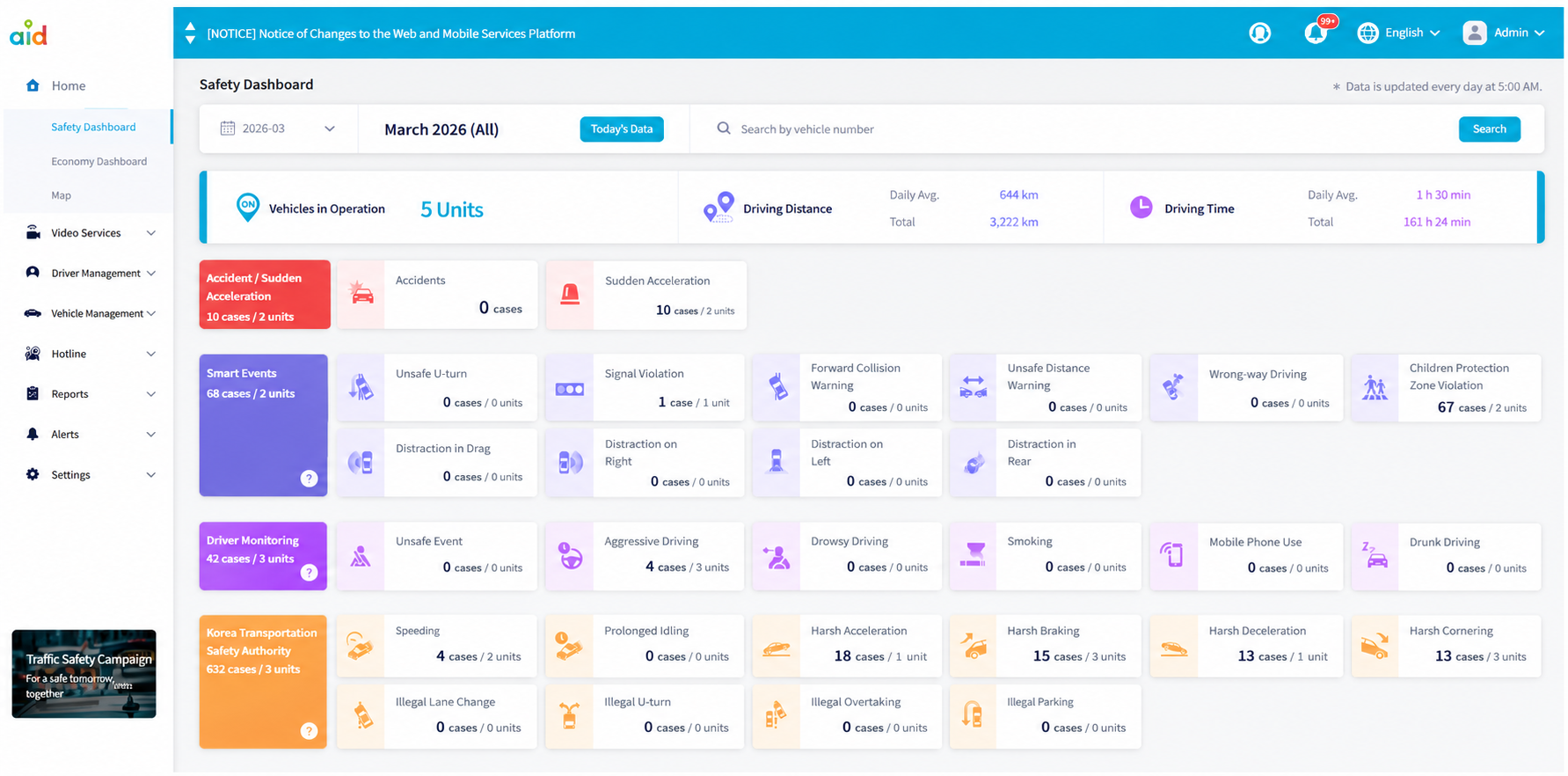
A.I.Matics' aidis an AI safe driving solution that uses AI cameras installed in vehicles to detectdriver risk behaviors (drowsy driving, distracted driving, cell phone use, etc.) and road hazards (red lights, speeding, pedestrians in blind spots, etc.) in real time, alert the driver as soon as a hazard occurs, and automatically logall events on the admin platform.
From an incident handling perspective, AID enables
Immediate pre- and post-accident video
You can simultaneously view all camera (front, interior, and blind spot) videos at the time of the accident on the admin platform without any data extraction work.
Automatic preservation of driver behavior data immediately before the accident
Dangerous signals that occurred just before the accident, such as drowsy driving warnings and blind spot warnings, are automatically accumulated and immediately utilized as data for accident cause analysis.
Provide objective data for determining liability
Video and data serve as objective data to support the company's position in insurance negotiations and criminal and civil proceedings.
④ Verification of Korea Transportation Safety Organization pilot project
In a six-month pilot project involving 500 vehicles from 13 transportation companies, a 55% reduction in accident rates was confirmed. In other words, it is more effective in reducing accidents than in making accident processing faster.
AID distracted driving platform dashboard
Frequently asked questions (FAQ)
Q. How long do I have to report an accident under the Cargo Vehicle Transportation Business Act?
A. The Commercial Vehicle Transportation Business Act stipulates that serious traffic accidents(such as rollover accidents, accidents involving fire, and accidents involving a certain number of casualties) must be reported to the Minister of Land, Infrastructure, Transport, and Tourism or the governor of the city or province in charge without delay. "Without delay" means not to delay without good reason, which generally means the earliest possible time after becoming aware of the accident. Simple contact and material incidents may not require separate reporting, but if you're unsure whether an incident is serious, it's always safe to check with your local government.
Q. How long do I have to report an accident to a freight mutual?
A. While the terms and conditions of each mutual will vary, it is generally recommended to file immediately or within 24 hours of the incident. Delays will slow down the claims process and, under some policies, may affect your coverage. It's always safer to call the 24-hour number immediately after an accident.
Q. How long do I have to report a fatal accident to the Ministry of Labor?
A. Under the Occupational Safety and Health Act, fatal accidents must be reported immediately (without delay) to the competent employment and labor office. The same applies to accidents involving injuries that require medical treatment for more than six months. Failure to report is subject to separate penalties (fines or criminal penalties) and may be an aggravating factor in the application of the Fatal Accidents Act.
Q. If a victim asks for a settlement immediately after an accident, do I have to accept it?
A. Immediate settlement at the scene of an accident is not recommended for two reasons. First, the victim's potential for future impairment cannot be accurately determined at that point. Second, any settlement before insurance processing may affect the payment of the claim. It's safer to go through the normal process with your insurer or adjuster.
Q. Are criminal liabilities waived if the 12 gross negligence accidents are insured?
A. No, criminal proceedings will be taken against you regardless of whether you have insurance or settle. While having comprehensive insurance may protect you from criminal penalties in most accidents, it does not protect you from the 12 deadly sins. For more information, see Companies can be penalized after a 12-wheeler accident.
Q. Why should I be prevented from taking a driver-only statement?
A. In the immediate aftermath of an accident, drivers are often in a state of shock and confusion, making it difficult for them to give an accurate account of the facts, and statements made against them can be used against them in subsequent criminal and civil proceedings. It is safer to complete a statement in a calm environment, after consulting with an attorney or insurance company representative.
To reduce accidents and respond quickly when they do occur
Using the five-step process and safety management checklist in this article as a guide, review your company's incident response system. With AI safe driving solutions, you can reduce accidents in advance and have a data system that can respond immediately when they occur.
Get a consultation on Freight Operator Safety Management System
This article is for general information purposes only. Specific legal and insurance procedures may vary depending on individual cases, and we recommend that you seek professional advice.

