
"Hasn't the buzz around the Serious Accidents Punishment Act died down a bit by now?"
No, it hasn’t. What’s happening now is moving in the opposite direction.
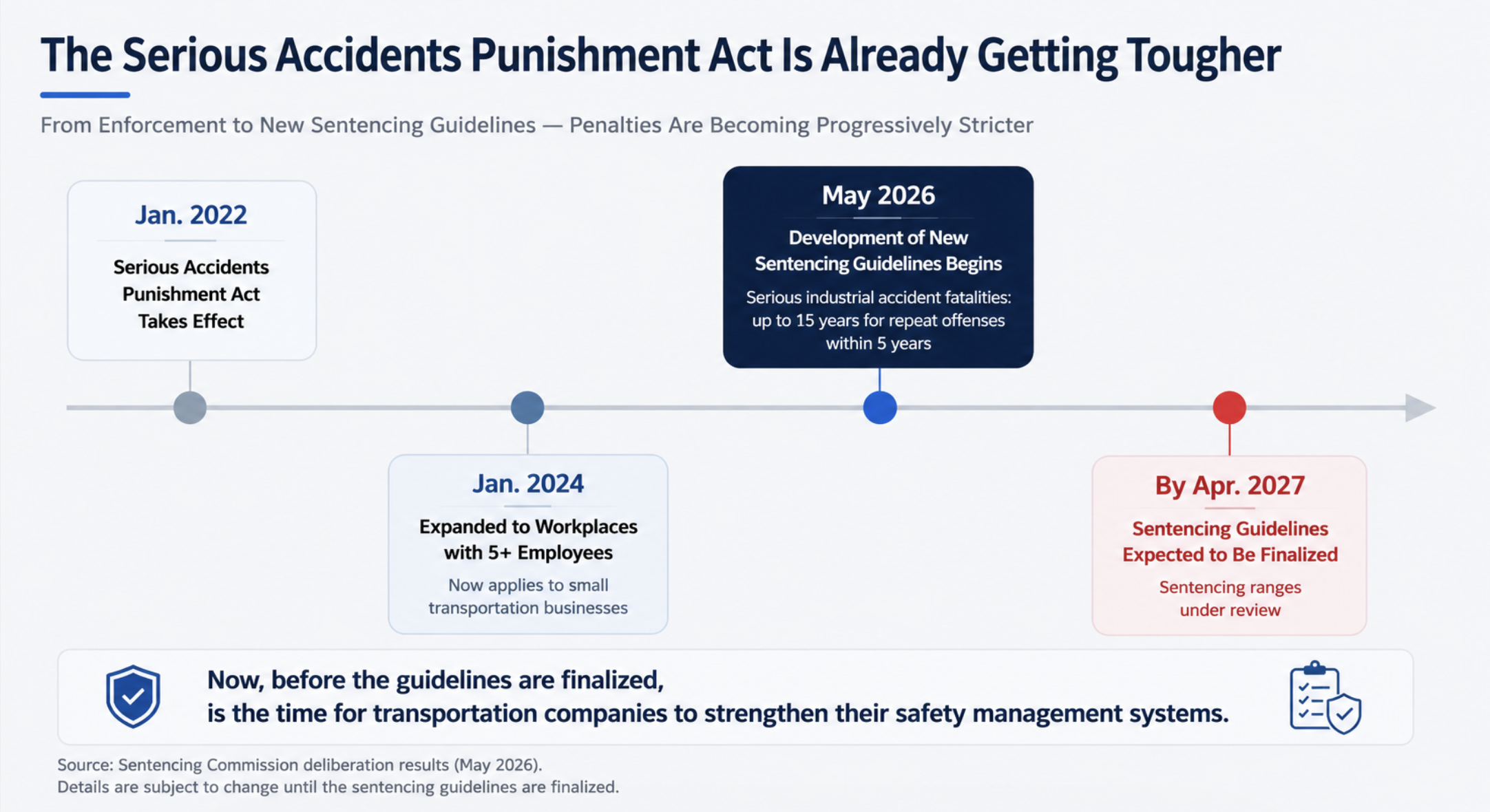
In May of this year, the Supreme Court’s Sentencing Commission began establishing new sentencing guidelines for crimes violating the Serious Industrial Accident Punishment Act. The proposal establishes “death by serious industrial accident” and “injury by serious industrial accident” as separate criminal categories and stipulates that if a repeat offense occurs within five years of a final judgment, both the minimum and maximum sentences will be increased by 1.5 times. This initiative was prompted by controversy over the perceived leniency of penalties for serious industrial accident cases and is scheduled to be finalized following discussions on sentencing ranges.
The significance of establishing these sentencing guidelines is clear. Even if the statutory provisions remain unchanged, the actual sentences handed down will be harsher and applied more consistently. The expectation that “it usually ends with a suspended sentence” will no longer hold true.
There is also one other change that has already taken effect. Any business with five or more regular employees is subject to the Serious Accidents Punishment Act. Starting in January 2024, the law will be fully enforced even for workplaces with fewer than 50 employees, meaning small-scale transportation companies are no exception.
The strengthening of penalties isnot just a warning— it is already underway. And now, before the standards are finalized, is the time for the transportation industry to get its affairs in order. This article outlines that preparation in three steps : assessment, intervention, and documentation.
Why Have We Reached the Point of Sentencing Guidelines? — The End of “It Just Ended with a Suspended Sentence”
Understanding the background behind the establishment of sentencing guidelines reveals that this is not merely a formal change.
Under the Act on the Punishment of Serious Accidents, the statutory penalty for fatal accidents is at least one year of imprisonment or a fine of up to 1 billion won—by no means a light sentence. However, looking at actual rulings since the law’s enactment, the proportion of suspended sentences has been overwhelmingly high. From the very first ruling, suspended prison sentences were handed down to management officials, and only a handful of cases resulted in actual prison terms. This is why the perception that “the law is strict, but in reality, it’s a suspended sentence” spread throughout the industrial sector.
The sentencing guidelines are designed to address this very gap. As the controversy over reduced sentences in serious industrial accident cases became a social issue, the Supreme Court’s Sentencing Commission began the process of effectively raising the minimum sentencing threshold. In particular, the measure to increase penalties by 1.5 times for repeat offenses structurally imposes harsher punishment for situations where “a company that has caused an accident once causes another one”—meaning that for a transportation company with a history of accidents, the severity of the next accident will be entirely different.
What the Law Actually Requires—The List of Obligations in the Enforcement Decree
The occupational safety and health management system required of management officials under the Enforcement Decree of the Act on the Punishment of Serious Accidents isnot an abstract declaration but a list of specific obligations. To highlight only those that are particularly critical for the transportation industry:
| Obligations under the Enforcement Decree | Implications for the Transportation Industry |
|---|---|
| Establishing procedures for identifying and rectifying hazardous and risky factors, including inspections and corrective actions | Are there procedures in place to verify the status of dangerous driving and overwork for each driver, and do they actually function? |
| Allocation and execution of the occupational safety and health budget | Was the budget actually spent on safety equipment and management systems? (Simply allocating the budget is not sufficient.) |
| Procedures forSoliciting Employee Feedback | Are drivers’ reports of hazards (such as unreasonable scheduling and fatigue) being gathered and addressed? |
| Establishment and Implementation of Measures to Prevent Recurrence Following Accidents | Are the root cause analyses and corrective actions following accidents and near-misses documented? |
| Inspections and evaluationsat least once per half-year | Are there records of checks conducted every six monthsto verify that these procedures are functioning? |
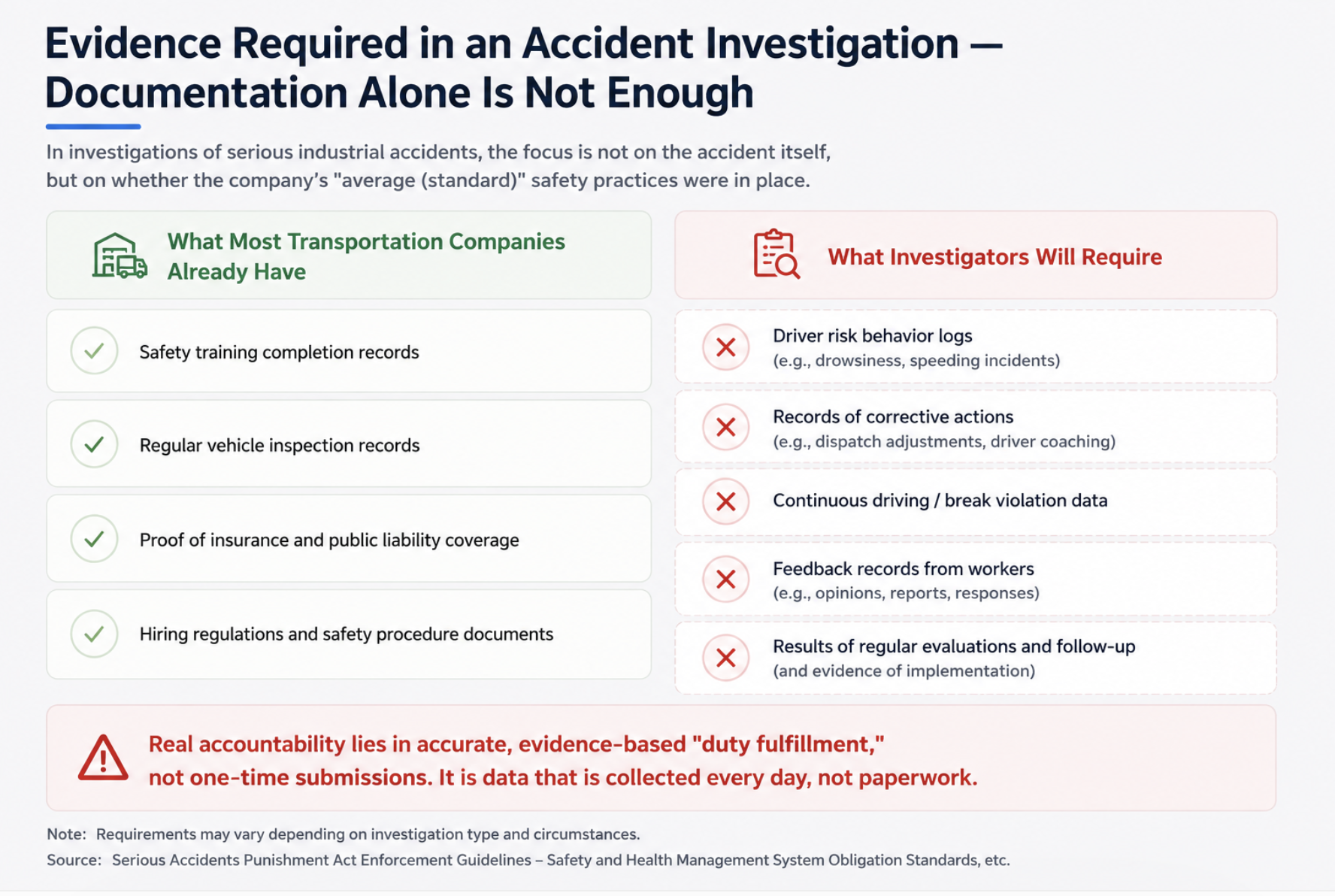
Particular attention should be paid to the last item— inspections at least once every half-year. Since the requirement is not whether the system was “established” but whether it was “inspected periodically,” a single set of documents from the time of implementation is not sufficient. This is an obligation that can only be fulfilled with continuously updated data and records.
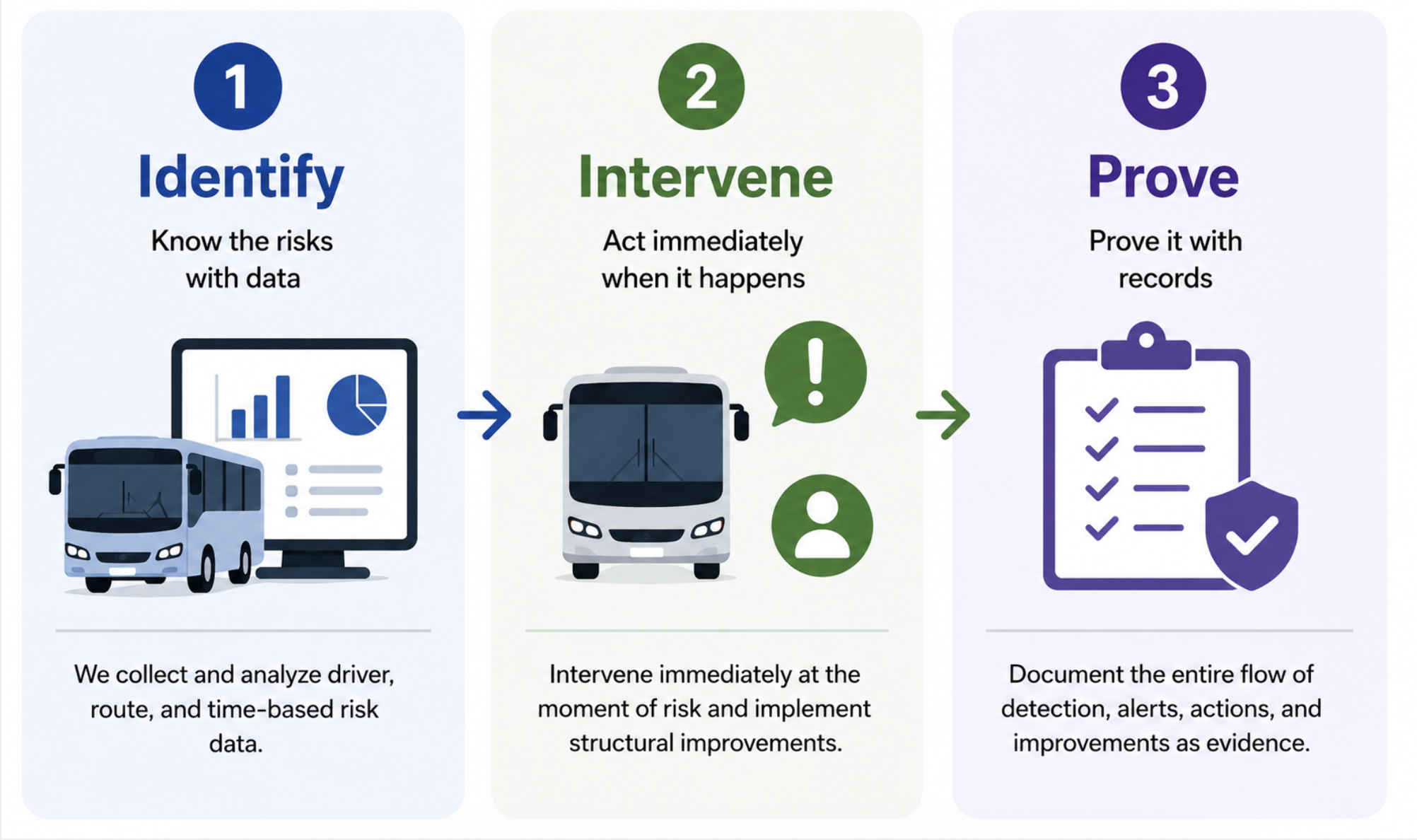
In summary, the questions that determine guilt or innocence and the sentence boil down to three:
- Did you actually identifythe risks?
- Did you actually interveneregarding the identified risks?
- Isthat process documented?
These three points constitute the three-step process of the safety management system for the transportation industry.
Three Stages of the Safety Management System
Step 1 — Identification: Starting with understanding hazards through data
The first question is this: “Do we know what risks are currently developing within our company?”
Most transportation companies answer this question with accident statistics. However, accidents are the result; risks have been building up long before that. Drivers receiving frequent drowsiness warnings, schedules with prolonged continuous driving, and risky behaviors concentrated during specific time periods— these are the warning signs that precede accidents.
In the transportation industry, the factors that need to be identified are specific.
- Risk driving patterns by driver —who is drowsy, fails to keep their eyes on the road, speeds, or accelerates abruptly, and how often do these occur?
- Status of consecutive driving and rest breaks —where are unreasonable schedules occurring?
- Risk distribution by vehicle and route —which routes and time periods see the highest concentration of risks
The data reveals just how vast this unknown territory actually is. In pre-implementation measurements from the Korea Transportation Safety Authority’s route bus pilot project, it was found that while a single bus traveled 1,000 km , drowsy driving occurred an average of 1.54 times and traffic signal violations occurred 12.75 times. No company was aware of these figures prior to the project’s launch— without a monitoring system, risks don’t even show up in the statistics.
Here are some questions to ask yourself.
Step 1: Self-Assessment ① Can you name the three drivers at your company who engaged in the most dangerous driving last month? ② Are the consecutive driving times for each driver being tracked? ③ Can you identify, based on data, the routes and time periods where risks are concentrated? — If the answer to even one of these is “No,” then the “procedure for identifying harmful and hazardous factors” required by the enforcement decree is effectively nonexistent.
In an era of sentencing guidelines, “I didn’t know” is no longer a valid defense. In an age where the means to identify these factors exist, the very fact of failing to do socan constitute grounds for a breach of duty.
Stage 2 — Intervention: If You Knew, You Had to Act
Once the risk has been identified, the next question follows: “So, what was done about it?”
Intervention must be two-fold.
- Intervention in the moment — Warnings must be sent to the driver immediately upon the occurrence of risks such as drowsiness or failure to maintain forward attention. Post-incident reports cannot prevent accidents. The time from the onset of drowsiness to veering out of a lane is measured in seconds.
- Structural intervention — For drivers who repeatedly exhibit risk patterns, the first step should be to offer a helping hand through schedule adjustments, guaranteed rest periods, and individualized training, rather than reprimands. Routes where excessive scheduling is confirmed must be adjusted.
Here is an example of what structural intervention looks like in practice:
- Driver with repeated drowsiness warnings on a late-night route → Adjust thedriver’s schedule to daytime shiftsand document the reason and date of the adjustment
- Concentration of risky driving by multiple drivers on a specific route → Inspect issues with the route itself (scheduling intervals, rest conditions), and link this to gathering feedback from employees
- New or inexperienced drivers → Implement an intensive coaching period based on risk data from the first three months; assign them to solo shifts only after confirming an improvement trend
This is how the “verification and improvement” procedures and “solicitation of employee feedback” stipulated in the enforcement decree actually work in practice. And whether improvements have been made is verified using the following month’s data—since the numbers confirm whether the driver’s risky behavior has actually decreased after training, the intervention becomes a measurable cyclerather than a one-time measure.
There is one important point to note. Simply identifying a risk without intervening actually increases the danger. If there is only a record showing that the risk was known but no record of action taken, this becomes evidence that the risk was “knowingly neglected.” Identification and intervention must always go hand in hand.
Step 3 — Verification: Compliance Is Proven Only Through Records
If an accident occurs, investigations and trials will verify whether management fulfilled their duties. At that point, it is records—not statements—that protect the company.
- Whenwas the risk detected,
- whenthe driver was warned, and
- what measures the company took (training, route adjustments, ensuring rest breaks), and
- whether the risk was actually reduced afterward—
A company that has this sequence of events documented in data is in a completely different position from one that has nothing but the statement, “We have always emphasized safety.” Particularly during the sentencing phase, management efforts prior to the accidentbecome key mitigating factors that determine the severity of the sentence.
Furthermore, documentation is not just for responding to accidents. Recall the obligation to conduct a semi-annual reviewmentioned earlier. Since companies must inspect and evaluate whether “our system is functioning” every six months, if data on risk detection, warnings, and corrective actions is being accumulated, this inspection simply becomes a matter of compiling monthly reports into a semi-annual report. Conversely, without data, the semi-annual review becomes a repetitive, perfunctory paperwork exercise each time, and this lack of substance will be exposed during an investigation.
Whether you have an evidence-based system in place can be confirmed with a single question.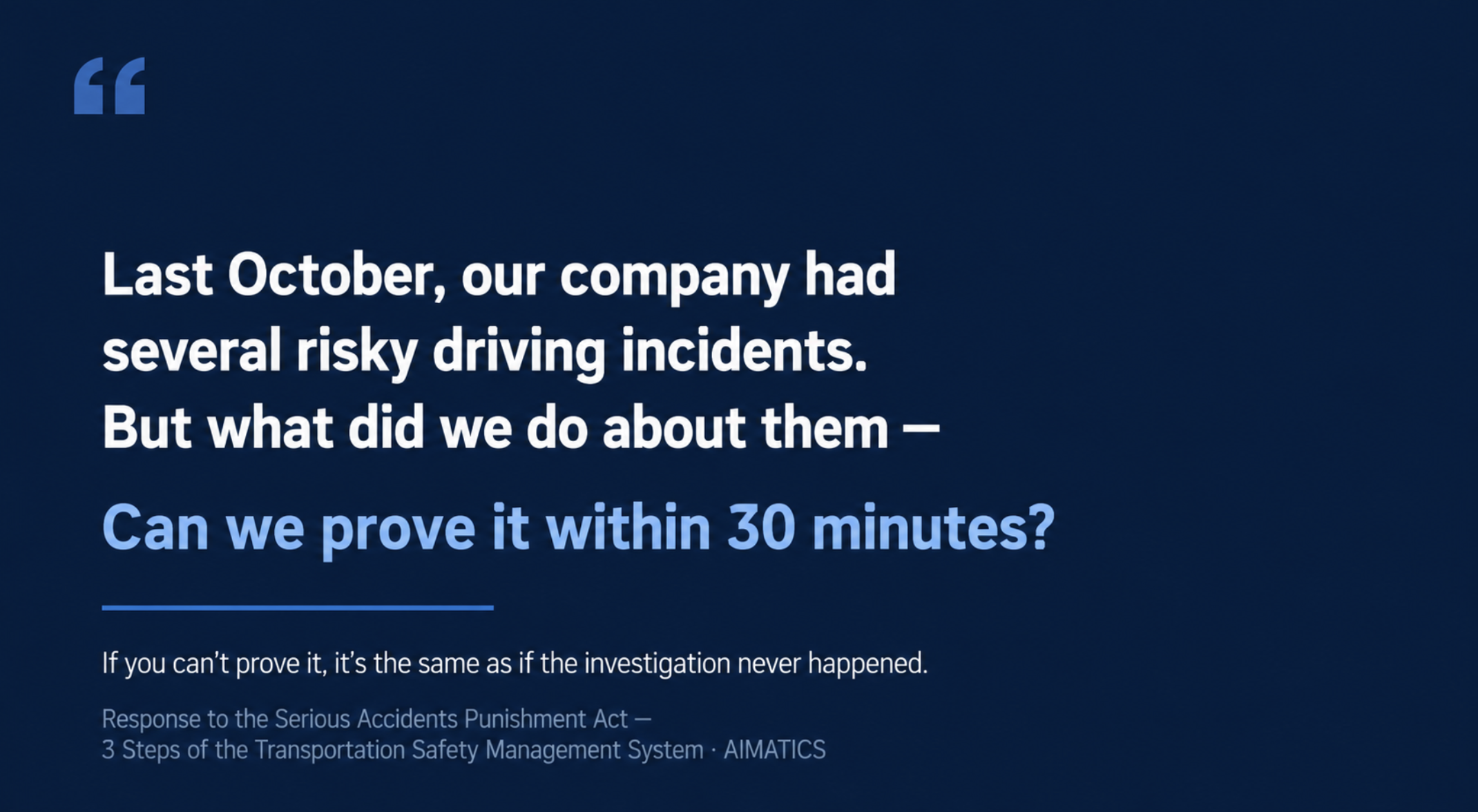
A Practical Approach to Implementing the Three-Step Process
If “Identification–Intervention–Documentation” is to be done manually, you would need as many administrative staff members as there are vehicles. Therefore, it is more practical to implement this system using data.
AIMATICS’ AI safe driving solutionaligns perfectly with these three stages.
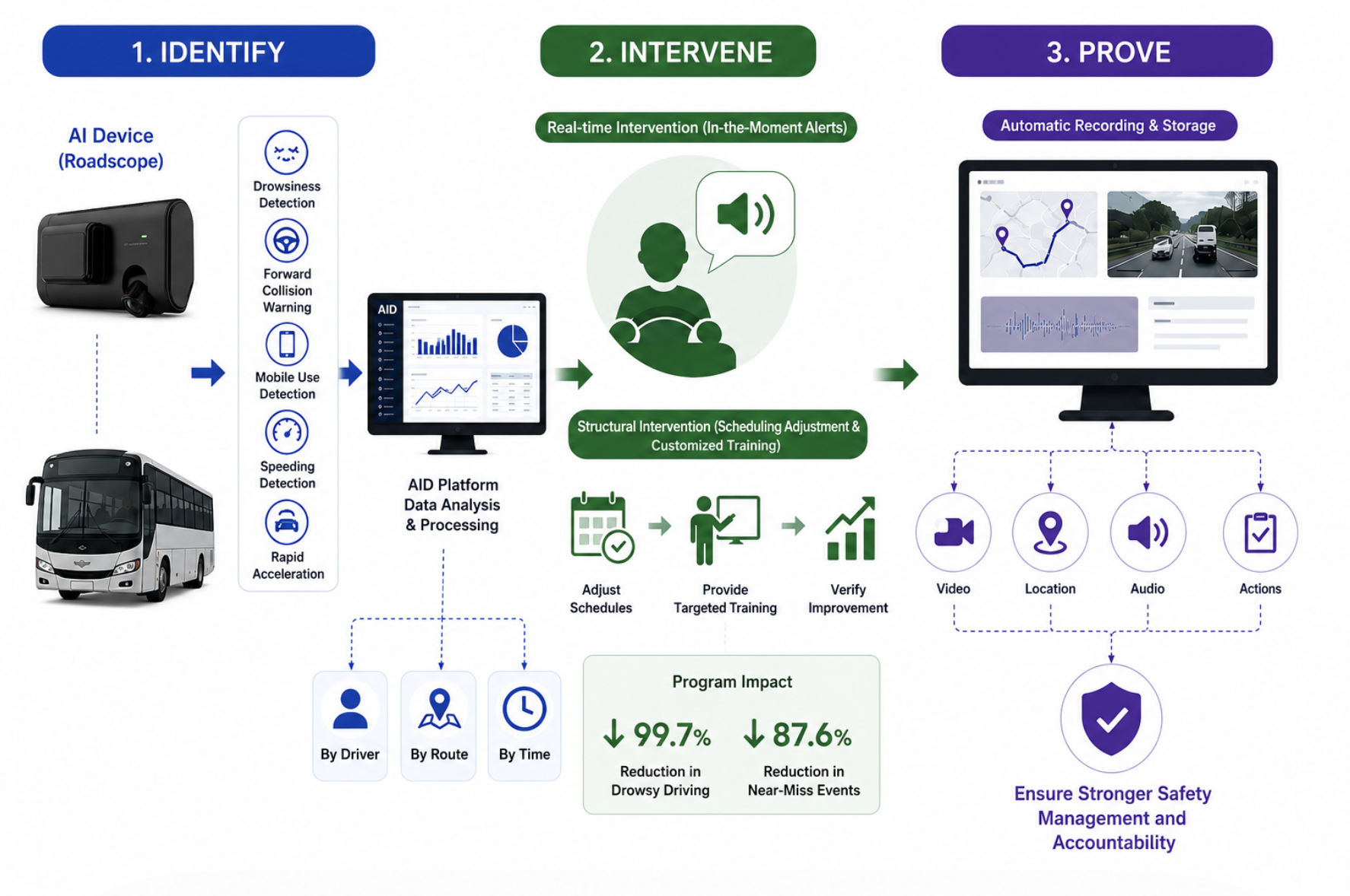
- Identification — The Roadscope AI device installed in each vehicle detects risky driver behaviors—such as drowsiness, failure to monitor the road ahead, and cell phone use—as well as dangerous driving practices like speeding and sudden acceleration in real time, and the aid platform organizes this data by driver, route, and time of day. You begin to see where risks are emerging.
- Intervention — A voice warningis delivered to the driver the momentrisky behavior occurs (immediate intervention), and schedule adjustments and customized training can be designed based on accumulated data (structural intervention). In a pilot project for route buses conducted by the Korea Transportation Safety Authority, this approach was found to reduce drowsy driving by 99.7% and traffic signal violations by 87.6%.
- Verification — The entire process of detection, warning, and action is automatically recorded along with timestamps, locations, and video footage. Evidence thatthe occupational safety and health management system isactually functioningaccumulates daily.
Summary — Compliance with the Act on the Punishment of Serious Accidents in the Transportation Industry: A 3-Step Overview
| Stage | Key Questions | Practical Actions | Records to Keep |
|---|---|---|---|
| ① Identification |
Do you know what risks are emerging? |
Compile data on the distribution of risky driving, consecutive driving, and route-specific risks by driver | Risk Status Data, Monthly Aggregation |
| ② Intervention | Now that you know, what have you done? | Real-time alerts (in the moment) + dispatch adjustments, guaranteed rest breaks, and customized training (remediation) | Details of actions taken, dates, and improvement trends |
| ③ Documentation | Can compliance be verified? | Automatic recording of detection–alert–action; semi-annual inspections in data reports | History including time, location, and video footage; semi-annual inspection and evaluation results |
These three stages are both a sequence and a single, integrated process. Intervention without assessment is like an arrow without a target; assessment without intervention is evidence of neglect; and compliance without documentation is as good as nonexistent in a court of law. The essence of preparing for the Serious Accidents Punishment Act ultimately lies in establishing a system where these three elements operate in a continuous, daily cycle.
👉 Inquire about implementing the AI Safe Driving Solution
Frequently Asked Questions (FAQ)
Q. What will change once sentencing guidelines are established?
A. While the statutory sentencing ranges (e.g., imprisonment of one year or more) will remain unchanged, guidelineswill be established for courts to follow when actually handing down sentences. Previously, there were concerns that sentencing for serious industrial accident cases varied widely due to a lack of case law, and that the rate of suspended sentences was high. Once the sentencing guidelines are finalized, they will work to ensure more consistent and harsher sentencing. In particular, a proposal is under discussion to increase the upper and lower limits of the sentence by 1.5 times for repeat offenses within five years, which will place a greater burden on companies with a history of repeated accidents. The classification of offense types has already been approved, and the guidelines are expected to be finalized following discussions on the sentencing ranges.
Q. Does this apply to us, even though we are a small transportation company with 30 employees?
A. Yes, it applies. Starting in January 2024, the regulation will be fully implemented for workplaces with five or more regular employees, so even small transportation companies with fewer than 50 employees are subject to it. In fact, the smaller the company, the more difficult it is to employ dedicated safety personnel, so it is more practical to supplement compliance with a data-driven system.
Q. Isn’t it enough to have comprehensive insurance?
A. No. Insurance only covers civil liability. The Act on the Punishment of Serious Accidents imposes criminal penaltieson individual management officials, soit cannot be replaced by insurance. The only way to reduce criminal liability is to actually fulfill the obligation to ensure occupational safety and health and to be able to prove that you have done so.
Q. Does a traffic accident caused by a driver qualify as a serious industrial accident?
A. There are two possible scenarios. First, if a driver dies while on the job, the case is reviewed as a serious industrial accident involving the death of an employee. Second, if a civilian diesin an accident, the company’s compliance with its safety management obligations may also be examined during the investigation. Regardless of the route, the key issue is the same—whether the company identified the risks, took action, and maintained records of those actions.
Q. What exactly is a safety and health management system?
A. It refers to the obligations that management must fulfill, including procedures for identifying and mitigating hazards, allocating safety personnel and budgets, soliciting employee input, and implementing measures to prevent recurrence. When applied to the transportation industry, this ultimately boils down to three key elements: procedures for identifyingrisks specific to each driver and vehicle; procedures for addressingthe identified risks; and procedures for documentingthe implementation of these measures.
Q. Where should we start?
A. Start with Step 1 (Identification). The starting point is to use data to verify the current situation—specifically, the types and frequency of risky driving behaviors occurring within your company. Training programs and regulations developed without proper identification are unlikely to be recognized as effectively implemented. You can receive a diagnosis of your current risk status through consultation even before implementation.
The content in this article regarding sentencing guidelines is based on the publicly disclosed deliberation results (resolutions on the establishment of categories) of the Supreme Court’s Sentencing Commission; detailed criteria, such as sentencing ranges, will be finalized following future discussions. Specific determinations regarding the application of the law and the fulfillment of obligations may vary depending on individual cases and the review of legal experts.

