
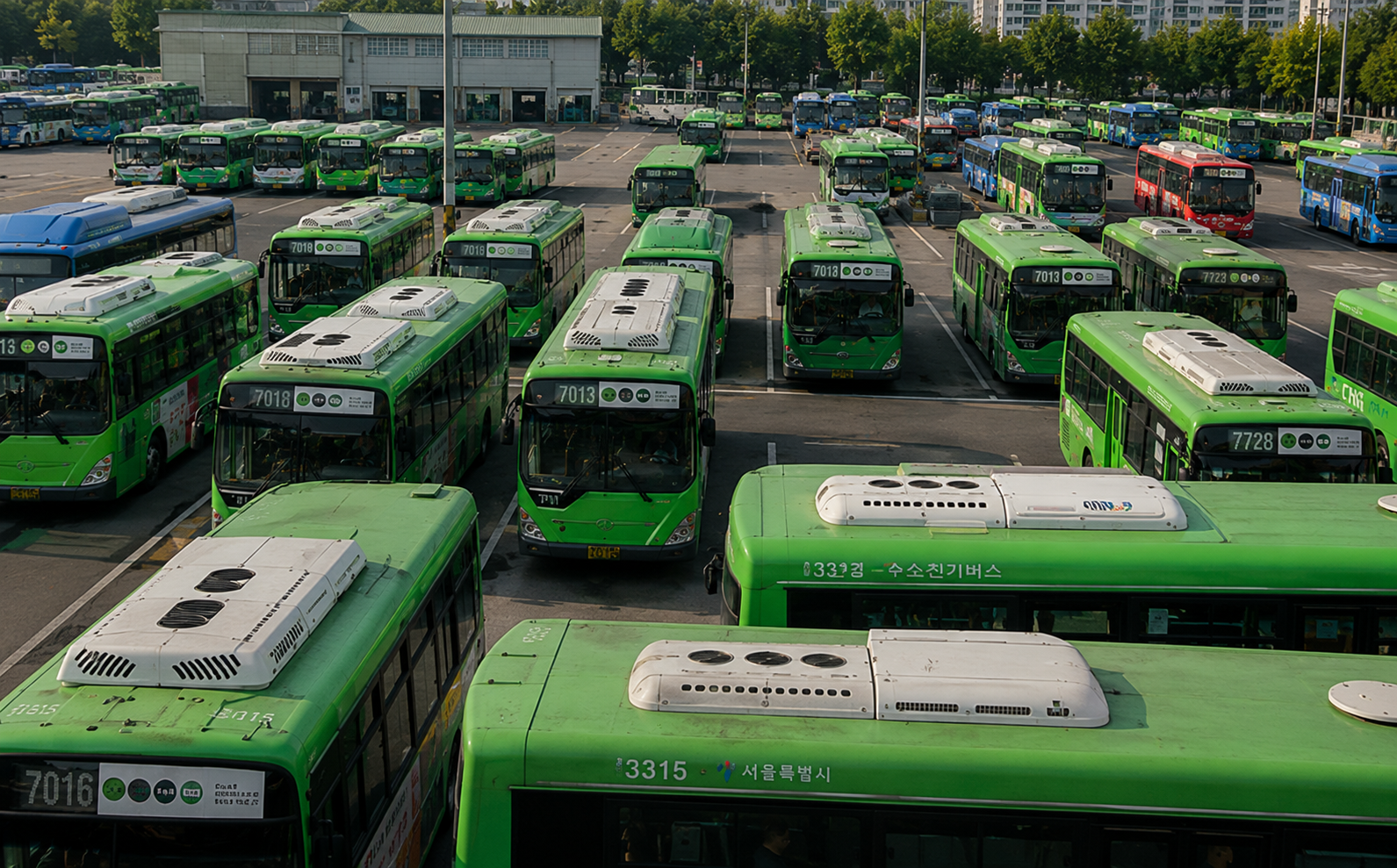
If you’re in charge of safety management for public bus routes, there’s a task that comes up every year: arranging refresher training for transportation workers, managing completion certificates, and verifying that no one has failed to complete the training.
Since this is a legal requirement, it must be done. However, one question remains:
“If training is completed every year, why aren’t accidents decreasing?”
This article answers that question. To get straight to the point: it’s not because statutory refresher training is insufficient, but because it alone cannot address individual risks.
First, let’s make one thing clear. This article is not suggesting that we replace mandatory refresher training. Mandatory training is a legal obligation and must be completed. This article explores what additional measures, built on top of that, can lead to a tangible reduction in accidents.
Training for transportation workers is a legal obligation
To avoid confusion, let’s first clarify the legal requirements.
Training Required by Law
Pursuant to Article 25 of the Passenger Transportation Business Act, transportation workers must undergo training.
- Initial Training — Must be completed before beginning driving duties
- Refresher Training — A 4-hour training session conducted by the Traffic Training Institute once a year (combining in-person and online formats)
- Refresher Training for Violators — Must be completed within three months of the date of the penalty (e.g., administrative fine). The training duration has been increasedfrom 4 to 8 hours.
Failure to complete this training will result in a penaltybeing imposed on the transportation company. In other words, this is not optional but a mandatory requirement.
Furthermore, the time spent on training counts as labor costs.
A recent important court ruling has further reinforced this point. The Supreme Court ruled that refresher training for transportation workers is “a statutory obligation imposed on both the driver, as an employee, and the transportation operator, as an employer,” and determined that the training hours are included in working hours.
The implications of this ruling are clear. Training is not free. The time spent on training represents labor costs borne by the company.
This raises an even more pressing question: Given the costs incurred to provide annual training, is that training actually reducing the number of accidents?
Why does it often amount to little more than a formality?
Mandatory refresher training is absolutely necessary. However, due to its structure, it is difficult to address individual risks. There are three reasons for this.
① It covers general principles for the entire target audience
The annual four-hour training session delivers the same contentto all transportation workers. This includes common topics such as changes in regulations, safety guidelines, and accident case studies.
The problem is that actual risk patterns vary from driver to driver. Some drivers frequently fall asleep at the wheel, some have trouble obeying traffic signals, and others repeatedly make sudden starts and stops. General principles aimed at the entire group cannot address these individual differences.
② Training proceeds without knowing what needs to be corrected
For training to lead to tangible improvements, it is essential to first identify “what this specific driver needs to correct.”
However, most workplaces lack this data. Since there are no objective records of what specific risky behaviors individual drivers actually exhibit or how frequently they do so, training tends to remain at the level of simply urging drivers to “drive safely in general.”
③ Only completion status is tracked
If the only way to measure the effectiveness of training is through a certificate of completion, the focus of management naturally narrows to **“whether or not the training was received.”**
There is no way to verify whether the driver’s risky behaviors have actually decreased before and after the training. Since improvement cannot be measured, the training is repeated every year, but the results do not accumulate.
In summary, this is not a limitation of mandatory training itself, but rather a limitation of the structure—"general principles + lack of measurable outcomes." That is why individual-level data is essential.
What Is Data-Driven Training? — Substantial Improvement Built on Top of Mandatory Training
To reiterate, data-driven training does not replace mandatory refresher training. Drivers must still complete the mandatory training as required, but in-house training that addresses individual risk profilesis added on top of it. If mandatory training is a “common standard,” then data-driven training is a “personalized prescription.”
So, what constitutes that “individual prescription”? Let’s take a closer look at what the AI safe driving solution does. A.I.Matics’ AI Safe Driving Solutionuses an AI device (Roadscope 10) installed in the vehicle to detect and warn of risks while driving; these records are accumulated by driver on the AID platform and serve as the basis for training.
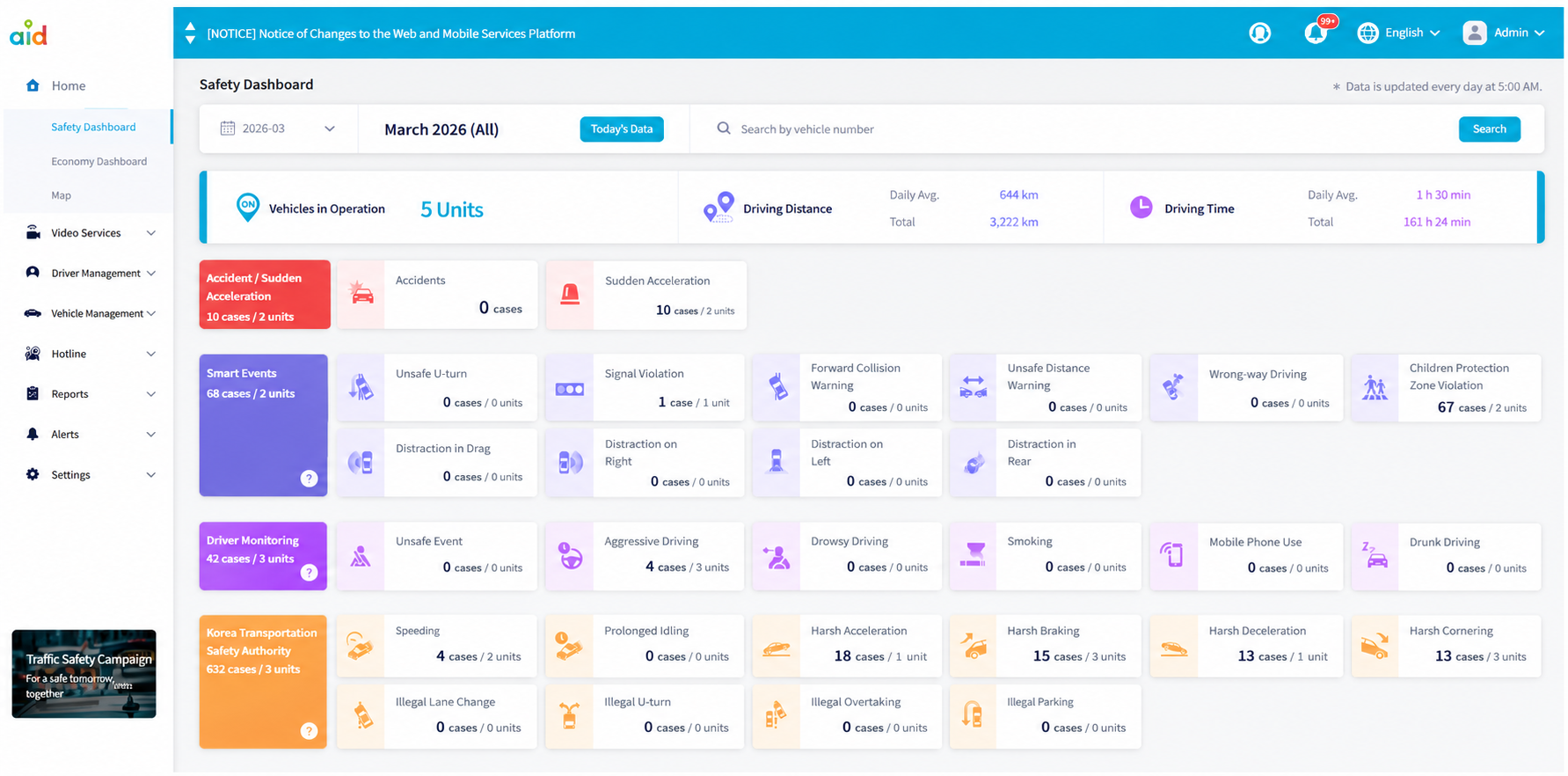
① Identifying driver-specific risk patterns through data
The AI camera simultaneously monitors both the interior of the vehicle (the driver) and the exterior (driving conditions). Driver-related incidents—such as drowsy driving, failure to watch the road ahead, cell phone use, and smoking—as well as driving-related incidents—such as running red lights, crossing the center line, and failing to maintain a safe following distance—are recorded on an event-by-event basis, noting when, where, and by which driver they occurred.
Crucially, video footage is recorded alongside each event. It’s not just a number—such as “3 traffic signal violations”—but the actual video from that moment serves as evidence. As these records accumulate , a safe driving score and reportare generated for each driver. Statements like “Driver Kim frequently receives drowsiness warnings, and Driver Lee has issues with traffic signal compliance” are no longer mere hunches but are verified by numbers and video footage.
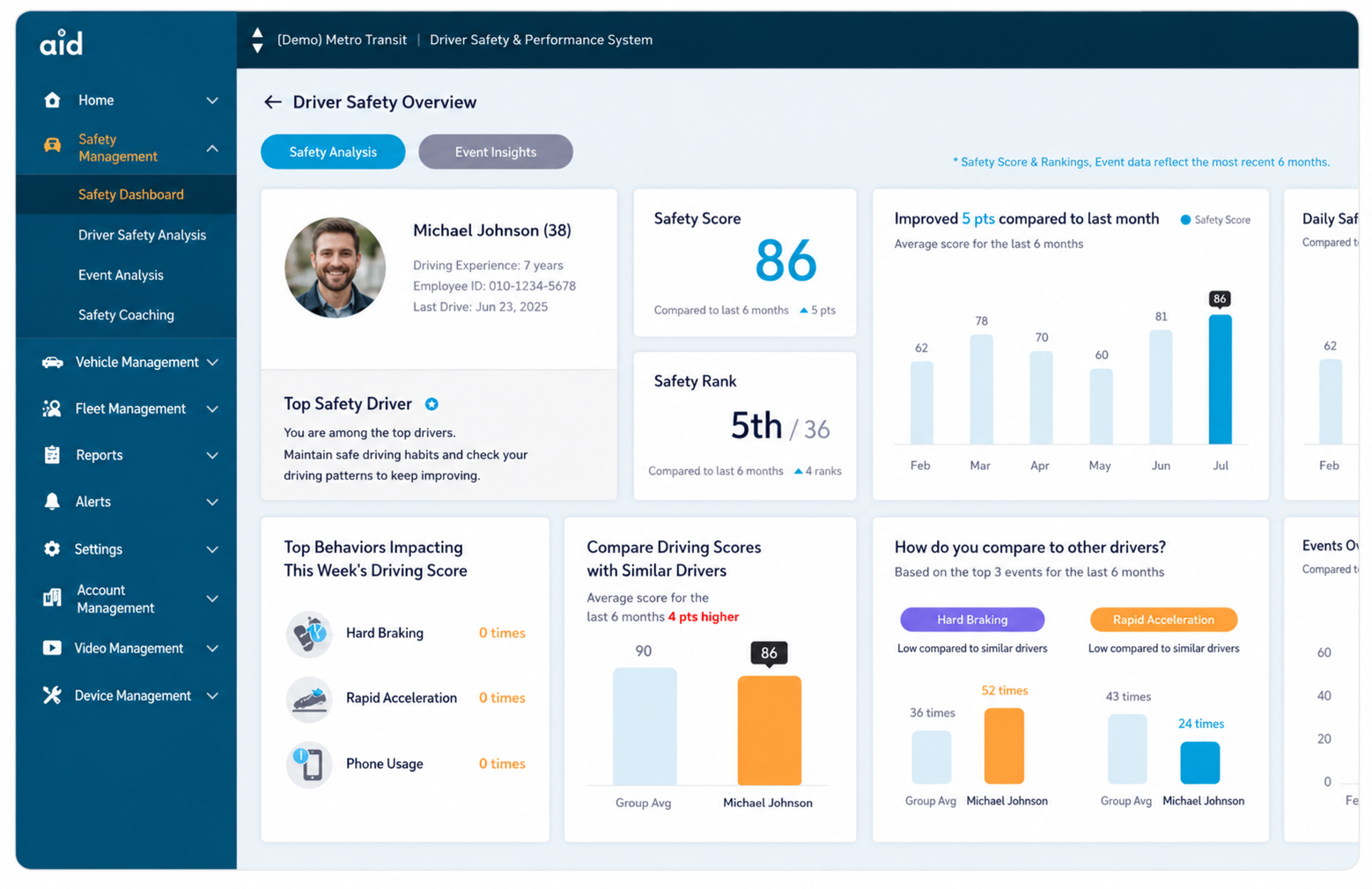
② This leads to personalized training
Once risk patterns are identified, the training is tailored accordingly. The key is that drivers receive coaching while watching their own driving footage. Rather than simply being told, “Drive safely,” they review the exact moments when they violated traffic signals.
- Drivers who frequently drive while drowsy → Review data on when drowsiness was detected alongside their work schedules and rest periods
- Drivers who repeatedly run red lights → Individual coaching based on footage from the specific sections and time periods where violations occurred
- Drivers with frequent sudden starts and stops → Specific feedback linked to passenger safety
Additionally, drivers can be prioritized for management based on their low safe driving scores. Rather than a one-size-fits-all approach where everyone is gathered for a general lecture, this training addresses what each driver actually needs to correct, in order of urgency.
③ Real-time alerts reinforce the training daily
Another key aspect of data-driven trainingis that it doesn’t end with a single annual session.
An AI device installed in the vehicle immediately issues a voice warningto the driver as soon as it detects risky behavior. If the driver starts to doze off, an alert sounds instantly to correct the behavior. In other words, separate from group training sessions held in an office, real-time training is repeated daily right inside the vehicle.
If group training is “learning once a year,” real-time alerts are “reminders at every moment.” When these two are linked through data, habits change.
④ Measure Improvement
The key to data-driven training is the ability to compare results before and after the training.
Since each driver’s safe driving score is recorded monthly, the following month’s score confirmswhether the frequency of that driver’s risky behaviors has actually decreased after training and real-time alerts. Because improvement is measurable, training is managed based on results, not just certificates of completion.
Evidence of Tangible Improvement — Korea Transportation Safety Authority Pilot Project
A pilot project confirmed that the data-driven approach actually changes behavior.
Measurement Conditions: Korea Transportation Safety Authority (KOTSA) Route Bus Pilot Project · June–December 2024 · 13 transportation companies · 500 vehicles · 1,615 drivers · Based on 1,000 km of driving distance
| Risky Driving Behaviors | Before Implementation | After Implementation | Reduction Rate |
|---|---|---|---|
| Drowsy Driving | 1.54 times | 0.005 incidents | 99.7% decrease |
| Failure to keep eyes on the road | 0.024 incidents | 0.002 times | 93.4% decrease |
| Running a Red Light | 12.75 times | 1.58 times | 87.6% decrease |
| Crossing the center line | 5.60 times | 2.97 times | 46.9% decrease |
| Smoking | 0.54 times | 0.32 times | 41.4% decrease |
| Failure to Maintain a Safe Distance | 20.3 times | 13.8 times | 32.1% decrease |
How these results were achieved is key. This wasn’t simply a matter of providing more training; it was the result of correcting behavior in real time through alerts and providing driver-specific feedback based on data.
In particular, the 99.7% reduction in drowsy driving and the 87.6% reduction in traffic signal violations are figures that would be difficult to achieve with just one annual group training session. This is because intervention at the very moment a risk occurs, combined with repeated feedback based on individual data, worked in tandem.
3 Key Points to Consider Upon Implementation
① Is the structure designed to run in parallel with mandatory training?
Data-driven training does not replace mandatory refresher training. The correct structure is to complete mandatory training as required through traffic training centers, while implementing data-driven training in parallel as a complementary measure for in-house safety management. Clearly defining this distinction prevents confusion in the field.
② Driver Communication — Coaching, Not Surveillance
Since the system handles driver-specific data, drivers may feel they are being monitored during the initial implementation phase. A common practice among sites that have overcome this challenge is designing a systemthat incorporates score-based feedback, recognition of improvements, and a rewards system.
Data is helpful to drivers when the system is operated as a tool for collaborative improvementrather than a tool for detection. This is because it serves as objective proof for accident-free drivers.
③ Does the Data Reach Managers?
For driver-specific reports to be generated, the detected data must be transmitted to managers and accumulated. Simply installing devices in vehicles is not enough. A platform that collects and analyzes data for each drivermust operate in tandem to translate this into training.
Summary — Results, Not Just Certificates
Safety training for route bus drivers can be summarized in a single sentence as follows:
Mandatory refresher training is a common standard that must be met. However, a general overview once a year is insufficient to address individual risks. When using driver-specific data to identify what needs to be corrected and measure improvements, training is managed by results, not certificates.
Maintain the statutory training, but build data-driven training on top of it. This is the path toward substantive improvement, moving beyond mere formal compliance.
👉Get a diagnosis of your driver-specific risk patterns
Frequently Asked Questions (FAQ)
Q. If we implement data-driven training, do we no longer need to undergo mandatory refresher training?
A. No. Under the Passenger Transportation Business Act, refresher training for transportation workers is a legal obligation and must be completed annually through the Korea Transportation Training Institute. Failure to complete the training results in a penalty imposed on the transportation company. Data-driven training complements, rather than replaces,this mandatory training. Mandatory training covers common standards, while data-driven training addresses individual risk profiles.
Q. If training time counts as working hours, won’t increasing training lead to higher labor costs?
A. That is why precise trainingis crucial. According to a Supreme Court precedent, training time is included in working hours; therefore, repeating ineffective training only increases costs. The advantage of data-driven training is that it allows us to identify exactly who needs what training. Focusing on drivers with specific risk patterns is more cost-effective than repeating training for the entire workforce.
Q. Won’t drivers resist data collection?
A. That’s a reaction that might arise during the initial implementation phase. The key is to operate the system as a coaching tool, not a punishment mechanism. Acceptance increases when you design a system that combines score-based feedback with recognition and rewards for improvement. Additionally, the data works in favor of accident-free drivers, as it allows them to objectively prove their safe driving practices in the event of an accident or customer complaint.
Q. Can small bus companies implement this as well?
A. It can be applied regardless of company size. In fact, the fewer drivers there are, the easier it is to manage them individually. However, since the system must be linked to a platform that transmits data to managers and tracks cumulative records for each driver—which is essential for connecting the data to training—it’s important to verify that the devices and platform are compatible.
Q. What types of risky behaviors can be identified through the data?
A. The AI safe driving solution detects driver conditions—such as drowsy driving, failure to monitor the road ahead, cell phone use, smoking, and failure to wear a seatbelt—as well as driving situations like running red lights, crossing the center line, and failing to maintain a safe following distance. This data is accumulated for each driver and compiled into a safe driving report, which serves as the basis for personalized training.
Q. How do you verify the effectiveness?
A. The advantage of data-driven training is that it allows for a comparison of performance before and after training. When training is combined with real-time warnings, it is possible to verify whether the frequency of risky behaviors by the driver has actually decreased in subsequent data. In the Korea Transportation Safety Authority’s route bus pilot project (based on 1,000 km of driving), a 99.7% reduction in drowsy driving and an 87.6% reduction in traffic signal violations were confirmed.
The laws and regulations regarding training cited in this article are based on the Passenger Motor Vehicle Transport Business Act, and the data on reduction effects are based on the results of the Korea Transportation Safety Authority’s route bus pilot project. Specific requirements for mandatory training and standards for penalties may vary depending on vehicle type, region, and timing, so individual verification is necessary.

