

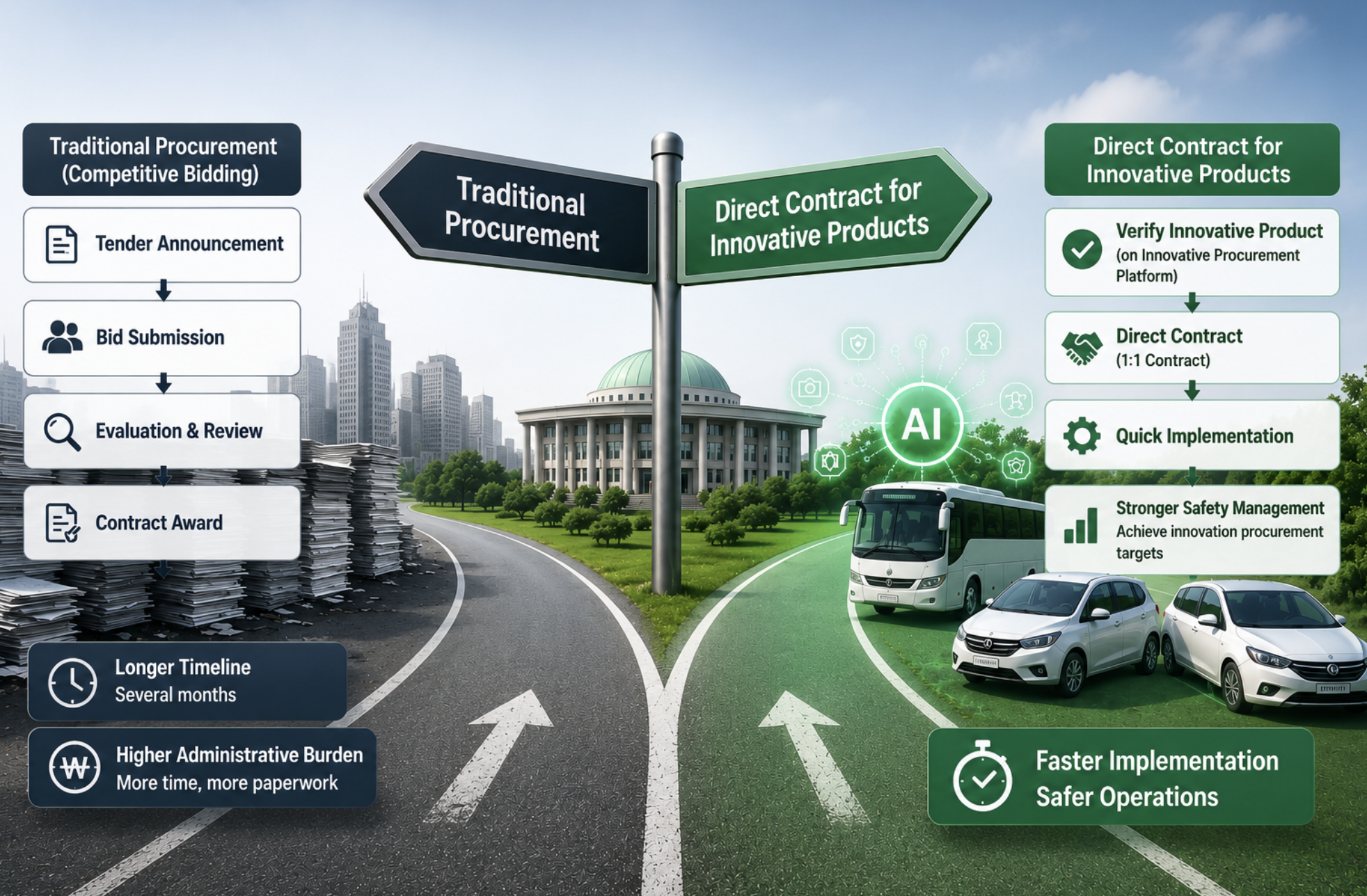
When vehicle safety managers at public institutions seek to adopt new safety solutions, the first hurdle they face is the bidding process. It is standard practice for public institutions to go through a competitive bidding process when purchasing goods above a certain value, and this process—from initial review to contract signing—can take a considerable amount of time. In situations where safety incidents are a concern, this period can feel interminable.
A system designed to alleviate this burden is the Korea Public Procurement Service’s “Direct Contract for Innovative Products.” Products designated as “innovative products” can be procuredby public institutions through direct, one-on-one contracts without a bidding process, and procurement officers are protected by procurement immunity.
This article explains what direct contracts for innovative products are, when and how public institutions can utilize them, and how AI-based safe driving solutions can be adopted through this system.
What Is a Direct Contract for Innovative Products?
First, let’s clarify the terminology.
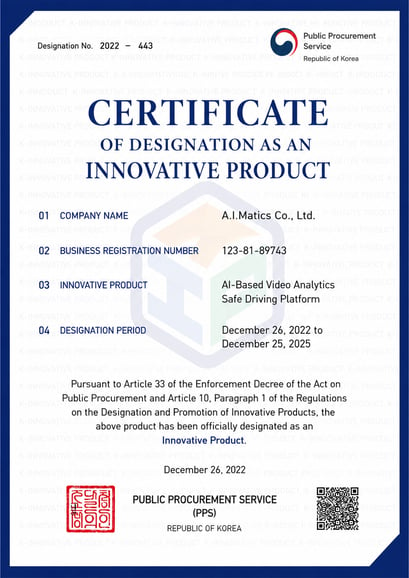
An “Innovative Product” is
a designation granted by the Public Procurement Service to products recognized for their public benefit and innovative nature. It is based on Article 27 of the “Act on Public Procurement” and remains valid for three yearsonce designated.
Obtaining this designation is a rigorous process. Products must either have been developed through national R&D projects or pass the innovation evaluation criteria separately established by the Public Procurement Service. Final designation is granted following review by a deliberation committee.
A direct contract is
a methodof entering into a contract on a one-on-one basis without going through a bidding process. While public institutions are generally required to conduct a bidding process for purchases of 50 million won or more (under the National Procurement Act), Article 26 of the “Enforcement Decree of the National Procurement Act” specifies exceptions where direct contracts are permitted. The purchase of innovative products is one such exception.
Therefore, “direct contracting for innovative products” is
a system that allows public institutions to directly purchaseproducts designated as “innovative products” by the Public Procurement Service without going through a bidding process. These products can be utilized for three years following their designation as innovative products.
The reason for establishing this system is clear: to reduce procedural burdens so that newly developed innovative technologies can be rapidly adopted in the public sector.
Situations in Which Public Institutions Can Utilize Direct Contracts
Direct contracts for innovative products are particularly valuable in the following situations:
1. When safety or disaster response is urgent
Situations where the risk of vehicle accidents is mounting and it is difficult to wait for a regular bidding process. For example, in cases where incidents of drowsy driving by bus drivers or passenger safety accidents recur on route buses or commuter buses, proven innovative products can be rapidly introduced instead of spending months on the bidding process.
2. When performance targets for innovative procurement must be met
The government manages each public institution’s performance in innovative procurement to expand the purchase of innovative products by public institutions. Introducing innovative products in the vehicle safety sector allows institutions to simultaneously strengthen safety management and meet their innovative procurement targets.
3. When procurement officers are concerned about potential liability
Article 27 of the “Act on Public Procurement” provides a procurement liability exemption clause for the purchase of innovative products. If an innovative product is purchased in accordance with lawful procedures, the procurement officer can reduce their liability for the procurement decision, provided there is no intent or gross negligence. This alleviates the greatest burden that often causes hesitation in adopting new technologies.
4. When a contracted transportation company seeks to strengthen its safety management proposals
Transportation companies contracted to operate public institutions’ commuter buses and official vehicles can leverage the designation of an innovative productas a key differentiator when proposing safety management solutions to the contracting authority (public institution). From the contracting authority’s perspective, this eliminates the burden of bidding while also securing a track record of innovative procurement.
Which organizations are eligible to use direct contracts for innovative products?
The following organizations are highly likely to utilize direct contracts for innovative products.
- Local government departments responsible for operating official vehicles
- Public institution commuter bus operations departments
- Facility Management Corporations
- Urban development corporations
- Airport authorities
- Port Authority
- Vehicle Operations Organizations of Public Enterprises
- Shuttle bus operations organizations of affiliated agencies
- Public transportation operators
The greater the importance of preventing vehicle accidents within an organization, the greater the potential benefits of utilizing innovative products.
Procedures for Introducing Innovative Products Through Direct Contracts
The procedure for public institutions to procure innovative products through direct contracts is simpler than that for general procurement.
Step 1 — Search for Products on the Innovation Marketplace
Search for innovative products designated by sector on the Innovation Marketplace (Innovation Procurement Platform) operated by the Public Procurement Service. In the vehicle safety sector, products such as AI video recognition systems, DTG integrated devices, and driver behavior analysis solutions are registered.
Step 2 — Purchase Directly Using Your Own Budget or Apply for a Pilot Purchase Through the Public Procurement Service
There are two options.
- Purchase with Own Budget: The public institution enters into a direct contract with the manufacturer of the innovative product using its own budget
- Public Procurement Service Pilot Purchase: The Public Procurement Service purchases innovative products using its own budget and provides them to public institutions. Results are evaluated and feedback is collected after the pilot period.
Most vehicle safety solutions are adopted through Path 1.
Step 3 — Entering into a Direct Contract
In accordance with Article 26 of the “Enforcement Decree of the National Contract Act,” a one-on-one contract is concluded with the manufacturer without a bidding process. The contract officer prepares a statement of reasons for the contract; however, since the legal basis for purchasing innovative products is clear, the burden is significantly reduced compared to a bidding process.
Step 4 — Implementation and Operation
After the contract is signed, the solution is installed in vehicles, and operational data is managed. If the pilot purchase route was followed, a results report is required after a certain period.
AI Safe Driving Solutions and the Innovative Product System
Direct contracts for innovative products are becoming increasingly common in the field of vehicle safety. This is because AI-based video recognition solutions for safe driving are rapidly spreading across the transportation and public sectors.
Changes in Vehicle Safety Management for Public Institutions
Safety management obligations for vehicles in the public sector—such as local government official vehicles, public institution commuter buses, and vehicles operated by municipal and provincial agencies—are becoming increasingly stringent. Accidents result in administrative and legal liability, along with significant additional burdens such as a surge in public complaints and media coverage.
By adopting AI safe driving solutions—designated as innovative products—through direct contracts, the following benefits can be achieved simultaneously:
- Rapid implementation without the burden of competitive bidding
- Protection of responsible personnel through procurement immunity
- Achieving performance targets for the Innovative Procurement Program
- Objective safety management based on driver behavior data
A.I.Matics’ aid Solution
A.I.Matics’ aidis an integrated solution that uses AI to analyze accident risk factors inside and outside the vehicle in real time. It combines driver behavior detection, external hazard detection, passenger safety management, and automatic operation data logging into a single device.
The key features of aid are as follows.
- Smart Event Alerts — Real-time detection and alerts for traffic signal violations, crossing the center line, and reckless driving
- Driver Status Analysis (DMS) — Detection of drowsy driving, failure to watch the road ahead, cell phone use, smoking, etc.
- ADAS Alerts — Lane departure, collision risk, and forward pedestrian detection
- Blind Spot Detection (BSD) — Detection of pedestrians and two-wheeled vehicles in left, right, and rear blind spots
- AI Video Monitoring Platform — Integrated management of real-time events, location tracking, and driver scores
- DTG and e-TAS Integration — Automatic saving of driving records and submission to administrative authorities
In particular, numerous implementation cases have been accumulated in the public sector, including route buses, commuter buses, and government vehicles. A pilot project conducted by the Korea Transportation Safety Authority on 500 route buses confirmed a 99.7% reduction in drowsy driving, a 93.4% reduction in failure to watch the road ahead, and an overall 55% reduction in accident rates.
View the A.I.MATICS aid solution
Proven Implementation Results
In a case study involving the deployment of the solution on approximately 2,400 commuter buses operated by a leading domestic manufacturing conglomerate, the following results were confirmed.
| Metrics | Effect |
|---|---|
| Insurance Costs per Bus | Approx. 1.47 million won (68%) reduction |
| Safe Driving Score | 50.9 points → 76.9 points (73% increase) |
| Traffic Signal Violations | 41% decrease |
| Total Accidents (AID+ADAS) | Approx. 44% decrease |
These results demonstrate that the same safety management benefits can be expected in the public sector as well.
Summary — Direct Contracts for Innovative Products: A New Option for Safety Management in Public Institutions
To summarize the points discussed so far in a single sentence:
Public institutions can quickly adopt vehicle safety solutions through direct contracts for innovative products without going through a bidding process; procurement officers are protected by procurement indemnity; and they can simultaneously meet their innovative procurement targets.
Vehicle safety accidents impose administrative, legal, and reputational risks on public institutions simultaneously. Direct contracts for innovative products are one of the fastest ways to reduce those risks.
Can our agency or operating company utilize direct contracts?
Check the following five points.
| No. | Checkpoint | Status |
|---|---|---|
| 1 | Does our organization operate or manage any vehicles (commuter buses, official vehicles, vehicles belonging to affiliated organizations, etc.)? | ⬜ |
| 2 | Is there a need to strengthen vehicle safety management (including concerns regarding accidents, public complaints, or legal liability)? | ⬜ |
| 3 | Is achieving the annual innovative procurement target a burden? | ⬜ |
| 4 | Are there any solutions whose implementation is being delayed due to the burden of the bidding process? | ⬜ |
| 5 | If you are a contracted transportation provider, do you plan to propose a safety management solution to the client? | ⬜ |
If you answered “Yes” to three or more of these questions, you should consider utilizing the direct contract option for innovative products.
👉Get advice on introducing direct contracts for innovative products in public institutions
Frequently Asked Questions (FAQ)
Q. Can all public institutions use direct contracts for innovative products?
A. In accordance with Article 26 of the “Enforcement Decree of the National Procurement Act” and Article 25 of the “Enforcement Decree of the Local Procurement Act,” this system is available to central administrative agencies, local governments, and public institutions alike. This includes government ministries, local governments, public corporations, and institutions governed by the Act on the Operation of Public Institutions.
Q. Is there a limit on direct contracts?
A. For innovative products, direct contracts are permitted without a separate limit. However, the contracting officer must prepare a statement of reasons for the direct contract and follow internal approval procedures. This structure exempts such purchases from the mandatory bidding requirement that applies to general purchases of 50 million won or more.
Q. What exactly does “procurement immunity” mean?
A. Pursuant to Article 27 of the “Act on Public Procurement,” officials who purchase innovative products through standard procedures are exempt from liability even if product-related issues arise afterward. This system alleviates the greatest burden that often discourages the adoption of new technologies.
Q. Can contracted transportation companies also use innovative products?
A. When a contracted transportation company purchases an innovative product directly, it is considered a standard transaction. However, if the contracted transportation company proposes an innovative product to the contracting authority (public institution) and the contracting authority makes the purchase, a negotiated contract is possible. From the perspective of the contracted transportation company, this serves as a proposal strategy that can reduce the bidding burden for the contracting authority.
Q. Are performance results under the Innovative Procurement Target System actually reflected in evaluations?
A. Each public institution is assigned an annual target for the purchase of innovative products, and its performance in meeting these targets is regularly reviewed. The operation of the Innovative Procurement Target System is central to the government’s innovative procurement policy, and institutions with low performance are subject to requests for improvement.
Q. Are AI safe driving solutions designated as innovative products?
A. In the field of vehicle safety, solutions based on AI image recognition and driver behavior analysis are designated as innovative products and are currently in use. Specific designated products and methods of use can be found on the Public Procurement Service’s Innovation Marketplace; however, it is most accurate to contact suppliers directly to confirm the latest information.
This article is intended to provide general information. Procedures and regulations regarding direct contracts for innovative products may vary depending on the circumstances of individual agencies and the latest official notices; therefore, please refer to the Korea Public Procurement Service’s Innovation Marketplace and supplier guidelines at the time of actual purchase.

