

The reaction of a freight carrier’s CEO upon receiving a renewal notice is usually the same: “Is this amount based on how many accidents we had last year?” And in even more frustrating cases: “We had no accidents—why did it go up?”
To put it simply, freight mutual insurance premiums are determined by the product of two variables: the company’s accident record(which affects discounts or surcharges) and the association’s total claims costs(the base premium). The former is within the company’s control, while the latter is not—and it tends to rise every year. This explains why the contribution rate rises even with a clean accident record, and therefore, the focus of management should be on maintaining the one controllable variablerather than questioning “why it went up.”
Furthermore, freight transport companies face one additional variable that bus companies do not— the contract driver system. Later in this article, we’ll discuss the conditions under which an accident involving a single contract driver can lead to an increase in the contribution rates for the company’s entire fleet.
How Are Contribution Rates Determined? — The Product of Two Variables
The contribution fees charged by mutual aid associations (equivalent to insurance premiums charged by insurance companies) are basically calculated using the following structure.
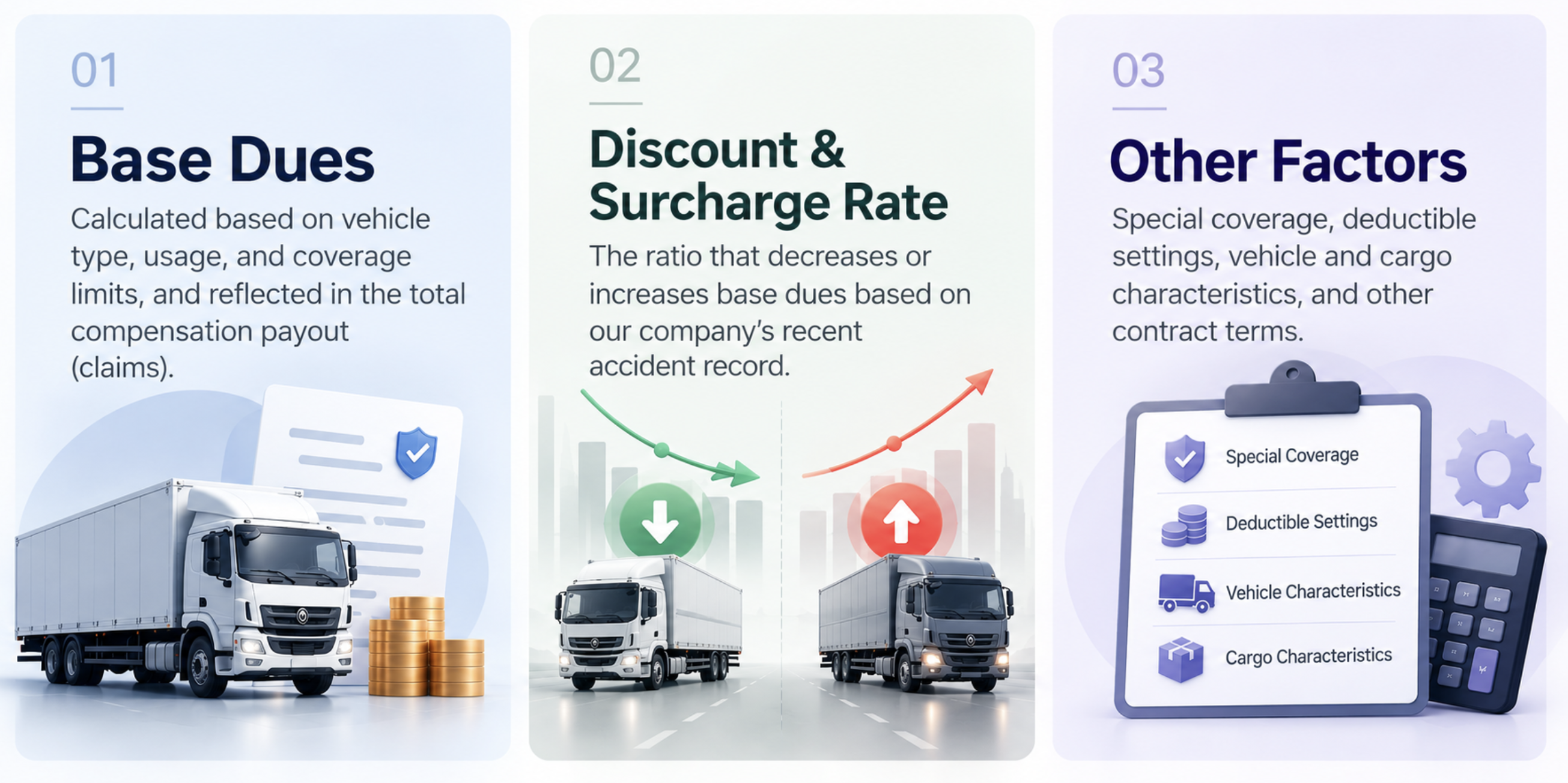
| Composition | Details | Who Is Involved |
|---|---|---|
| Base Contribution | Base amount based on vehicle type, purpose, and coverage scope — Reflects the association’s total compensation expenditures (loss ratio) | Overall accident and claims trendsacross the association |
| Discount and Surcharge Rates | The rate by which the base premium is reduced or increased based on our company’s (the policyholder’s) recent accident history | Our company’saccident history |
| Other Rate Factors | Riders, deductible settings, vehicle and cargo characteristics, etc. | Contract Terms |
The multiplicative structure is important. Even if you maintain a clean driving record to qualify for a discount, your premium may still increase if the base premium itself rises. Conversely, if you have an accident and a surcharge is applied, the surcharge is multiplied by the increased base premium, resulting in a larger perceived increase.
Since detailed rate tables and rating systems vary by association and policy and are not publicly disclosed, the most accurate way to verify our company’s specific discount and surcharge tiers and applicable rates is through your renewal notice and your local association branch. However, the basic structure—where accident history determines discounts and surcharges, and the association’s loss ratio sets the base amount—is consistent across all plans.
Where Premiums Go: Coverage Structure of the Freight Mutual Insurance Association
To properly understand your renewal notice, you must first know what types of coverage make up the premium. The insurance products offered by the National Freight Truck Mutual Aid Association are structured around a framework similar to general auto insurance, with additional coverage tailored to freight.
| Coverage | Coverage Details | Remarks |
|---|---|---|
| Liability for Bodily Injury | Liability for injury or death to third parties while the vehicle is in operation | Mandatory (Personal Injury I) + Optional (Personal Injury II) |
| Property Damage Liability | Liability for damage to another person’s property | Mandatory up to a certain limit |
| Personal Injury Coverage | Injuries to the driver | Optional |
| Damage to Own Vehicle | Damage to my vehicle due to collision, rollover, fire, etc. | Optional — High deductible based on the vehicle’s value |
| Workers’ Compensation | Compensation for employee injuries | Cargo-Specific |
| Cargo Liability | Liability for damages to entrusted cargo during transport | General and individual freight carriers are required to enroll (Freight Vehicle Transportation Business Act) |
There are two key practical points to note. First, the policy includes a mix of coverages subject to discounts and surcharges and those that are not—since accident history primarily affects personal injury, property damage, and vehicle damage coverage, you must review the premium breakdown by coverage type in the notice to see where and why costs have increased. Second, liability for cargo damage is a separate obligation—it is distinct from the truck’s motor vehicle insurance, and failure to enroll is subject to a fine, so it must be checked during renewal.
Why is the premium rising even with a clean driving record? — Circumstances involving uncontrollable variables
The primary factor driving up the base premium is the association’s overall claims expenditure. And that expenditure is structurally on the rise.
- Rise in the unit cost of personal injury compensation —Following the Supreme Court’s ruling (2018Da248909) raising the working life expectancy for manual laborers from age 60 to 65, the period for calculating lost income has lengthened, raising the baseline for personal injury compensation amounts. The sharp increase in traditional Korean medicine treatment costs for traffic accidents is also cited as a factor driving up the cost of personal injury compensation.
- High property damage costs specific to freight transport — Freight truck accidents often involve a combination of total loss of the opposing vehicle, damage to cargo, and damage to road infrastructure, making the property damage compensation per incident tend to be higher than in passenger car or bus accidents. Rising vehicle prices and costs for parts and repairs further drive up these rates.
- The pass-through structure for major accidents —since mutual aid associations operate on a risk-sharing model among members, if the association’s loss ratio rises due to a major accident involving another company, that burden is distributed to all members through their basic contribution fees.
This pressure is also evident in the association’s financial statements. According to a news report analyzing the financial disclosures of the Freight Truck Mutual Aid Association, the association’s retained earnings fell by 95.1 billion won in just one year—from +85.8 billion won in 2020 to -9.3 billion won in 2021—resulting in a deficit, while the liability reserve set aside for future claims payments stood at 401.4 billion won. When the association’s financials shift in this way, the pressure ultimately falls on one thing—the basic premiums paid by all members.
In short, the increase in contribution fees for accident-free companies isnot a matter of “what we did wrong,” but rather a sharing of the rising costs across the entire association. This variable is beyond the control of individual companies. An analysis of the same structure in the bus industry can be found inthe article “Bus Mutual Aid Association Contribution Fees: Why Do They Keep Rising Every Year?”

A Factor Unique to Freight: Under What Conditions Do Accidents Involving Contract Drivers Result in a Surcharge for the Entire Company?
So far, this is the same story as with buses. However, there is an additional layer for freight transport companies.
Under the contract-hire system, the vehicle is registered in the name of the transport company. Therefore, mutual aid contracts are generally signed in the company’s name, and accident records are tallied based on that contractual unit. However, one thing must be made clear from the outset— not every accident involving a contract-hire driver automatically results in a premium surcharge for the entire company. There are two conditions that determine the outcome.
| Conditions | Decisive Factors |
|---|---|
| ① Contract Unit | Is the leased vehicle included in the company’s consolidated mutual insurance contract, or is there a separate contract for each vehicle (or separate insurance in the driver’s name)? |
| ② The association’s method for assessing discounts and surcharges | Is the accident history evaluated at the policyholder (company) level or at the vehicle level? — This varies depending on the insurance association and the policy terms |
Full pass-through occurs when “company-wide policy + policyholder-level assessment” overlap, anda significant number of lease-based transportation companies actually fall into this category. The process in such cases is as follows.
- Leased-vehicle driver A causes an accident. Although the driving, cargo, and de facto vehicle management are all handled by A—
- the accident is recorded as part of the company’s contract accident record, and
- and at renewal, the surcharge is reflected not just for that single vehicle but in the discount/surcharge rating for the entire contract,
- causing the contribution rates for company-owned vehicles and other leased vehicles—which are unrelated to the accident—to rise as well.
For companies falling under this arrangement, the concept of “that driver’s personal accident” ceases to exist from the perspective of contribution fees. The less the company is involved in the operation of a leased vehicle ,the greater this asymmetry becomes—because it is a structure where the company exercises the least control over the vehicle but passes the costs on to the entire fleet.
Therefore, the first step in this section is not analysis but verification: ask the union branch which contracts our leased vehicles are grouped under and in what units, and how accident records are evaluated,and keep a written record of the response. The magnitude of the leased vehicle accident risk varies depending on this answer, and so do the priorities for the responses outlined below.
There are two key points for addressing this issue in practice.
- Contract stage — How to determine who bears the burden of accident-related surcharge increases in the consignment contract. However, even if there is a post-accident settlement clause, the surcharge is initially reflected in the company’s contract, so the risk does not disappear simply because of the clause.
- Operational Stage — Ultimately, it is accident prevention—including for leased vehicles—that prevents these surcharges, not the settlement clause. This is the subject of the final section below.

Practical Judgment in the Event of an Accident — Should It Be Covered by the Insurance Deduction or Paid Out of Pocket?
There is one decision that practitioners actually face when managing co-payments: whether to handle a minor accident through the insurance claim or out of pocket.
(The procedures for receiving, reporting, and securing evidence immediately after an accident are outlined chronologically in the “Freight Truck Accident Handling Procedures”; here, we address only the cost-based decision made after those procedures are complete.)
The framework for this decision is simple—it’s a comparison between the compensation amount for this incident and the premium surcharges that will accumulate over the next few years. If the claim is processed through the mutual aid fund, the association covers the compensation, but the accident record remains on file and results in a renewal surcharge, which continues throughout the evaluation period. In the case of a minor property damage accident, the cumulative premium surcharge may exceed the compensation amount; in such cases, settling the claim out of pocket may be more economical.
However, three points require caution.
- Accidents involving personal injury are not candidates for out-of-pocket settlement —compensation amounts for injuries can increase later due to the possibility of permanent disability, and the legal risks of an out-of-court settlement are significant. In principle, claims involving personal injury must follow the association’s deduction and insurance procedures.
- The impact of the premium surcharge must be calculated based on the terms of the policy —since the outcome may vary depending on your company’s current rating, the evaluation period, and how the number of accidents is factored in, it is best to confirm with your union branch exactly how much your renewal premium will change if you handle this accident out-of-pocket before making a decision.
- Even if you handle it out of pocket, you must still record it in company records —just because it’s excluded from mutual aid records doesn’t mean the accident never happened. If the causes and corrective actions for near-misses and minor accidents are not documented in internal records (recurrence prevention log), the same risks will recur and eventually lead to a major accident—at which point, the option to handle it out of pocket will no longer be available.
5 Things to Check on Your Renewal Notice
When you receive your renewal notice next year, don’t just look at the amount; be sure to review the following items separately:
- Applied discount and surcharge rates — Your company’s current rating and any changes compared to the previous year. If your rating remains the same despite having no accidents, it means your base premium has increased.
- Changes in premiums by coverage type — Which category has increased: bodily injury, property damage, or vehicle damage? An increase in vehicle damage premiums is a sign of rising vehicle values or repair costs, while an increase in bodily injury premiums indicates a rising loss ratio for the association.
- Details of accident history reflection — How many accidents were factored in and the period covered (if you have any objections, check with the association before renewal)
- Deductible settings — Is there a trade-off where increasing the deductible lowers the premium?
- Coverage status for mandatory coverage, such as cargo liability insurance — Risk of fines if there are gaps in coverage
The only variable a transportation company can control — accident history
Of these two variables, the association’s cost is beyond our control. That leaves only our company’s accident record, and a key characteristic of this variable is its long-lasting impact—since accident records are not resolved with a single renewal but are reflected in discount and surcharge assessments for several years, preventing even a single accident safeguards not only that year’s compensation costs but also maintains our premium tier for the years to come.
The first step is assessing the current situation. Please check whether you can answer the following four questions based on your current data—any items you cannot answer represent blind spots where accident records are being created.
4-Point Self-Assessment of Accident History
- Accident Status Over the Past 3 Years — Can you tally the number of incidents and compensation amounts by year, broken down by company-owned and contract vehicles? (Can you verify this against the details listed on your renewal notice?)
- Recurring Accident Types — When grouped by type (e.g., rear-end collisions, lane changes, reversing), are there recurring patterns? (Recurring types = areas where training and equipment interventions are needed)
- Risk Levels by Vehicle and Driver — Do you know if accidents, near-misses, and risky driving are concentrated among specific vehicles, drivers, or routes? (These issues are typically concentrated among a small number of individuals, and that small group is likely to be responsible for future accident records)
- Discount and Surcharge Factors Applied at Renewal — Do you know exactly which accidents are reflected in this premium and when the evaluation period ends?
The challenge lies in what comes next. Simply telling drivers, “Don’t have an accident,” won’t improve performance. To address the recurring patterns and high-risk drivers and vehicles identified in the above review, three things are necessary — Detection and warning the moment risky behavior occurs(intervention before an accident happens), analysis of accident and risk data by type(the basis for determining where to focus training and equipment), and trend management for each high-risk driver(verifying whether actual improvements have occurred after corrective measures). The effectiveness of these three elements has been confirmed by public field tests — In a pilot project by the Korea Transportation Safety Authority (involving 13 transportation companies, 500 vehicles, and 1,615 drivers), the introduction of real-time detection and warnings led to a 99.7% reduction in drowsy driving and an 87.6% reduction in traffic signal violations; and an analysis of 1,077 commuter buses operated by major domestic corporations showed a 68% year-over-year decrease in insurance payouts (based on accident data from the Chartered Bus Mutual Aid Association).
From a freight carrier’s perspective, it is crucial that this management system include contract-leased vehicles. Since surcharges are calculated on a per-contract basis, if preventive measures are applied only to company-owned vehicles, the segment with the highest risk is effectively left unprotected. A.I.MATICS’ AI safe driving solution provides these three elements—real-time detection and alerts, data analysis, and driver-specific trend management—on a per-vehicle basis, regardless of whether the vehicle is company-owned or leased.
Let me make one thing clear. The figures above represent actual reductions in accidents and insurance payouts; however, the extent to which this lowers each company’s contribution depends on the association’s calculation standards and contract terms. Improving accident records does not guarantee a reduction in contribution payments; rather, it provides a basis forfavorable treatment during contract renewals and rating assessments.
Summary
| Question | Answer |
|---|---|
| How are contribution payments determined? | Base premium (overall loss ratio of the association) × discount/surcharge rate (our company’s claims history) — multiplication structure |
| Why is my premium increasing even though I haven’t had any accidents? | The association’s total compensation costs have risen due to extended vehicle service life, increased traditional Korean medicine treatment costs, and higher property damage claims (the association’s retained earnings have also turned to a deficit) — You are sharing in the overall increase across the entire pool |
| Are accidents involving leased vehicles subject to our company’s surcharge? | Conditional — If the policy falls under the “company-consolidated contract + policyholder-level assessment” model, a single accident involving a leased vehicle will result in a surcharge applied to the entire fleet. The first step is to confirm with the association which model applies to your policy |
| Handling of Minor Accidents | Determine by comparing the current compensation amount to the premium surcharges accumulated over several years — However, for personal injury claims, follow the principles of deductibles and insurance; even if settled out of pocket, keep internal records |
| What can be controlled | Our company’s accident record — Preventing a single accident isn’t just about that year’s claims; it’s about maintaining our rating for years to come |
| Methods | Identify blind spots through 4 self-checks → Monitor detection, analysis, and trends for all vehicles, including leased ones |
Get an assessment of where your accident record originates
We’ll guide you on how to use data to identify when and where risky driving occurs in both company-owned and contract-leased vehicles.
Recommended Reading
- Why Do Bus Mutual Aid Association Dues Keep Rising Every Year? — The Relationship Between Accident Records and Dues — The Bus Industry’s Equivalent Structure: Analysis of Dues Calculation and the Association’s Loss Ratio
- Freight Truck Accident Handling Procedures — From Accident Reporting to the Freight Mutual Aid Association to Company Reporting — If an Accident Has Already Occurred: Reporting, Notification, and Compensation Procedures
- Safety and Health Management System Under the Serious Accidents Punishment Act — 4 Records Transportation Companies Must Maintain Now — How to Establish a Record-Keeping System for Managing Risky Driving, Including Subcontracted Vehicles
Frequently Asked Questions (FAQ)
Q. How are freight truck mutual aid association premiums calculated?
A. They are calculated by multiplying the base contribution—which is determined by vehicle type, purpose, and coverage scope—by discount or surcharge rates reflecting the policyholder’s (company’s) recent accident history, as well as other factors such as special provisions. The base contribution fluctuates based on the association’s overall claims expenditure (loss ratio), while discounts and surcharges vary depending on our company’s performance. Since detailed rate tables differ by association and contract, you must check your renewal notice or contact your local association branch to confirm your exact rating and amount.
Q. Why is my premium increasing even though I have no accidents?
A. This is because the base premium—which serves as the benchmark—has increased, separate from any discounts or surcharges. Factors such as the increase in the calculation standards for personal injury compensation following the court ruling setting the working age limit at 65, rising costs for traditional Korean medicine treatments, high compensation costs for property damage and cargo losses specific to freight accidents, and rising vehicle and parts costs have driven up the association’s overall compensation costs. Since the mutual aid system is structured so that the burden is shared among all members, the premiums paid by accident-free companies also increase accordingly. In fact, the Freight Mutual Insurance Association’s retained earnings turned into a deficit in 2021.
Q. Are accidents caused by contract drivers also factored into the company’s premium surcharge?
A. It depends on the contract structure. If the leased vehicles are included in the company’s consolidated mutual insurance contract and the association evaluates accident records on a policyholder (company) basis—a common structure for transport companies that rely heavily on leased vehicles—accidents involving leased drivers are reflected in the surcharge for the entire contract, including company-owned vehicles. On the other hand, if there are separate contracts for each vehicle or if the insurance is in the driver’s personal name, the scope of liability differs. The first step is to confirm with your local association branch which category your contract falls under. Even if the agency agreement includes a clause specifying liability in the event of an accident, the surcharge itself remains part of the contract; therefore, the fundamental solution is to prevent accidents involving leased vehicles.
Q. Which is more advantageous: a mutual insurance association or a commercial insurance company?
A. It’s difficult to generalize. Mutual insurance is known for its coverage tailored to commercial vehicles and relatively low contribution fees, but the contribution fees fluctuate based on the association’s loss ratio. Insurance companies, on the other hand, offer a wider range of products and riders, but premiums for commercial freight trucks are often higher. It is best to compare quotes by applying the same criteria to coverage scope, deductibles, and premium surcharge conditions.
Q. Is it better not to file a claim with a mutual aid association for a minor accident?
A. It depends on the situation. The deciding factor is a comparison between the immediate compensation amount and the cumulative premium surcharges that will apply over the next few years; in some cases, it may be more economical to settle minor property damage claims out of pocket. However, accidents involving personal injury should not be handled out of pocket due to the risks of permanent disability and legal liability; the exact financial implications should be determined after confirming the impact on premium surcharges with your local union branch. Even if you handle the accident out of pocket, the cause of the accident and the measures taken must be documented internally to prevent a recurrence of the same risk.
Q. Is it mandatory to enroll in cargo liability insurance?
A. Under the Freight Transportation Business Act, general and individual freight transport operators are required to carry cargo liability insurance (mutual insurance), and failure to do so is subject to a fine. Since this is separate coverage from automobile mutual insurance (personal injury and property damage), it is advisable to review both your coverage status and compensation limits at the time of renewal.
Q. How many years does a single accident affect my premium rate?
A. Discount and surcharge evaluations are generally based on accident history over the past few years, so the impact of a single accident does not end with the next renewal but continues throughout the evaluation period. While the specific duration and method of application depend on the association’s terms and conditions and must be verified based on your contract, the general principle that “one accident = several years’ worth of rating” applies universally. Conversely, as you accumulate an accident-free period, your discount rating will be restored.
Q. What is a realistic way to lower my premium?
A. Since individual companies cannot alter the association’s overall costs, the only controllable variable is our company’s accident record. First, review four key areas—accident status over the past three years, recurring accident types, vehicle-specific risks, and renewal assessment factors—to identify blind spots. A proven approach is to intervene in recurring risks through real-time detection and alerts, combined with monitoring driver-specific trends. — A pilot project by the Korea Transportation Safety Authority confirmed a 99.7% reduction in drowsy driving and an 87.6% reduction in traffic signal violations; a field test involving 1,077 commuter buses from large corporations showed a 68% reduction in insurance payouts. However, since the method by which accident reductions are reflected in premium rates follows union standards, improving performance does not guarantee a rate reduction but rather serves as a basis for renewal negotiations. For freight transport companies, it is crucial to ensure that contract-leased vehicles are included in this management system.
This article provides general information on the structure of mutual aid contributions. Since rates and surcharge criteria may vary by association and contract, please refer to the terms and conditions and renewal notices of your specific association for accurate details. The association’s financial figures are based on publicly reported data (2021 Management Disclosure Analysis), and the statistics are based on the results of data analysis from the Korea Transportation Safety Authority’s pilot project and the accident status data from the Chartered Bus Mutual Aid Association.

