

When you start learning about vehicle management systems (FMS), you’ll soon run into some confusion. This is because different companies use the term “FMS” to refer to different things. Some describe GPS tracking—which displays vehicle locations on a map—as FMS, while others use the same name for systems that use AI cameras to detect dangerous driving. Systems with different scopes and functions are all being referred to by a single term.
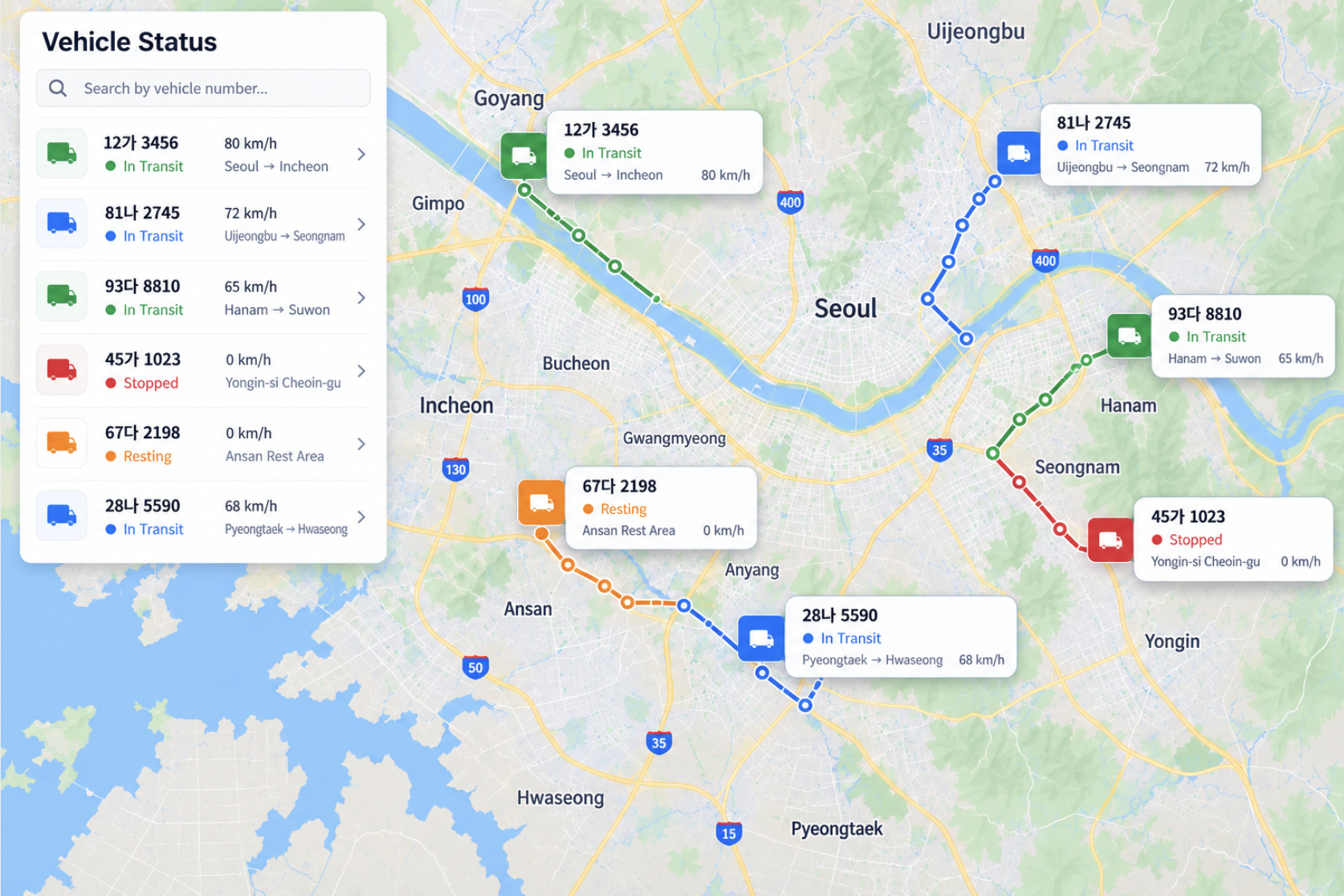
To summarize the conclusion, FMS can be divided into two types depending on “what it monitors”: location monitoring, which tracks a vehicle’s position and history, and safety monitoring, whichmonitors driving conditions both inside and outside the vehicle—including the driver’s condition, hazards ahead, and even blind spots. Which one is needed depends on the questionthe company wantsits monitoring system to answer—is it “Where is the vehicle?” or “Is the driving safe?” This article provides the criteria for making that determination.
What Is FMS? — Definition and Basic Components
An FMS (Fleet Management System) is a system that allows companies to monitor and manage the vehicles they own and operate from a single screen. Regardless of the specific type, all FMS systems consist of two parts.
- Vehicle Terminal — Hardware installed in vehicles to collect data. It typically includes a GPS receiver and a communication module; for safety monitoring, a camera and an AI chip are added.
- Control Platform — Software that aggregates data sent by the terminals and displays it as maps, lists, and reports. Administrators and dispatchers view this information via a web interface or app.
The similar term “telematics” is a broader term referring to vehicle communication technology in general, while FMS refers to a system that uses that technology to “manage a fleet” of vehicles. In practice, the two terms are used almost interchangeably.
In South Korea, adoption is rapidly increasing, particularly in the car rental, logistics, and transportation industries. The demand for monitoring systems stems from a structure where the number of vehicles requiring management is increasing while the number of staff remains constant—the labor shortage in the transportation industry discussed in previous articles.
One afternoon, holding two quotes
Manager Park from the management team at a logistics company. Responsible for managing a fleet of 80 vehicles, including those under contract, he was tasked with implementing an FMS. He received quotes from two vendors, but the two documents sitting on his desk were vastly different.
Company A offers a GPS-based system—vehicle locations and routes are displayed on a map, and with an optional DTG integration, the submission of driving logs is automated. Company B offers a system that includes AI cameras, providing not only location and log management but also detection of drowsiness and failure to look ahead, as well as driver-specific reports. The quoted prices differ by an order of magnitude.
“They both say it’s an FMS, but what’s the difference, and what do we actually need?”
The difference isn’t the price— it’s what they monitor. Company A monitors thevehicle’s location—including where it is and how it was driven. Company B goes a step further by monitoring everything inside and outside the vehicle— whether the driver is drowsy, if there are hazards ahead or in blind spots, and which drivers repeatedly face risks. Let’s examine these based on this distinction.
Two Types of Monitoring — Tracking Location vs. Monitoring Driving Conditions Inside and Outside the Vehicle
| Classification | Location Monitoring (Vehicle Location and Records) | Safety Monitoring (Operating conditions inside and outside the vehicle) |
|---|---|---|
| Data Handled by the Platform | GPS location + (when expanded) DTG trip records | + Dangerous driving and driver condition detected by cameras and AI |
| Additional Devices | GPS + Communication Module | + AI camera (front-facing/driver-facing) |
| Data Collected | Records location, route, driving status, speed, mileage, etc. | + Driver status (drowsiness, failure to watch the road, etc.), forward hazards (rear-end collisions, lane departure), blind spots |
| Questions It Can Answer | Where is the vehicle? Is it moving according to the dispatch schedule? Have the required records been processed? | + Are there any vehicles driving dangerously right now? Which drivers are repeatedly engaging in risky behavior? Is there evidence that safety management measures have been implemented? |
| Timing of Intervention | Post-event verification (aggregation and reporting) | Real-time (immediate driver warning upon risk detection) |
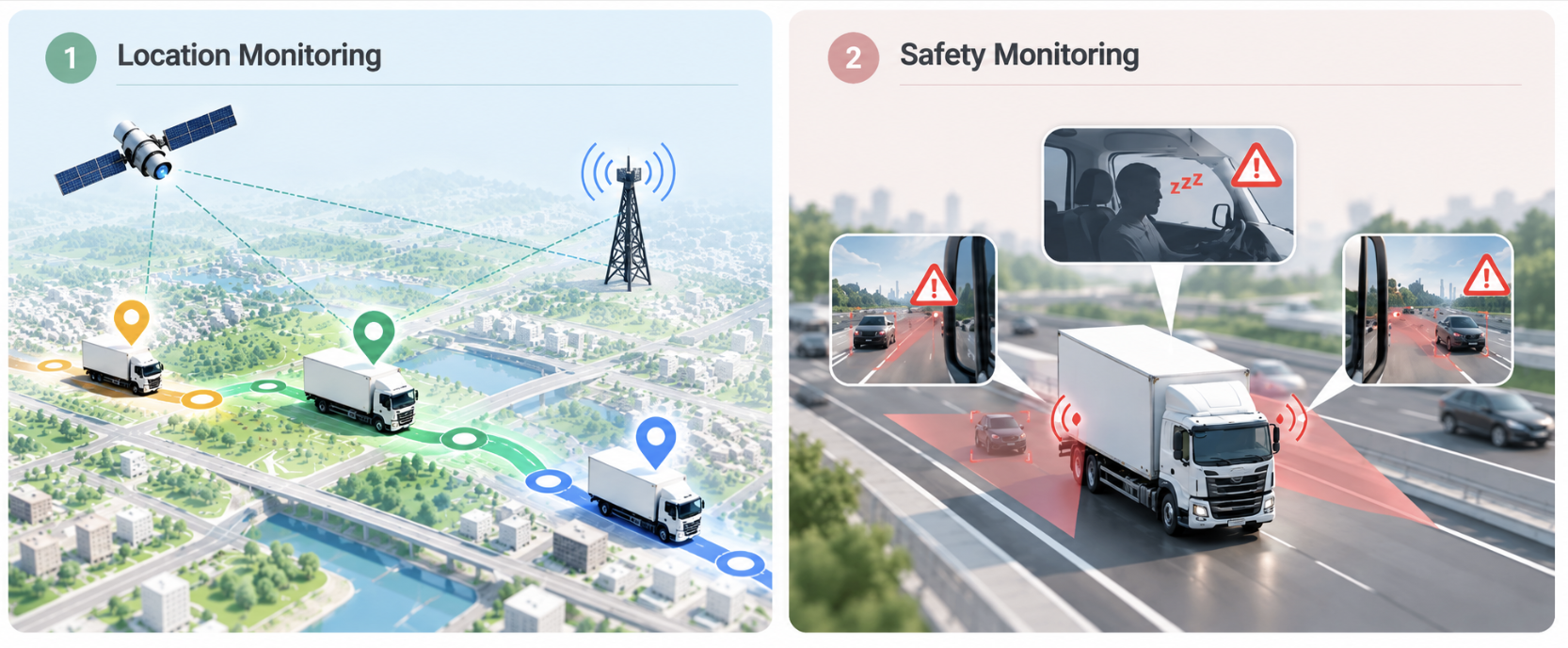
This classification corresponds to categories commonly used in the global market — Overseas, systems that monitor location and driving records are referred to as GPS tracking (GPS fleet tracking) and telematics, while those that use cameras to monitor inside and outside the vehicle are called video telematics;AI camera-based safety monitoring has established itself as a separate market category.
These two monitoring systems are not mutually exclusive but rather form a hierarchical relationship. Safety monitoring generally includes the functions of location monitoring, and conversely, it is often the case that organizations start with location monitoring and later find that safety monitoring becomes necessary. Therefore, the question to ask before implementation is not “Which system is better?” but “What questions do we need to answer through monitoring?”
The decisive difference lies in the limitations of location monitoring. While GPS and trip log data can detect speeding and sudden acceleration or deceleration, driver conditions—such as drowsiness and failure to watch the road ahead, which account for the largest proportion of accident causes—do not appear in vehicle data. This is because, in most cases of drowsy driving, speed and route remain normal right up until the moment of the accident. To assess the driver’s condition, sensor-based monitoring irected at the driver—that is, Driver Monitoring System (DMS) technologies—is required, and this is the core of safety monitoring.
Expanding Location Monitoring — What Does Integration with DTG Change?
There is a common misunderstanding here. Commercial vehicles are already equipped with Data Tachographs (DTGs)—because it is a legal requirement. However, in most cases, these DTGs operate as isolated devices that merely record data, and the data is manually extracted via USB only when it needs to be submitted. Even companies that use GPS location tracking often have systems that rely solely on GPS data and are not connected to the DTG mounted alongside them.
Integrating the DTG isn’t about installing a new device; it’s an expansion that connects the existing DTG to the monitoring platform, transforming “recording” into “management.” The moment the connection is established, two things change — The submission of driving logs (eTAS), which the person in charge used to handle manually each time, becomes automated, and the records that were simply piling up inside the vehicle are transformed into analytical data organized by driver and vehicle. This is why domestic location tracking products highlight DTG integration and logbook automation as their core features, and in fact, many companies begin considering the adoption of an FMS (Fleet Management System) precisely because of this need. The scope of DTG requirements and associated fines are outlined in the DTG Mandate Guide.
Where Do Domestic Transportation Companies Stand Now?
Applying this classification to the current domestic situation reveals the following: Most companies are at the location monitoring stage, while a significant number are at earlier stages. Although DTG devices have been installed across the board, many companies still submit data manually because they are not connected to a platform; even among those using monitoring systems, usage generally extends only to location and dispatching verification, with DTG automation not yet implemented. For city and route buses, local government Bus Information Systems (BIS) monitor location and scheduling; however, these are intended for passenger information and are not safety management tools for transport companies.
Safety monitoring—which examines both the interior and exterior of vehicles to prevent accidents—is still in its early stages of adoption. It is now beginning to spread as cases where effectiveness has been verified through actual measurements emerge, such as the Korea Transportation Safety Authority’s pilot project and commuter bus programs operated by large corporations. In other words, companies currently considering safety monitoring are among the industry leaders.
Assessing the Purpose — What Problem Led to the Search for Monitoring?
Applying the purpose of implementation to the two monitoring systems simplifies the choice.
If the goal is vehicle management → Location tracking
“I want to see the vehicle status at a glance” — If your goals are tracking vehicle locations, confirming schedules, and managing idle vehicles, basic location monitoring is sufficient.
“I want to automate DTG and eTAS submissions” — If submitting driving records is a burden, a location tracking system that includes DTG integration is the right choice. You should verify whether the system is compatible with the DTG for your vehicle model, whether it automatically handles the process from data collection to eTAS submission, and whether it goes beyond simply collecting data for submission to also provide driver-specific trip analysis.
In either case, it’s best to verify scalability—costs in two to three years will vary depending on whether the system requires replacing the entire device if safety requirements arise after implementation, or whether it allows for the addition of new features.
If safety is the goal → Safety Monitoring
“We need to reduce accidents and demonstrate compliance” —If your company is concerned about accident and insurance costs, or needs to document safety management compliance to meet the Serious Accidents Punishment Act, safety monitoring is the right choice. At this stage, monitoring includes all the “visual tools” provided by location tracking, plus two additional features.
- Real-time Intervention — The moment a risk is detected, a warning is sent to the driver, and managers can review the event. This is intervention before an accident occurs, not just post-incident analysis.
- Aggregation and Documentation — Detected events are aggregated by driver to generate a safe driving score and reports, and the entire “detection–warning–action” process is logged. This record serves as the “evidence of routine compliance” required under the Serious Accidents Punishment Act.
Evidence of the system’s effectiveness also emerges at this stage. In a pilot project by the Korea Transportation Safety Authority (involving 13 transportation companies, 500 buses, 1,615 drivers, and a 1,000-km driving distance), the introduction of real-time detection and warnings resulted in a 99.7% reduction in drowsy driving, and traffic signal violations by 87.6%. Additionally, an analysis of 1,077 commuter buses operated by major domestic corporations showed a 68% year-over-year decrease in insurance payouts (from 2.165 billion to 692 million won).
6 Things to Check on the Pre-Implementation Checklist
Items to verify during the quote comparison stage.
- First, define the questions you need to answer —is it about the vehicle (location, records) or the driver (safety, evidence)? This answer determines the type of monitoring system, and the type determines the budget range. Comparing quotes comes next.
- Relationship with existing devices — Does it integrate with already installed DTGs or black boxes, or does it require additional terminals? The more terminals there are, the higher the installation and maintenance costs, and the more potential points of failure.
- Data Ownership and Transfer — Can you download the monitoring data (trip records, event history) when the contract ends? You should avoid a system where years’ worth of safety management records are lost when switching providers.
- Application to leased and subcontracted vehicles — Does the system work only for company-owned vehicles, or are there contractual and operational arrangements that allow it to be applied to vehicles operated by leased drivers as well? The effectiveness of an FMS for the transportation industry usually hinges on this point.
- Quality of Alerts — Does the system flood users with every single event, or does it filter alerts based on risk level? If there are too many alerts, monitoring staff become desensitized and may miss critical warnings.
- Whether reports are practical for day-to-day operations — Check sample reports to ensure they aren’t just a list of raw data, but rather provide trends by driver or route, help identify candidates for training, and can be used directly as material for semi-annual inspections.
Summary
| Questions | Answer |
|---|---|
| What is FMS? | A system that allows you to manage your fleet on a single screen using vehicle terminals and a monitoring platform |
| Why Do Quotes Vary? | The difference between “location monitoring,” which tracks vehicle locations, and “safety monitoring,” which monitors both in-vehicle and external operating conditions—both under the same name |
| What is DTG integration? | An extension of location monitoring that connects pre-installed DTGs to the platform, enabling automated data submission and operational analysis |
| How to Choose | Start by defining the “questions that monitoring must answer”—if it’s about dispatch efficiency and automated record-keeping, it’s location monitoring; if it’s not just location monitoring but also accident reduction and evidence collection, it’s safety monitoring |
| The Crucial Difference | Location monitoring only tracks vehicle data, so it cannot detect driver conditions such as drowsiness or failure to watch the road ahead, nor can it identify blind spot hazards—this falls under the domain of safety monitoring |
A.I.MATICS’ aid platform falls under the category of safety management described above — It includes real-time location monitoring and DTG/eTAS automation, while also featuring a system where managers review hazardous events detected by the vehicle’s AI camera and track them through driver-specific reports and scoring. Its effectiveness has been verified through the industrial complex pilot project mentioned above and actual measurements on commuter buses.
Get a consultation on a monitoring configuration tailored to your company’s operations
We’ll guide you on which configuration is best suited to your company’s fleet size, vehicle types, and regulatory requirements.
Frequently Asked Questions (FAQ)
Q. What is a Fleet Management System (FMS)?
A. It is a system that collects location, operation, and status data from vehicles operated by a company via in-vehicle terminals, allowing you to view and manage this information at a glance through a monitoring platform (web or app). The basic version provides GPS location tracking; when integrated with a Data Tachograph (DTG), it automates record management and submission; and when combined with cameras and AI, its capabilities expand to include detection of dangerous driving and driver condition. Depending on the configuration, even within the same “FMS” category, functions and costs can vary significantly.
Q. Are GPS vehicle tracking and FMS different?
A. GPS vehicle tracking is the most basic form of FMS. It can determine where a vehicle is and whether it is moving according to the dispatch schedule, but it cannot handle mandatory driving log requirements or detect dangerous driving. Since systems that incorporate DTG integration or AI detection are also collectively referred to as FMS, when comparing them, you should focus on “what the configuration actually monitors” rather than just the name.
Q. Can FMS detect drowsy driving?
A. It’s difficult with a GPS- or DTG-based system. This is because drowsy driving often involves normal speed and route patterns right up until the moment of an accident, so it doesn’t show up in vehicle data. Driver conditions such as drowsiness or failure to look ahead are detected by safety monitoring systems equipped with AI cameras focused on the driver (Driver Monitoring System, DMS). A pilot project by the Korea Transportation Safety Authority confirmed a 99.7% reduction in drowsy driving using this method.
Q. If a vehicle already has a DTG installed, is a separate FMS necessary?
A. A DTG is a device that “records” driving data, while an FMS is a system that collects and “manages” that data. If only a DTG is installed, the person in charge must manually extract and submit the records; however, when the DTG is linked to a monitoring platform, data collection and submission (eTAS) are automated, and data organized by driver and vehicle can be viewed on the management screen. Compatibility with existing DTGs must be verified before implementation.
Q. Is a bus monitoring system the same as an FMS?
A. It is the same concept, but the name varies depending on the vehicle type. However, because buses have specific requirements—such as route and scheduling management and passenger safety—configurations that include driver status monitoring and passenger-related features (such as warnings of the risk of a passenger collapsing) in addition to location tracking are often considered. Conversely, for freight, the application to contract vehicles and blind spot detection are the main points of consideration.
Q. How are the costs for implementing an FMS structured?
A. Generally, it consists of the vehicle terminal cost (purchase or lease) and a monthly service fee (for communication and the platform), and the total varies significantly depending on the configuration. GPS location tracking starts at a few thousand won per vehicle per month, while safety monitoring that includes AI cameras costs more, depending on the terminal and feature configuration. One aspect often overlooked in cost comparisons is the total cost perspective—costs over several years can vary depending on whether features can be expanded without replacing the device and whether data migration is possible. Furthermore, to make an accurate comparison, safety monitoring costs must be calculated in conjunction with the reduction in accident and insurance costs.
The statistics in this article are based on the results of an analysis of data from the Korea Transportation Safety Authority’s pilot project and the Korea Chartered Bus Mutual Aid Association’s accident statistics. Since the scope and deadlines for the mandatory submission of DTG and trip record data vary by vehicle type and industry, please refer to a separate article for details.
Recommended Reading
- Comprehensive Guide to Mandatory DTG Tachographs — Installation, Submission, and Fines — Detailed Guidance on Legal Obligations: Eligible Vehicles and Submission Requirements
- What Does Driver Monitoring AI Detect and How? — The Principles of Facial Recognition, Eye Tracking, and Behavioral Analysis — The Technical Principles of Safety Monitoring: How Detection Actually Works
- New Sentencing Guidelines Under the Serious Accidents Punishment Act: What Should the Transportation Industry Prepare? — Three Stages of the Safety Management System — The Context in Which Monitoring Records Serve as “Evidence”

