

There’s a routine task that repeats at the end of every month. I go around the garage, export the driving records from the DTG to a USB drive for each vehicle, return to the office, log in to eTAS, upload the files one by one, and go back to re-export the records for any vehicles that had errors. If there are 10 vehicles, this takes half a day; if there are 50, it takes several days. And when the next month rolls around, the whole process starts over from the beginning.
This article covers two main topics. First, the exact procedure for submitting to eTAS and what to check when a submission fails —information designed to reduce trial and error if you’re currently doing this manually. Second, three ways to automate this repetitive process —methods for moving beyond manual submissions.
If you’re wondering why submission is mandatory or whether your vehicle is subject to the requirement, check out our comprehensive guideto the mandatory DTG tachograph systemfor details on eligible vehicles and fines (including the maximum penalty). The criteria for large freight vehicles (cargo trucks with a payload of 25 metric tons or more, and towed special-purpose vehicles with a gross vehicle weight of 10 metric tons or more), for which monthly submissionshave been mandatory since October 2024, are summarized in the “Guide to Monthly DTG Submissions for Large Freight Vehicles.” This article begins with the question, “So, how do I submit the data?”
What is eTAS? — Where the Data Is Collected
eTAS (Driving Record Analysis System, etas.kotsa.or.kr) is a system operated by the Korea Transportation Safety Authority (KOTSA) and serves as the final destination where DTG driving records from commercial vehicles are collected. It is the transportation company’s obligation to ensure that the vehicle’s DTG generates “records” and that those records are “submitted” to eTAS. The submitted data is used by the Korea Transportation Safety Authority for driving analysis (such as speeding and sudden acceleration/deceleration) and serves as the basis for traffic safety inspections and subsidy programs.
There are two prerequisites for submission: registering as an eTAS member (for the transportation company) and pre-registering vehicle license plate numbers— a step thatoften trips up many administrators at first. We’ll cover this again below.
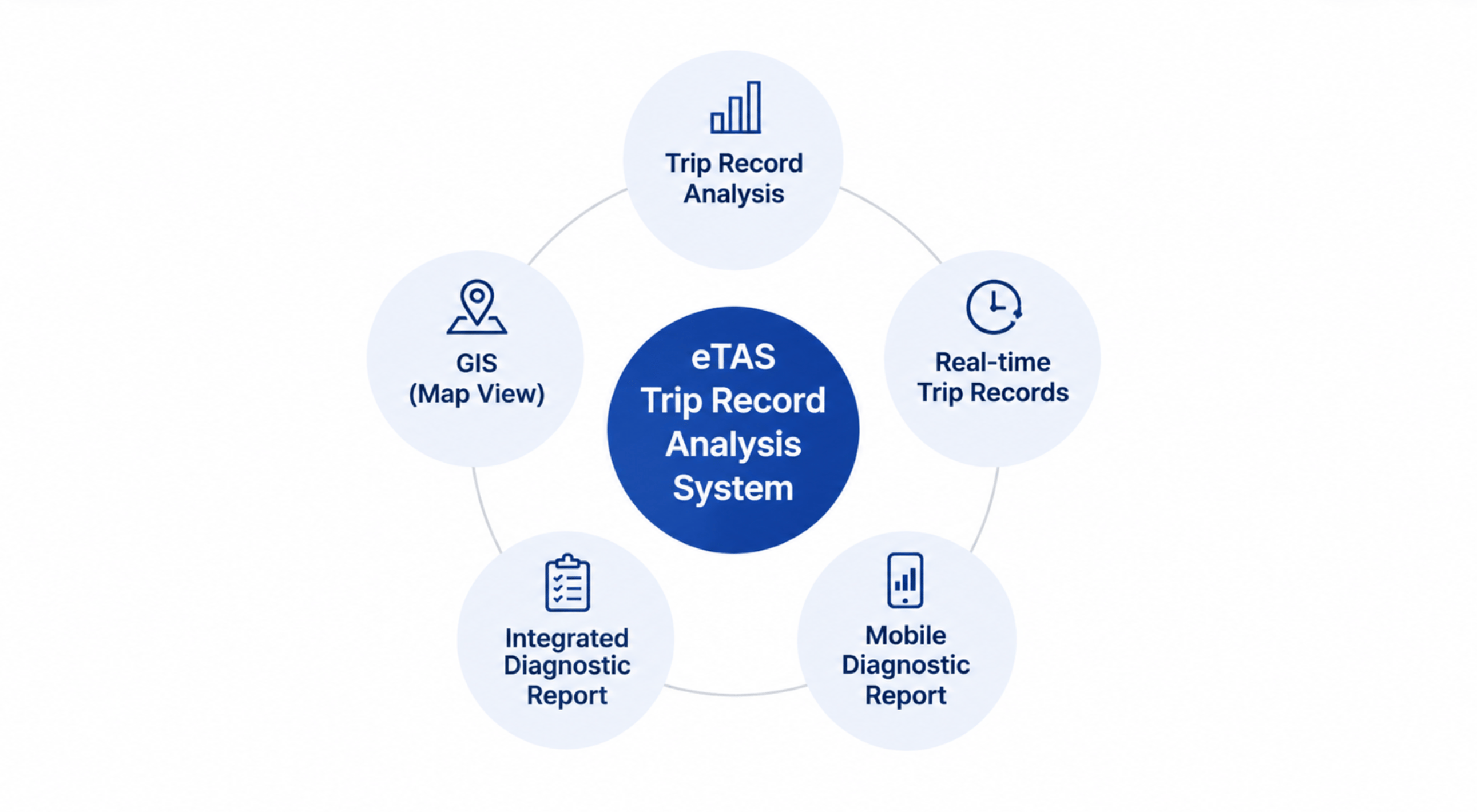
Three Methods of Manual Submission — Step-by-Step Procedures
There are three official channels for submitting driving records to eTAS.
| Method | Procedure | Applicable Cases |
|---|---|---|
| ① Web Upload | Extract data from the DTG to a USB drive → Log in to the eTAS website → Upload the file via the “Submit Trip Records” menu | For cases with a small number of vehicles and infrequent submissions |
| ② Dedicated Program (ETASSetup) | Log in to eTAS → Install ETASSetup from the Software Library → Add files in the program and transfer them in bulk | Regular submissions involving multiple files at once |
| ③ Mobile app (eTAS Trip Data Submission) | Log in to the app → Select the trip record file from a USB storage device → Transfer → Check the results | If you want to submit directly from the field |
Regardless of the method, the first step isalways extracting the data from the vehicle—a physical process involving plugging a USB drive into the DTG unit, which accounts for most of the time required for manual submission. This step is particularly difficult if vehicles are scattered across different locations or are leased vehicles.
Must verify before submission — Pre-register the vehicle number
According to the Corporation’s FAQ, this is the most common reason for submission failure. If a vehicle number is not registered in eTAS at least once, the submission will be rejected with the error message: “This is not a vehicle belonging to the logged-in transportation company.”You must first register your owned vehicles under “Basic Information Management → Vehicle Number Management”in the “Transportation Company” menu, and you must update this list whenever you acquire a new vehicle or a leased vehicle changes. New staff members often get stuck here because they did not receive a proper handover from their predecessor.
When Submission Fails — 5 Steps to Troubleshoot
If the upload fails or the analysis does not proceed, check the following items in order.
- Vehicle Registration Status — Has the vehicle been pre-registered as described above? (Most common cause)
- File Format — Is it in the original format extracted from DTG? (Formatting may be corrupted during compression or renaming)
- Business and Driver Information — Do the records match the business and driver information registered in eTAS?
- Recording Period — Does the file actually contain records for the period you are trying to submit? (Gaps may occur due to DTG malfunctions or power issues)
- Analysis Status — Since eTAS does not allow the same file to be uploaded again while analysis is in progress, wait for the analysis to complete after submitting a large file before retrying
If these five steps do not resolve the issue, it is quickest to contact the Korea Transportation Safety Authority’s eTAS Customer Support. The key is not to wait until the submission deadline is imminent to make your first attempt —resolving errors can take several days, and missing the deadline will result in fines.
The True Cost of Manual Submissions — Factors Beyond Time
If you view the problems with manual submission as merely a “hassle,” they may seem minor. The actual risks are threefold.
- Time Cost — Time spent extracting, transporting, and uploading data per vehicle × number of vehicles × number of months. This cost has increased since the mandatory monthly submission requirement for heavy-duty trucks took effect.
- The Cost of Oversights — Omissions are structurally inherent in manual processes. The risk of omissions arises whenever employees take leave, leave the company, or vehicles are replaced, and failure to submit data results in fines.
- Reliance on a single person — If the methods for data extraction, license plate number management, and error handling exist solely in one person’s mind, the entire submission system grinds to a halt the moment that person is absent. From the perspective of the “Compliance Review of Relevant Laws and Regulations” (conducted once per half-year), as discussed in theprevious four posts, compliance that relies on individuals becomes a source of uncertainty during every review.
Three Paths to Automation
There are currently three ways to move away from manual submission.
| Path | Method | Features |
|---|---|---|
| ① Submission Agency Service | DTG manufacturers and agencies handle record collection and submission on your behalf | Easy to implement; per-transaction or monthly flat-rate fees. Quality varies depending on the collection method (on-site/remote) |
| ② DTG-Integrated Monitoring (FMS) | Vehicle terminals automatically collect driving records via communication → The platform handles everything up to eTAS submission | USB data extraction is eliminated. Goes beyond submission to include driver-specific trip analysis — as described in the FMS article, “From Records to Management” |
| ③ Next-Generation Connected DTG | A system that generates driving records from data collected in real time from vehicles and automatically submits them to eTAS — Currently being developed by Hyundai Motor and the Ministry of Land, Infrastructure and Transport | A long-term strategy focused on new vehicles. Not an immediate solution for existing fleets |
The decision criteria are simple. For companies with few vehicles that only need to resolve the submission issue, Option ① is sufficient; for companies with many vehicles, a mix of company-owned and contract-leased vehicles, or those that require safety management anyway,Option ② is the right choice — In Option ②, submission automation is an additional feature because the same data is reused for driver-specific risky driving analysis and safety management records. Option ③ is not currently a viable option but rather a direction that “will be addressed starting with new vehicles in a few years,” so the plan is to fill the gap until then with Options ① and ②.
A.I.MATICS’ aid platform corresponds to Option ②. — It includes the automatic collection of DTG data and the automation of eTAS submissions, with a structure where that data is used for driver-specific safe driving analysis and records of responses to serious accidents. The biggest difference compared to manual processes is that there is no need to create separate “submission data” and “safety management data.”

Summary
| Question | Answer |
|---|---|
| Submission methods include | Web upload / Dedicated program (ETASSetup) / Mobile app — All three follow the same initial step of extracting data from the DTG via USB |
| If submission fails | Check in the following order: Vehicle number pre-registration (most common cause) → File format → Business operator/driver information → Recording period → Analysis progress status |
| Risks of manual submission | Time and cost + omissions (fines) + reliance on staff — all of which have increased since monthly submissions became mandatory |
| Automation Options | Submission Agency (Simple) / DTG-Integrated Monitoring (Submission + Analysis, including leased vehicles) / Connected DTG (Long-Term Direction) |
| Selection Criteria | Just submission → Agency / Including safety management → DTG-linked monitoring |
Get a consultation on automating trip log submissions
Based on the number of vehicles, vehicle types, and whether they are leased, we’ll guide you through the submission automation configuration that best suits your company.
Recommended Reading
- Comprehensive Guide to Mandatory DTG Tachographs — Vehicles Subject to Installation, eTAS Submission Requirements, Penalty Standards — Why Submission Is Mandatory: Scope, Retention, Penalties
- Monthly DTG Submission Guide for Large Freight Trucks — Cargo Trucks Over 25 Metric Tons and Special-Purpose Vehicles Over 10 Metric Tons — Criteria for Vehicles Subject to Monthly Submission Starting October 2024
- What Is a Vehicle Monitoring System (FMS)? — What Is the Difference Between Location Monitoring and Safety Monitoring? — How Integrating with DTG Transforms “Recording” into “Management”
Frequently Asked Questions (FAQ)
Q. How do I submit driving records via eTAS?
A. There are three methods: ① Log in to the eTAS website (etas.kotsa.or.kr) and upload the file via the “Submit Trip Record Data” menu; ② Install the dedicated program (ETASSetup) from the software library to upload multiple files in bulk; or ③ Use the mobile app (“eTAS Trip Record Submission”) to transfer files from a USB storage device. Regardless of the method, you must first extract the records from the vehicle’s DTG to a USB drive, and you must be a registered eTAS member with your vehicle registration number pre-registered.
Q. Why can’t I upload data to eTAS?
A. The most common cause is an unregistered vehicle number—if you do not register the vehicle once in the “Vehicle Number Management” section of “Basic Information Management,” the submission will be rejected with the error message “This is not a vehicle belonging to the logged-in transportation company.” Other potential causes include corrupted file formats, discrepancies in business or driver information, gaps in the recording period, and cases where a previous submission is currently being analyzed (re-uploads are not permitted while analysis is in progress). Please check these in order.
Q. How often do I need to submit driving records?
A. It depends on the vehicle type and industry. Starting in October 2024, monthly submission has become mandatory for large cargo vehicles with a payload capacity of 25 metric tons or more and towed special-purpose vehicles with a gross vehicle weight of 10 metric tons or more. for other commercial vehicles, the submission frequency and retention requirement (6 months) vary by vehicle type, so it is best to check the comprehensive guide on mandatory DTG or the eTAS announcements for accurate information. The general rule is to avoid submitting at the last minute—since resolving errors can take time.
Q. What happens if I don’t submit my driving records?
A. Violations of obligations related to the driving recorder are subject to fines, and repeated failure to submit or retain records will result in a negative assessment during administrative inspections. Under the manual submission system, omissions are structurally prone to occur due to the absence of the person in charge or when vehicles are replaced; therefore, if you have a large fleet, considering the automation of submissions is also a way to manage the risk of fines.
Q. Is there a way to automate eTAS submissions?
A. There are three options. A submission agency service is easy to implement but only handles the submission itself; DTG-integrated vehicle management systems (FMS) automatically collect trip records via communication and process them all the way through eTAS submission, eliminating the need for USB extraction altogether and enabling driver-specific trip analysis using the same data. Next-generation connected DTGs (real-time automatic submission) represent a long-term direction being pursued by the government and manufacturers, so they are not an immediate alternative for existing vehicles. If you have a large fleet or a mix of company-owned and leased vehicles, the second option is the most practical.
Q. Will staff members have nothing to do if we use automatic submission?
A. While repetitive tasks such as extraction and uploading will disappear, the role of verification remains—this includes updating the registry for new or replaced vehicles, verifying submission results and identifying missing vehicles, and utilizing the accumulated trip data for safety management (such as monitoring risky driving by individual drivers and maintaining semi-annual inspection records). The value of automation lies not in eliminating staff, but in shifting the nature of their work from simple, repetitive tasks to management and analysis.
The submission procedure described in this article is based on the Korea Transportation Safety Authority’s (KTSA) public guidelines and FAQs for eTAS (Operational Record Analysis System); screen layouts and specific procedures are subject to change due to system updates. Submission frequencies, requirements, and penalties vary by vehicle type and industry, so please refer to KTSA announcements or related articles for details.

