
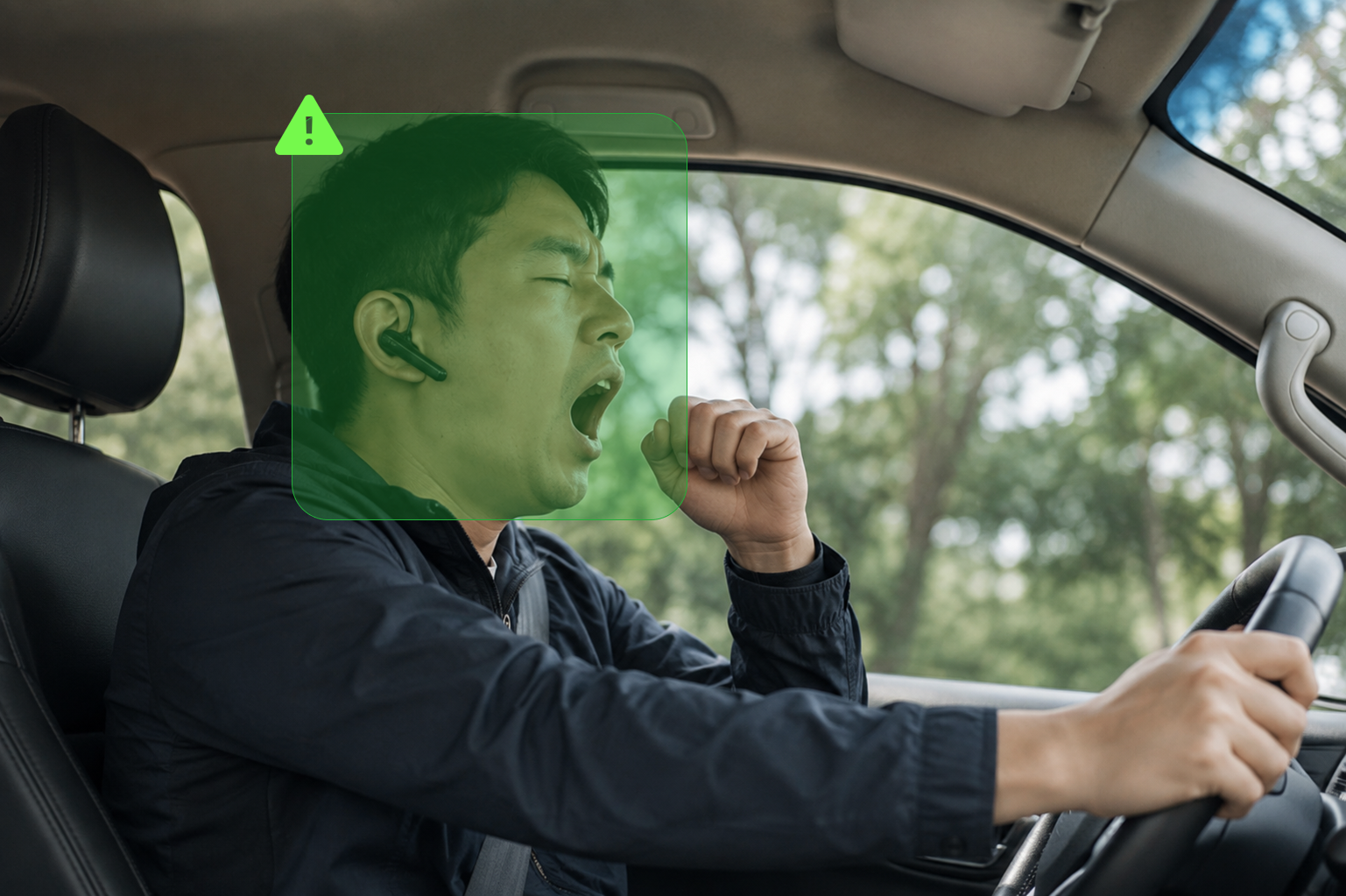
There is a common misconception about drowsy driving.
"Since drowsy driving isn't one of the 12 major traffic offenses, the insurance will cover it even if I get into an accident."
That’s only half true. Drowsy driving itself isn’t one of the 12 major traffic offenses. However, the actual penalties aren’t that simple. There are penalties even without an accident; if you doze off and run a red light, that instantly becomes one of the 12 major traffic violations. In the event of a fatal accident, neither insurance nor a settlement will help, and if it involves a commercial vehicle, liability can extend all the way up to the company’s CEO.
This article breaks down, step by step, how penalties for drowsy driving escalate. If you’re a transportation company that employs drivers, you must read all the way to the end.
First, let’s look at why this is treated so severely. According to traffic accident statistics from the Korea Road Traffic Authority (2021–2023), the fatality rate for drowsy driving accidents is 2.7 deaths per 100 accidents— roughly twice the average for all traffic accidents (1.4 deaths). According to the Korea Expressway Corporation, drowsy drivingwas the overwhelming leading cause of death in highway traffic accidents over the past three years, accounting for 71.5% offatalities. This is because when drivers fall asleep, they fail to recognize dangers and collide without braking.
Step 1 — You Can Be Penalized Even Without an Accident
Surprisingly, many people are unaware of this fact. Drowsy driving is a violation of the law in and of itself, even if no accident occurs.
Article 45 of the Road Traffic Act stipulates, “No person shall drive a motor vehicle while in a condition where there is a risk of being unable to drive normally due to overwork, illness, the influence of drugs, or any other reason.” Driving while fatigued—the cause of drowsy driving—falls under this provision.
Violating this provision may result in a fine of up to 300,000 won or detention, pursuant to Article 154 of the same law. While the amount may not seem significant, the key point is that “it is illegal regardless of whether an accident occurs.” If the vehicle is for commercial use, this fact ties into the company’s duty of care—we’ll revisit this later.
Step 2 — If an Accident Occurs: Imprisonment for Up to 5 Years
If you injure someone while driving drowsy, the Special Act on the Handling of Traffic Accidents applies. The penalty is imprisonment for up to 5 years or a fine of up to 20 million won.
However, there is an exception here. For accidents involving general negligence—not falling under the 12 categories of gross negligence—you may avoid criminal punishment if you have comprehensive insurance or reach a settlement with the victim. Since drowsy driving itself is not included in the list of the 12 categories of gross negligence, there is a possibility that this exception could apply if the accident results in injury.
“So, doesn’t this just get settled by insurance after all?” — This is where the plot twists.
Step 3 — Drowsiness Never Comes Alone: The Shift to One of the 12 Major Negligence Categories
If we look at the reality of drowsy driving accidents, drowsiness brings other violations along with it.
A drowsy driver fails to recognize traffic signals and cannot stay in their lane. As a result, drowsy driving accidents are actually recorded as follows:
- Dozing off and running a red light, resulting in a collision → Traffic light violation (one of the 12 major traffic violations)
- Dozing off and crossing the center line, resulting in a collision with an oncoming vehicle → Center line violation (one of the 12 major traffic violations)
- Exceeding the speed limit by a large margin while drowsy → Speeding accident (one of the 12 major gross negligence offenses)
Although the cause of the accident is drowsiness, the legal assessment is based on the resulting actions. This is why the claim that drowsy driving is not one of the “12 Major Forms of Gross Negligence” is only half true. A significant number of drowsy driving accidents ultimately result in gross negligence, and at that moment, neither comprehensive insurance nor a settlement can prevent criminal punishment.
Furthermore, if the consequences are severe, the special exemption itself no longer applies. If serious consequences occur—such as a fatality—the drivermay face criminal penalties regardless of whether they have insurance. Given that the fatality rate for drowsy driving is twice that of ordinary accidents, this possibility is not insignificant.
Step 4 — If it’s a commercial vehicle: Liability shifts to the company
Up to this point, we’ve discussed penalties for the individual driver. For commercial vehicles, there’s an additional step.
If a driver dies — the Act on the Punishment of Serious Industrial Accidents
This is a perspective that is easy to overlook. In a transportation company , a driver is considered an “employee.” If a driver dies while on the job due to drowsy driving, it may be examined not merely as a traffic accident but as the death of an employee—that is, a serious industrial accident.
In such cases, an investigation is conducted to determine whether the company fulfilled its obligations regarding the worker’s overtime management, health care, and safety. If a breach of these obligations is confirmed, management officials may face criminal penalties. The structure of how the Act on the Punishment of Serious Accidents applies to the transportation industry is detailed in “The Act on the Punishment of Serious Accidents: Freight Transport Operators Are Also Subject to the Act.”
The Company’s Duty of Care — “I Didn’t Know” Is Not an Acceptable Defense
As seen in Step 1, driving while overworked is illegal in and of itself. Therefore, if a company continued to dispatch drivers without monitoring their continuous driving and rest periods, compliance with safety management obligationswill also be assessed in the event of an accident.
- Did the company track each driver’s continuous driving time?
- Are there records showing that measures were taken when warning signs of drowsiness appeared?
- Were rest periods actually guaranteed?
Companies that can provide documented answers to these questions and those that cannot find themselves in completely different positions regarding the same accident.
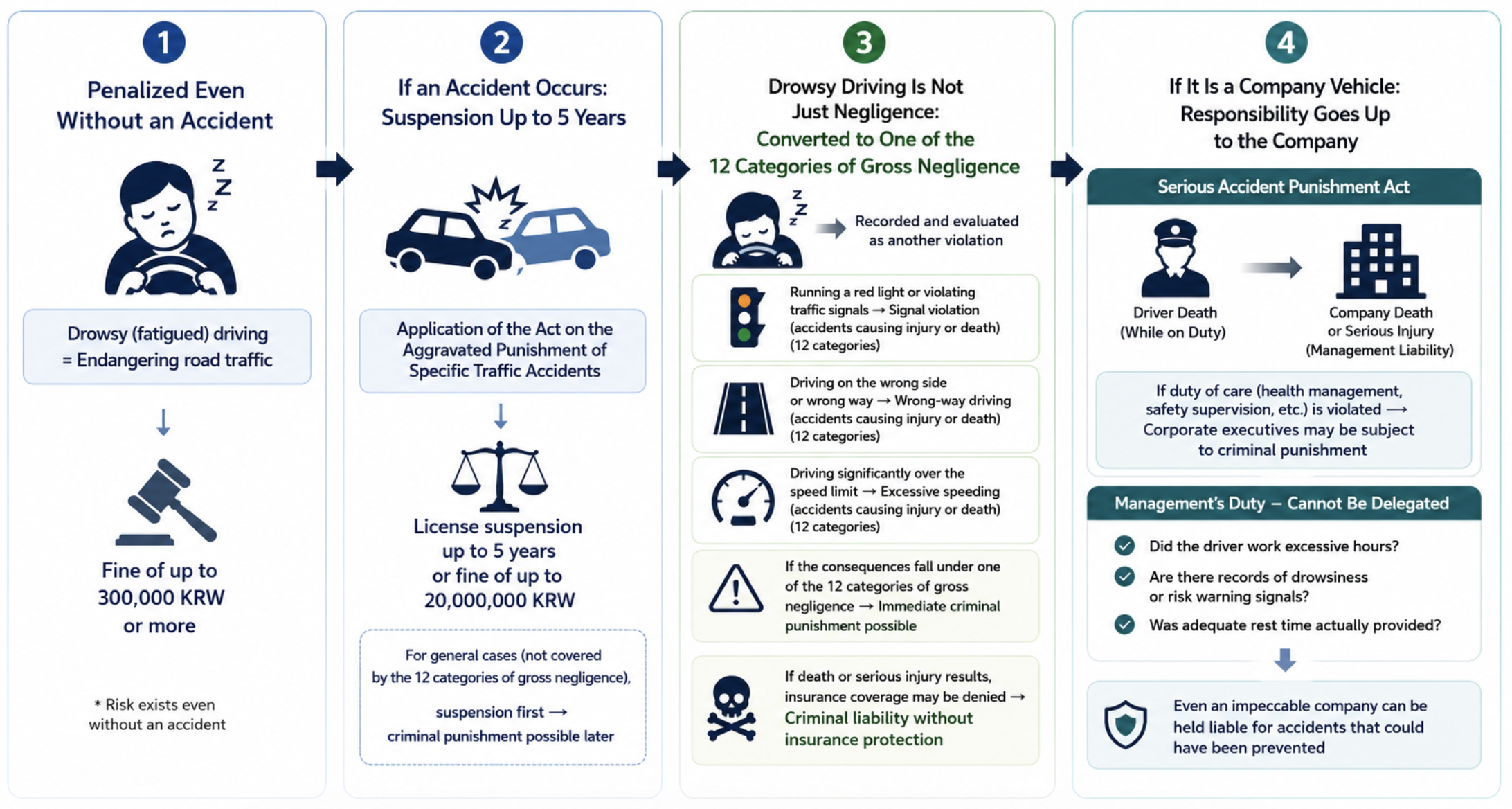
Penalties for Drowsy Driving: A Quick Overview
| Level | Situation | Penalty | Exempt Through Insurance or Settlement? |
|---|---|---|---|
| 1 | Drowsy (overworked) driving itself | Fine of up to 300,000 won or detention (Articles 45 and 154 of the Road Traffic Act) | — |
| 2 | Accident resulting in injury (general negligence) | Imprisonment for up to 5 years or a fine of up to 20 million won (Special Act on Traffic Accidents) | Possible (Special Provisions) |
| 3 | Running a red light or crossing the center line while drowsy, etc. | Accidents involving any of the 12 types of gross negligence — Same penalties as above | Not applicable |
| 3+ | Serious consequences, such as death | Criminal penalties (regardless of insurance) | Not applicable |
| 4 | In the event of the death of a commercial vehicle driver | Serious Accidents Punishment Act — Consideration of criminal penalties for management officials | Not applicable |
Penalties become more severe as the stage increases, and with the exception of Stage 2, insurance does not provide coverage.
A Question That Precedes Punishment — When Can You Tell You’re Drowsy?
There isonly one way to avoid reaching this stage: recognizing drowsiness before it leads to an accident.
The problem lies in the nature of drowsiness. Drivers often fail to realize they are drowsy, and supervisors cannot observe the condition of drivers while they are on the road. That is why drowsiness has long been considered an “unmanageable risk.”
AIMATICS’ AI safe driving solutionaddresses this risk on two levels.
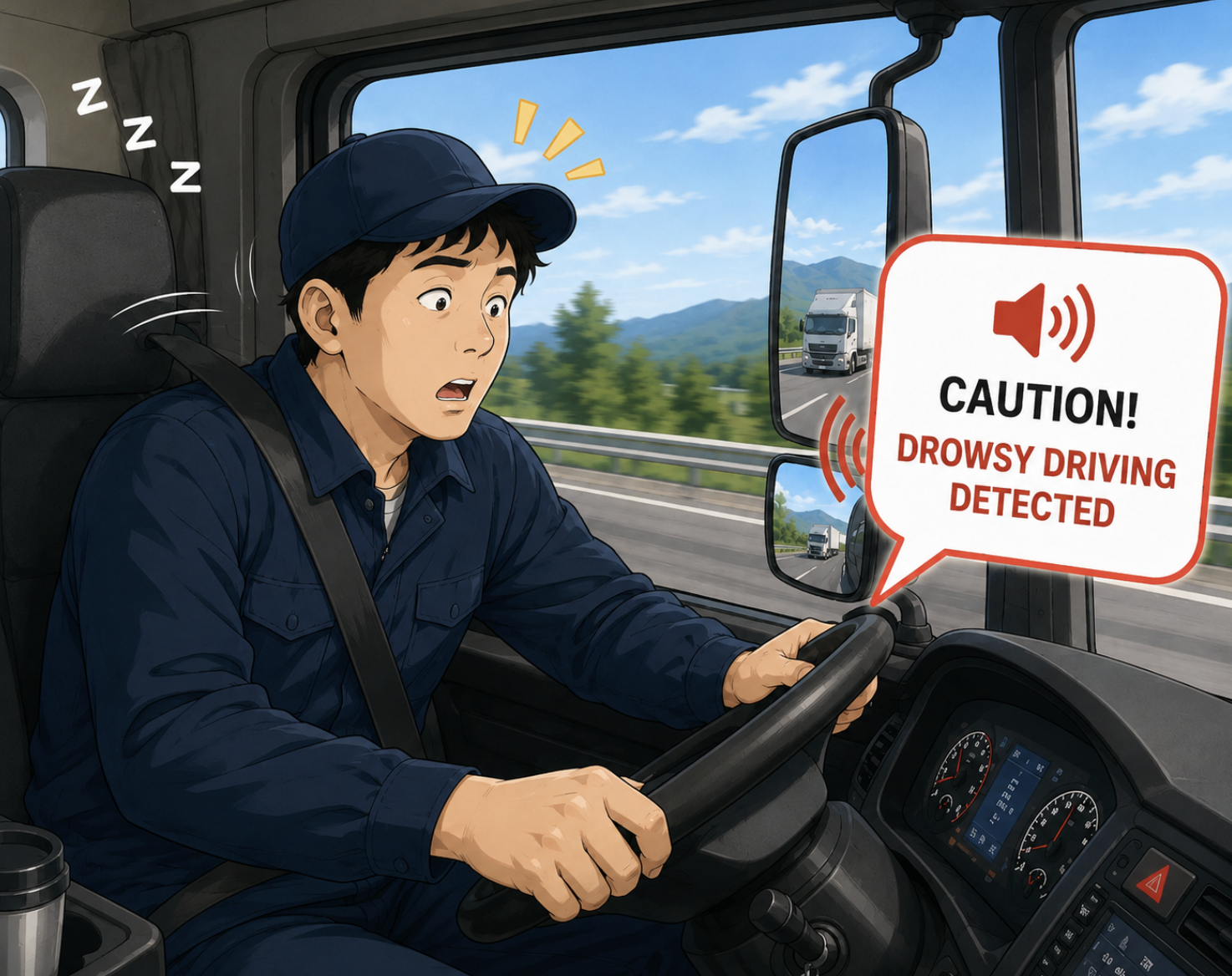
Inside the vehicle, the AI device Roadscope is in operation. An AI camera facing the driver’s seat monitors the driver’s face and eye movements in real time. If it detects signs of drowsiness—such as closed eyes or a drooping head— it immediately sounds a voice alert to wake the driver. Even without anyone watching, intervention occurs inside the vehicle the moment a risk arises.
Back at the office, the monitoring platform is in operation. As detected risk events are logged as data, the company gains insight into which routes, time periods, and work patterns carry a higher risk of drowsiness. Based on these findings, the company can take action — such asadjusting overly demanding schedules, ensuring that rest breaks are actually taken, and offering a helping hand—through schedule adjustments and training—rather than reprimands to drivers facing recurring risks.
From the driver’s perspective, this data is not surveillance but protection. Only when drowsiness risks are revealed through data does the company have grounds to demand improvements in rest periods and scheduling; and in the event of an accident, the driver’s regular record of safe driving proves their diligence. For the company, all these records provide the answer to the questionwe considered earlier : “Did the company identify the issue and take action?”
Inside the Car — A Warning the Moment Drowsiness Sets In
AIMATICS’ AI camera, Roadscope, detects a driver’s condition in real time while driving. The momentdrowsiness signals—such as closing eyes or nodding off—appear, a voice alertsounds, prompting the driver to recognize their condition. Dangerous behaviors that accompany drowsiness, such as failing to watch the road ahead or using a cell phone, are detected and warned against in the same way.
Its effectiveness has been verified through a public pilot program. In a pilot project conducted by the Korea Transportation Safety Authority on route buses (involving 13 transportation companies, 500 buses, 1,615 drivers, and a total operating distance of 1,000 km), drowsy driving incidents decreased by 99.7%(from 1.54 instances to 0.005 instances) using this method. Traffic signal violations—the “violations caused by drowsiness” mentioned in Stage 3—also decreased by 87.6%.
A.I.MATICS Roadscope 10 Series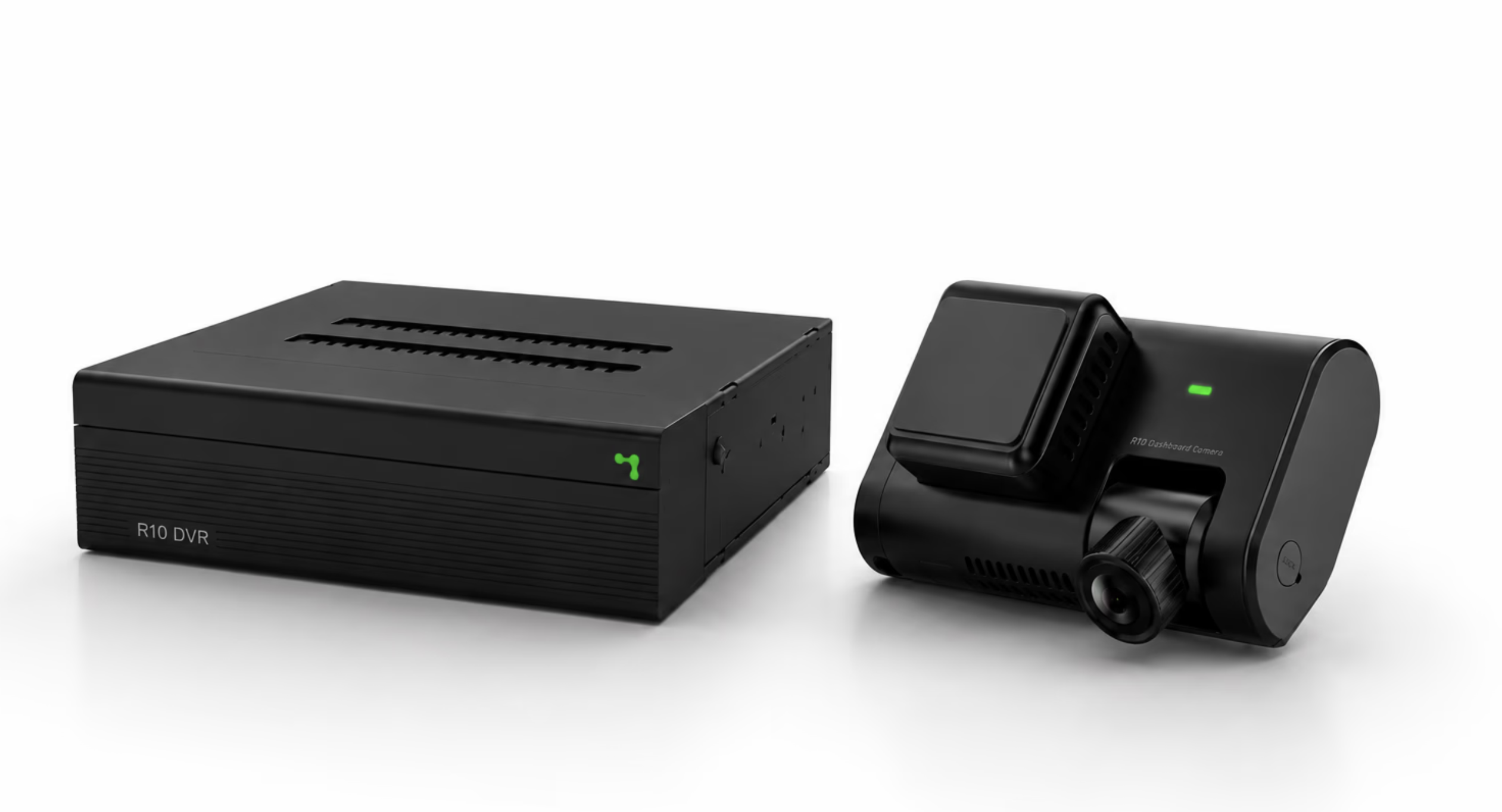
From the office — The answer to “Was the company aware?”
Detected events are transmitted to A.I.MATICS’ aid platform and aggregated by driver and by vehicle. This provides answers to the questions regarding the company’s management responsibilities discussed in Stage 4.
- Were continuous driving times tracked by driver? → Continuous driving data is automatically aggregated, serving as the basis for dispatch and rest break management
- Did the company take action in response to drowsiness warning signals? → Drivers who repeatedly receive drowsiness warnings are identified, enabling schedule adjustments and individualized training
- Are these records retained? → The history of detection, warnings, and corrective actions is accumulated as data, serving as evidence of compliance with safety management obligations in the event of an accident
In other words, RoadScope prevents accidents from escalating to the next stage, while aid shifts the company’s position when an accident does occur despite these measures.
We’ve covered what a driver monitoringsystem (DMS) is and how to choose one in “What Is a Driver Monitoring System (DMS)?,”and we’ve discussed in detail how to link the data to driver training in “Safety Training for Route Bus Drivers: Beyond Formal Compliance.”
👉Learn about AI Safe Driving Solutions
Frequently Asked Questions (FAQ)
Q. Is drowsy driving considered one of the “12 Major Traffic Violations”?
A. Drowsy driving itself is not one of the 12 major traffic violations. The 12 major traffic violations are defined as specific offenses such as running a red light, crossing the center line, speeding, driving under the influence, and driving without a license; drowsy driving is not included on this list. However, there is an important point to note—drowsy driving often occurs alongside violations such as running a red light or crossing the center line, and in such cases, the 12 Major Traffic Offenses are applied based on the resulting action. In other words, the criterion is not “it’s not a major traffic offense because I was drowsy,” but rather “what I did while drowsy.”
Q. Can I be penalized for drowsy driving even if I didn’t cause an accident?
A. Yes, you can. Article 45 of the Road Traffic Act prohibits driving while in a condition that makes normal driving difficult—such as due to overwork—and violations may result in a fine of up to 300,000 won or detention(Article 154). It is an illegal act regardless of whether an accident occurred.
Q. If I’m involved in a drowsy driving accident and have comprehensive insurance, will I avoid criminal punishment?
A. It depends on the circumstances. For general injury accidents that do not constitute one of the 12 major forms of gross negligence, there is a special provision allowing you to avoid criminal punishment through comprehensive insurance or a settlement. However, if the drowsy driver ran a red light or crossed the center line, the accidentis classified as one involving gross negligence, and the exception does not apply. Additionally, if the accident results in serious consequences such as death, the driver may face criminal penalties regardless of whether they have insurance.
Q. If a driver causes an accident while drowsy, will the company also be penalized?
A. The company’s liability may also be examined. In addition to civil liability for damages, if the company failed to manage the driver’s overwork or continuous driving, it may be held liable for violating its duty of care. In particular , if the driver dies—since the driver is an employee of the company—the incident may be classified as a serious industrial accident,potentially leading to criminal liability for management.
Q. Are there any proven methods to prevent drowsy driving?
A. The effectiveness of real-time detection and warning systems has been verified through public pilot programs. These systems use AI cameras to recognize signs of drowsiness—such as closed eyes—and issue immediate warnings; a pilot program conducted by the Korea Transportation Safety Authority on route buses confirmed a 99.7% reduction in drowsy driving. At the company level, managing each driver’s continuous driving time and ensuring adequate rest periods must go hand in hand.
Q. Why do drowsy driving accidents have such a high fatality rate?
A. This is because a drowsy driver fails to recognize danger and collides at full speed without braking or swerving. According to statistics from the Korea Road Traffic Authority (2021–2023), the fatality rate for drowsy driving accidents is 2.7 deaths per 100 accidents—approximately twice the average for all traffic accidents (1.4 deaths)—and According to data from the Korea Expressway Corporation, drowsy driving accounted for 71.5% of the causes of death in highway traffic accidents over the past three years.
The legal analysis in this article is based on the publicly available provisions of the Road Traffic Act, the Special Act on the Handling of Traffic Accidents, and the Act on the Punishment of Serious Accidents; legal determinations in individual cases may vary depending on the specific facts. Statistics are based on publicly available data from the Korea Road Traffic Authority, the Korea Expressway Corporation, and the Korea Transportation Safety Authority.

