
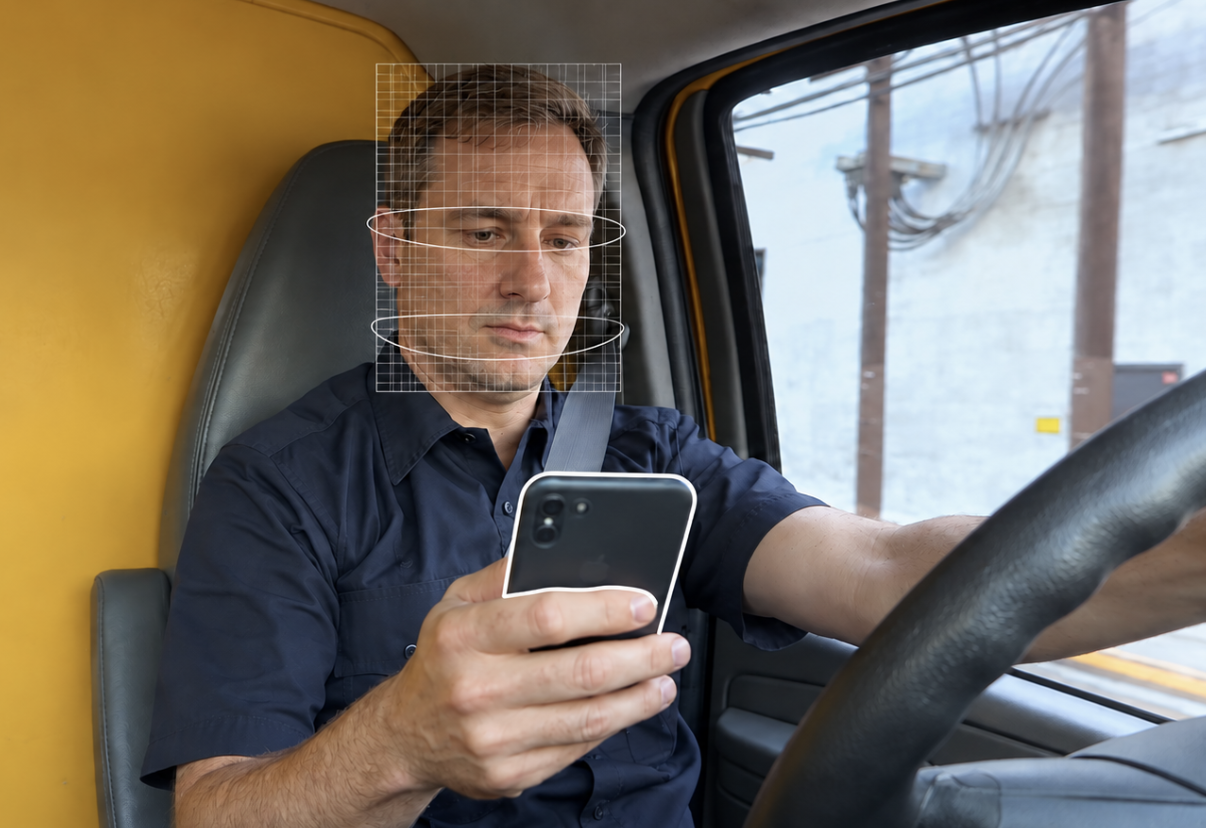
When reviewing driver monitoring systems (DMS), you inevitably end up asking the same question. “So how does this camera actually determine that the driver is drowsy?” Manufacturers’ brochures often simply state, “AI detects this in real time,” but that single sentence provides neither a basis for comparing solutions nor a solid explanation for drivers.
This article opens that black box. It explains the process by which driver monitoring AI assesses a driver in five steps: ① Who is driving? (Face recognition and identity verification) → ② Where are they looking? (Gaze and head tracking) → ③ Are they drowsy? (Drowsiness indicators) → ④ What are they doing?(behavioral analysis) → ⑤ What’s happening outside the vehicle (object recognition and depth estimation).
0.5 Seconds—Until the Warning Beep Sounds
It’s 5:50 a.m., and a bus is traveling on the highway. A small camera above the driver’s seat is capturing dozens of images per second even at this very moment. Suddenly, the driver’s eyelids remain closed longer than usual, and his head tilts slightly forward. The AI chip next to the camera detects this change from several consecutive images, and the moment the cumulative eye-closure time exceeds the threshold—a warning tone sounds: “Drowsy driving detected.” The driver startles awake and corrects his posture.
The entire process takes less than a second. In that brief moment, the AI completes four steps: “detecting the face → pinpointing the positions of the eyes, nose, and mouth → calculating the eye-closure duration and head angle → determining whether the cumulative pattern indicates drowsiness.” Now, let’s take a closer look at what happens in each step.
Step ① Who’s Driving? — Face Detection and Identity Verification (Face ID)
The starting point for all decisions is finding a face on the screen(face detection). The key to this stage is reliably identifying the facial area even under conditions such as nighttime, backlighting, or when the driver is wearing a mask; therefore, in-vehicle cameras also use infrared (IR) technology, which captures images even without lighting. This is because the system must be able to see the eye area even at night or through sunglasses.
Once a face is detected, the next step is to determine who that person is(face recognition and identity verification). This technology verifies a person’s identity by comparing facial features to those of registered drivers and has three primary applications in the transportation industry.
- Dispatch verification — Automatically verifies that the assigned driver is actually operating the vehicle. Prevents unauthorized driving and unauthorized shift changes
- Driver-Specific Data Segregation — In shift work where multiple drivers operate a single vehicle, accurately attributing risky driving records and safe driving scores to each individual driver
- Driver Eligibility Management — Serves as the foundation for a system that blocks unqualified drivers by linking eligibility to completion of required training
The most common question raised by practitioners here concerns privacy issues; this topic is addressed separately in the section below titled “Filming Drivers.”
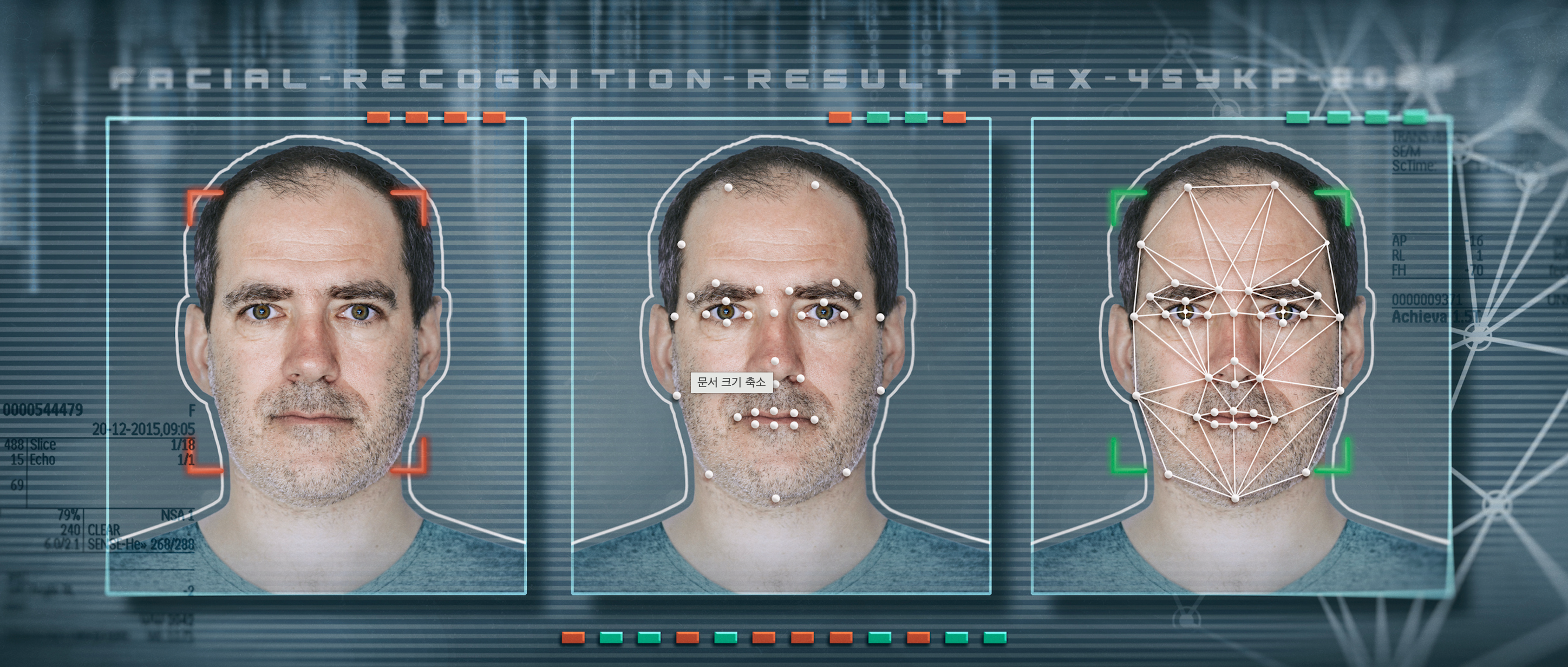
Step 2: What to Look For — Facial Landmarks and Gaze/Head Tracking
Once the AI detects a face, it marks dozens of reference points on it, known as **landmarks**. The outer corners of the eyes, the upper and lower eyelids, the bridge of the nose, the corners of the mouth, and the jawline—it’s essentially mapping the topography of a human face. This topographic map is necessary for subsequent calculations.
- Head Pose — The three-axis angles of the head (nodding, left-right rotation, and tilt) are estimated based on the relative positions of the landmarks. This is how the system distinguishes whether the head has turned toward the right side mirror or dropped toward a cell phone resting on the lap.
- Gaze direction — By reading the position of the pupil within the eye region, the system estimates whether the gaze is directed toward the road ahead. This is why the system can detect situations where the head is facing forward but the gaze is fixed on the navigation screen.
The determination of forward gazeis based on a combination of these two calculations. A warning is issued if the gaze or head position deviates from the front for a certain period of time. The key is the condition of “a certain period of time.” If the system were to issue a warning for even brief, necessary visual shifts—such as checking the side mirror—the driver would simply turn the device off. Therefore, distinguishing between normal checking motions and dangerous inattention based on time and angle determines the precision of this stage.
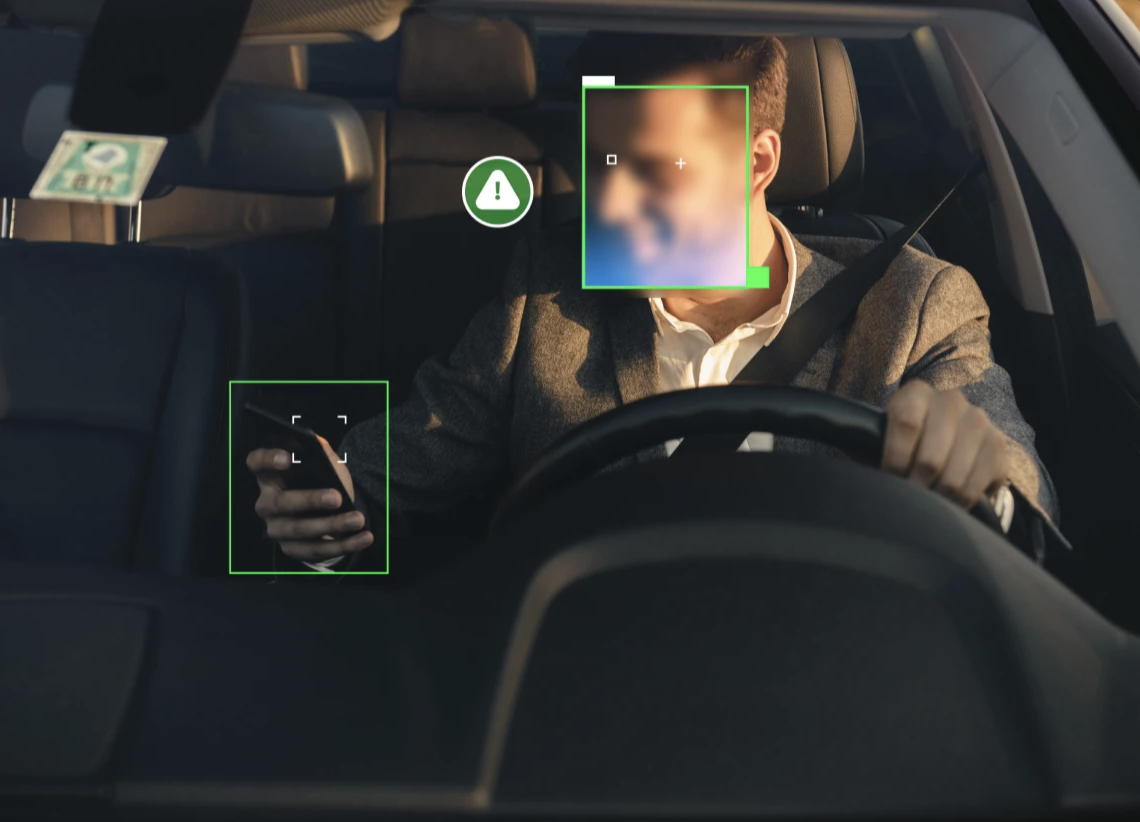
Step ③ Is the Driver Drowsy? — PERCLOS and Comprehensive Assessment
This is the most important question. On what basis does the AI determine that a driver is “drowsy”?
The primary indicator is PERCLOS (Percentage of Eye Closure). This metric measures the percentage of time the eyes were closedover a given period; it has been extensively validated in drowsiness research and is used as the international standard for driver monitoring. Since momentary blinks are filtered out and the system makes judgments based on cumulative patterns—such as “Did the percentage of time the eyes were closed in the last minute exceed the threshold?”—it can distinguish between blinking and drowsiness.
However, a good system does not rely solely on PERCLOS. This is because a single metric has its pitfalls—measurements of eye closure can be unreliable for drivers with naturally small eyes, those wearing sunglasses, or in backlit conditions. Therefore, actual determinations are made based on a combination of multiple signals.
| Signals | What Is Measured | Limitations When Used Alone |
|---|---|---|
| PERCLOS (Percentage of Eye Closure) | Cumulative eye-closure time | Sensitive to eye size, eyeglasses, and lighting conditions |
| Blinking patterns | Variations in Blink Frequency and Duration | Significant individual variation |
| Eye drift | Unfocused gaze, failure to fixate | Must be distinguished from forward gaze |
| Head nodding | Angle at which the head tilts forward and frequency of occurrence | A lagging sign that drowsiness has already set in |
| Yawning and changes in facial expression | Secondary signs of accumulated fatigue | Insufficient evidence for a determination when occurring alone |
When these signals appear simultaneously and cumulatively, the system determines drowsiness and issues a warning. This explains both “Why didn’t the warning sound even though I yawned just once?” and “Why did I receive a drowsiness warning even though my eyes were open?” (loss of focus).
One more thing—it’s better for the warning to be issued a step ahead of the actual detection. Since head nodding is a sign that drowsiness has already deepened, intervention must occur at the earlier stages—when the rate of eye closure increases and gaze focus declines—for the warning to effectively “wake the driver up.” In a pilot project by the Korea Transportation Safety Authority (involving 13 transportation companies, 500 vehicles, 1,615 drivers, and a driving distance of 1,000 km) ,this real-time warning system reduced drowsy drivingby 99.7% (from 1.54 times to 0.005 times) andand a 93.4% reduction infailure to maintain forward focus—demonstrates that the warning system functions as a pre-accident intervention measure.
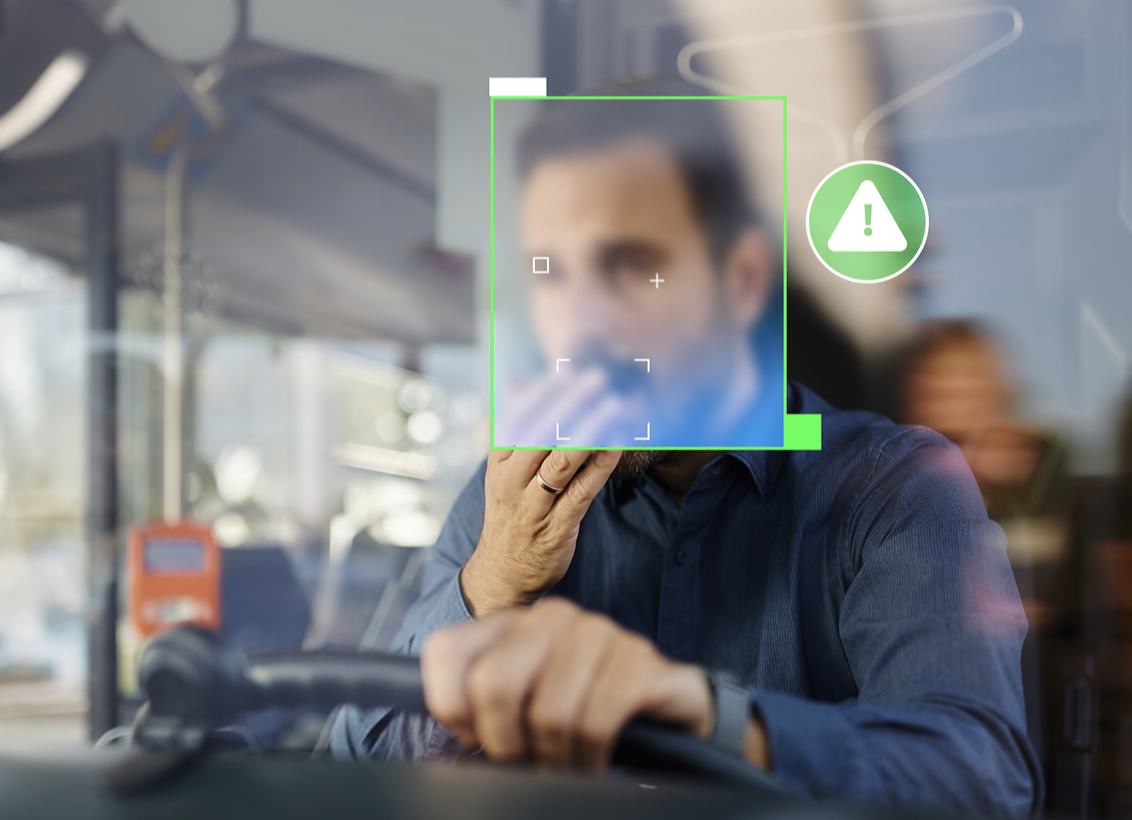
Step ④ What to Do — Behavioral Analysis
It’s not just about looking at the gaze and eyes. Behavioral analysis also interprets information beyond the face —such as hand position, the presence of objects, and posture.
- Cell phone use — The system detects a cell phone-shaped object near the hand and makes a determination by combining this with a “holding it to the ear” posture or a “pattern where both the gaze and hand move down toward the lap.” It is a combination of object recognition and posture estimation.
- Smoking — Recognition of a cigarette-shaped object near the hands and mouth, combined with a pattern of the hand repeatedly moving toward the mouth.
- Failure to wear a seatbelt — Recognition of the seatbelt’s shape in the shoulder-chest area.
Since each behavior is detected differently, when comparing solutions , it’s important to check item by item — not just a single line stating “behavior analysis support” —to see exactly which behaviors are detected and under what conditions (day/night, glasses, masks). Furthermore, when these detected behaviors are accumulated for each driver, they become the raw data for safe driving scores (scoring)—if detection is a “momentary warning,” then scoring is a “record of habits.”
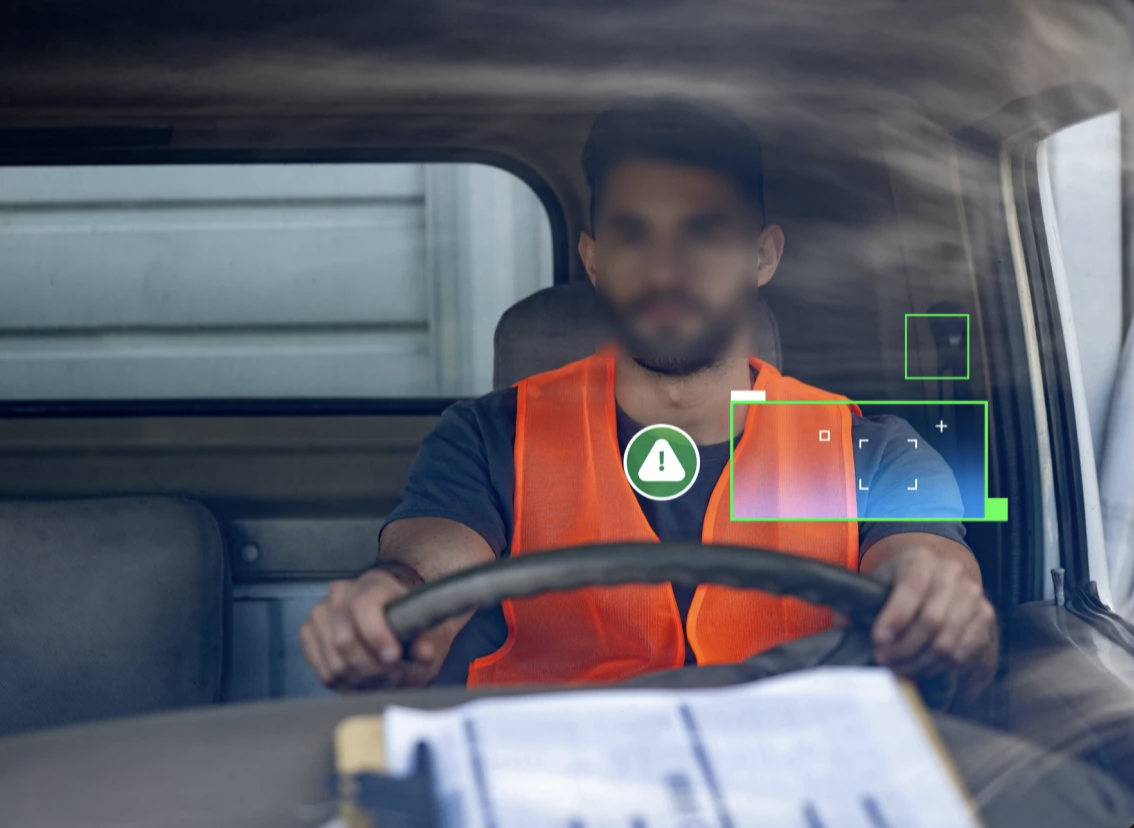
Step ⑤ What’s happening outside the vehicle? — Object Recognition and Depth Estimation
While the camera facing the driver (DMS) handles the tasks described so far, the final step falls to the forward-facing camera. Since the full picture of risk can only be completed by considering both the driver’s condition and the driving environment together, an integrated solution processes both directions simultaneously.
- Object Detection — Identifies and classifies vehicles, pedestrians, two-wheeled vehicles, lane markings, and traffic lights in real time from the forward-facing video feed. It answers the question, “What is ahead?”
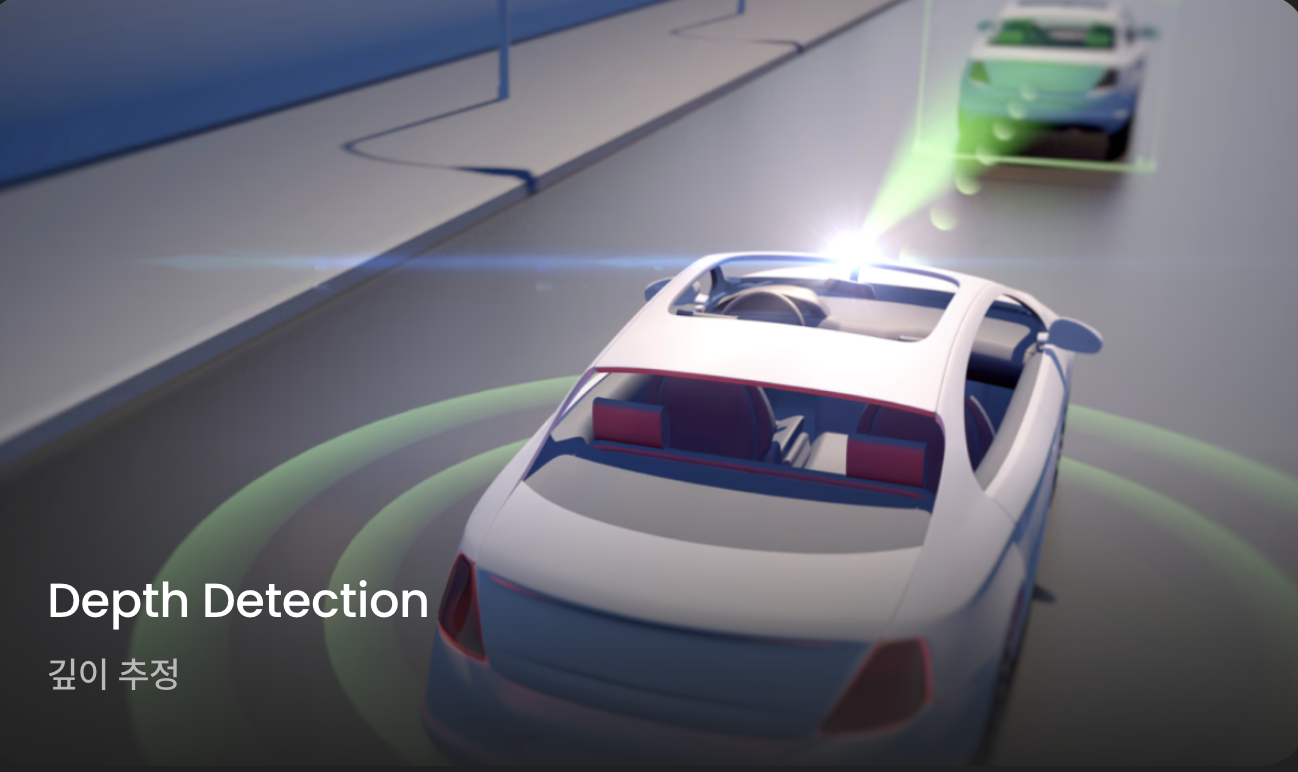
- Depth Estimation — Estimates the distanceto recognized objects based on the video feed. The core of this technology lies in calculating distance information using only camera footage, without the need for separate sensors such as radar or LiDAR. This answers the question, “How close is the car in front?” and serves as the basis for determining the distance to the vehicle ahead, assessing collision risk (forward collision warning), and detecting approaching pedestrians.
- Driving Context Assessment — By combining information on road rules—such as lane position (lane departure), traffic signals (traffic violations), and stop lines—with object data, the system determines whether “the current driving situation is dangerous.”
When the assessments from the driver camera and the front camera are combined, it enables judgments that individual devices cannot make on their own. For example, if “a stationary vehicle ahead (front camera) + the driver’s gaze not directed forward (DMS)” are detected simultaneously, the system can assess the situation as far more dangerous than either condition alone and issue a stronger warning.
Where does this calculation take place? — On-device processing
If the five-step calculation were to send the video to a server for processing, two problems would arise. Warnings would be delayed by the communication latency (drowsiness intervention is a race against the clock, measured in seconds), and the constant transmission of driver video to an external server would increase data costs and privacy concerns.
Therefore , on-device processing —where the vehicle’s AI chip analyzes the video on the spot and transmits only the determination results and necessary event footage to the control center—is becoming the standard for in-vehicle AI. Since only the result—such as “three drowsiness events”—is transmitted rather than the entire video, data transfer volume is drastically reduced, and the burden of constant surveillance on the driver is alleviated. This is why, when comparing solutions, it is essential to verify whether “analysis is performed on the device or on the server.”
The Next Step After Detection — Driver Scoring: Quantifying the Moment
The five steps described so far all pertain to “that moment.” Detecting drowsiness, sounding an alert, and the driver correcting their posture—if it ends there, the same risk will recur the following week. For detection technology to lead to a reduction in accidents, one more layer is needed. **Driver Behavior Scoring**, which accumulates detected moments into a score for each driver.
The calculation structure is as follows.
- Event Collection — Risky driving behaviors detected in steps ① through ⑤ (drowsiness, failure to monitor the road ahead, cell phone use, sudden acceleration/deceleration, lane departure, etc.) are recorded for each driver. This process requires the identity verification from Step ① as a prerequisite—because even during shift work, events must be accurately attributed to the “driver” rather than the “vehicle.”
- Adjustments and Weighting — To fairly compare drivers with different mileage and driving times, events must be converted to frequency per unit distance rather than absolute counts, and different weights are applied to behaviors with varying levels of risk (e.g., drowsiness vs. sudden acceleration).
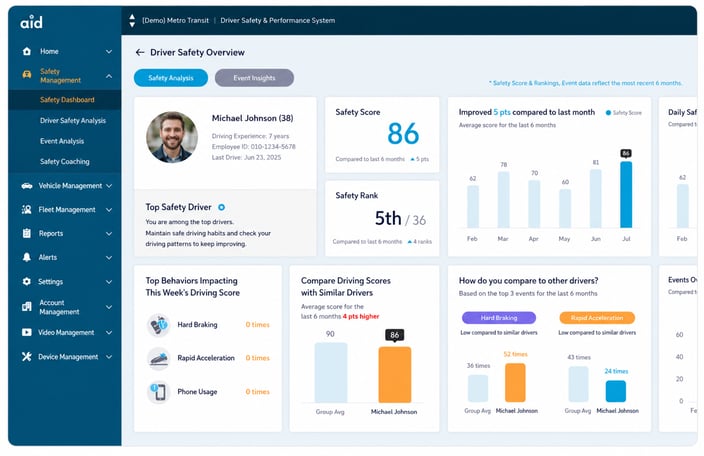
- Scores and Trends — Scores are calculated as safety driving scores for each period, allowing you to check an individual driver’s score for the current month, trends over time, and even which behaviors caused the score to drop.
This is where the changes brought about by the score differ from mere detection. If a warning is “correction in the moment,” then scoring is “preventing recurrence.” A vague reminder like “Drive safely” is transformed into specific feedback such as “Your instances of failing to look ahead have decreased this month compared to last month.” For less experienced drivers, this serves as the basis for tailored coaching, while for conscientious drivers, it provides an objective record proving their safe driving habits. When combined with a system that recognizes and rewards improvements in the score, safe driving becomes something that is recognized rather than criticized.
From a solution comparison perspective, this layer is a key differentiator. Even products with seemingly similar detection metrics differ in whether their post-detection process ends with a “list of events” or extends to providing driver-specific scores—adjusted for calibration and weighting— along with trend data. The reduction in accidents driven by behavioral change—a 68% decrease in insurance payouts—seen in the commuter bus example above is also a result of this scoring system. How scoring actually operates in the field was covered in the “Behavioral Change” section of “Why Driver Monitoring Is Necessary on Commuter Buses.”
Filming Drivers—How Is Personal Information Handled?
Cameras pointed at drivers, facial recognition, driver-specific scores—reading this far naturally raises a question: “Who has access to this data, to what extent, and in what form?” This is a critical point that must be addressed during the evaluation phase, and understanding the technical architecture clarifies the criteria for making this determination.
The key is to distinguish between “raw video” and “analysis results.” In the on-device architecture discussed earlier, video recorded continuously is analyzed and deleted within the device itself; the only data that leaves the device is the analysis result—such as “drowsiness event at [time]”—and the event footage from that specific segment. This differs fundamentally from continuous monitoring systems, where all video is stored on a server, in terms of the sheer volume of data collected. The same applies to facial recognition data—key verification points include whether facial data is processed and managed as feature values for comparison rather than as original photos, and whether encryption and retention period limits are in place. Recently, there has been a trend toward providing technology that automatically anonymizes (masks) the faces of passengers and pedestrians in event footage.
From a regulatory perspective, three requirements must be met: the explicit stipulation of data collection items, purposes, and retention periods(in employment rules or separate regulations); prior notification to and consultation with drivers(including labor-management consultation if a union exists); and restrictions on access rights(specifying who can view which data). The common thread among companies where this system was quickly adopted in the field lay not in the formalization of regulations, but in their operational principles—specifically, those that demonstrated through their operations that this data is not used to catch drivers in the act, but rather to prove a driver’s diligence in the event of accidents or customer complaints and to adjust unreasonable dispatch schedules.
How Far Has This Technology Come? — What the Regulatory Timeline Reveals
The regulatory timeline makes it clear that these technologies are no longer in the laboratory phase.
| Region | Details | Date |
|---|---|---|
| EU | Under the General Safety Regulation (GSR), Drowsiness and Distraction Warning (DDAW) systems are mandatory for all new vehicles | July 2024 (in effect) |
| EU | Expanded to include Attention Distraction Warning (ADDW) | All new vehicles produced starting July 2026 |
| International Standards | United Nations World Forum for Harmonization of Vehicle Regulations (WP29), adoption of international DMS standards — Applies to the Mutual Recognition Agreement signed by 64 countries, including South Korea | March 2026 |
| Japan | Mandatory installation of DMS through amendments to the Road Transport Vehicle Act safety standards — Applies to new vehicles first, then expands to existing vehicles two years later | Starting in September 2031 |
It is worth noting that the criteria for detection are also being specified in detail. Under the Japanese amendment, an alarm will sound if the driver’s gaze is directed toward the area around their hands (e.g., a cell phone) for 3.5 seconds at speeds of 50 km/h or higher, or for 6 seconds or more at speeds between 20 and 50 km/h. Drowsiness will be determined by analyzing eyelid and eye movements, as well as steering wheel operations. — This means that the “gaze duration” and “comprehensive analysis of multiple signals” explained in Steps ② and ③ above have become statutory standards. Market forecasts point in the same direction. Fujikamera Research Institute forecasts that the global DMS market will grow to approximately 1.2566 trillion yen by 2035—more than 55 times its 2021 size.
In short, driver condition monitoring is transitioning from an optional feature to legally mandated standard equipment, and discussions moving in the same direction are ongoing in South Korea as well, particularly regarding commercial vehicles. The full picture of mandatory requirements both domestically and internationally is summarized in the Driver Monitoring System (DMS) Guide.
What Sets a Good System Apart — A Comparative Review Checklist
Even among “AI driver monitoring” systems, there are significant differences in quality. Here are the items to check when considering implementation.
- Specific list of detection items — Not just a single line for “drowsiness detection,” but whether the system supports and how it determines drowsiness, failure to look ahead, cell phone use, smoking, seatbelt usage, and other specific items
- Performance under Adverse Conditions — Whether detection remains reliable at night (infrared), in backlighting, and when the driver is wearing glasses, sunglasses, or a mask
- False Alarm Rate — Does the system avoid excessive warnings triggered by normal side-mirror checks or brief blinks? Frequent false alarms are the leading cause of failure, often leading drivers to simply turn off the device in the field
- Processing Location — Whether analysis occurs on-device or via server transmission (latency, data costs, privacy)
- Post-detection workflow — Does it end with a warning, or does it extend to driver-specific scoring, reports, and integration with a monitoring system? Detection is just the beginning; accident reduction comes from effective operations
- Validation Evidence — Is there performance evidence verified by a third party, such as public pilot projects or actual measurement data?
Summary — Five steps, on one page
| Step | Question | Core Technology | Practical Value |
|---|---|---|---|
| ① Face Recognition and Identity Verification | Who is driving? | Face Detection, Face ID | Ride Assignment Verification, Driver-Specific Data Attribution |
| ② Gaze and Head Tracking | Where are they looking? | Landmarks, Gaze and Posture Estimation | Forward-Gaze Warning |
| ③ Drowsiness Detection | Are You Drowsy? | PERCLOS + Multi-Signal Fusion | Pre-crash Intervention (Pilot Program: Drowsiness Reduced by 99.7%) |
| ④ Behavioral Analysis | What are you doing? | Object Recognition + Posture Patterns | Cell Phone, Smoking, and Seat Belt Warnings; Raw Data for Scoring |
| ⑤ Object Recognition and Depth Estimation | What’s Outside the Car? | Forward Object Detection, Distance Estimation | Assessment of Risks: Rear-End Collisions, Pedestrians, Lane Deviations, and Traffic Signals |
| + Scoring | Is it recurring? | Event accumulation, calibration, and weighting | Safe Driving Score by Driver — Basis for Habit Improvement, Training, and Recognition |
A.I.MATICS’ AI Safe Driving Solution covers all five of these stages—Driver Behavior Recognition (DMS) handles steps ① through ④, while driving situation assessment technology handles step ⑤, and the detection results feed into the driver scoring and monitoring platform. Drowsiness detection employs a comprehensive analysis method combining PERCLOS, gaze deviation, and head nodding—as described above—and its effectiveness has been verified through a pilot project by the Korea Transportation Safety Authority.
Get a consultation on the configuration best suited for your company’s fleet
We’ll guide you on which detection items and configurations are needed based on your vehicle model and operating conditions.
Recommended Reading
- What Is a Driver Monitoring System (DMS)? — Concepts, Mandatory Requirements, and Implementation Guide — If this article explains the “how,” this one covers the “what” of the concept and regulations
- Why Driver Monitoring Is Necessary for Commuter Buses — 3 Principles for Reducing Commuter Accidents — The “why” and structure behind how this technology actually reduces accidents
- What’s the Difference Between ADAS and AI Safe Driving Solutions? — Key Differences Transportation Companies Need to Know — The Role of This Technology Across the Entire Device Hierarchy
Frequently Asked Questions (FAQ)
Q. What criteria should I use to select a driver safety solution that supports facial recognition?
A. There are three key factors to consider. First, the purpose of facial recognition—is it for simple detection (locating the face only), or does it include identity verification (comparison against a registered driver)? If you need to verify driver assignments and attribute data to specific drivers, identity verification is required. Second, performance under adverse conditions—whether it works with nighttime infrared imaging and whether recognition remains accurate when the driver is wearing glasses or a mask. Third, the method of personal data processing—whether video is continuously transmitted to a server or processed on the device itself, with only the results being sent. In Korea, companies such as AI-Matics provide driver monitoring solutions that include identity verification (Face ID).
Q. What specifically does driver behavior analysis detect?
A. Typically, it detects drowsiness (based on a combination of eye closure rate, gaze direction, and head position), inattention to the road ahead (duration that gaze or head is diverted from the road), cell phone use (object recognition + posture patterns), smoking, and failure to wear a seat belt. Since the supported features and detection criteria vary by solution, it is more accurate to check the specific list of supported features and performance under different conditions—such as daytime/nighttime and whether the driver is wearing glasses—rather than simply looking at whether “behavior analysis” is supported.
Q. How does AI distinguish between blinking and drowsiness?
A. It makes this determination based on cumulative data rather than individual instances. PERCLOS, a key indicator, measures the percentage of time the eyes are closed over a set period; thus, normal blinks lasting 0.1 to 0.2 seconds have almost no effect on this percentage. However, when drowsiness causes the eyelids to close for longer periods or more frequently, the percentage rises and exceeds the warning threshold. By analyzing this in conjunction with other signals—such as gaze focus, head nodding, and changes in blinking patterns—we minimize misjudgments caused by relying on a single metric.
Q. Why is an automotive safety solution capable of object detection and depth estimation necessary?
A. Because monitoring the driver’s condition alone reveals only half the risks. Object recognition identifies vehicles, pedestrians, lane markings, and traffic signals ahead, while depth estimation calculates the distance to those objects using only camera footage, without requiring separate sensors. Both of these are necessary to assess driving hazards such as the risk of a frontal collision, approaching pedestrians, and lane departure; when combined with driver status detection, they can identify the most dangerous situations—such as when “there is a hazard ahead but the driver is not aware of it.”
Q. Doesn’t continuously recording the driver’s face raise privacy concerns?
A. It depends on the processing structure, and there are three key points to verify: ① Whether the video is analyzed on the device and only event results are transmitted (i.e., whether video is transmitted continuously); ② Whether facial identification information is managed in accordance with the principles of encryption and data minimization; and ③ Whether the purpose, scope, and retention period of data collection have been clearly defined in employment rules or through labor-management agreements. In particular, the on-device processing method poses relatively fewer concerns because the raw video never leaves the device. When implementing this system, the key to successful adoption is to design operational guidelines for drivers that emphasize this is “not surveillance, but a record to protect them in the event of an accident.”
Q. Is there evidence that this technology actually reduces accidents?
A. There are actual measurement results from public pilot projects. In a pilot project by the Korea Transportation Safety Authority (involving 13 transportation companies, 500 buses, 1,615 drivers, and a total distance of 1,000 km), the introduction of real-time detection and warning systems resulted in a 99.7% reduction in drowsy driving (from 1.54 incidents to 0.005 incidents), inattention to the road ahead by 93.4%, and traffic signal violations by 87.6%. Separately, an analysis of 1,077 commuter buses operated by major domestic corporations showed that insurance payouts decreased by 68% compared to the same period the previous year.
The technical descriptions in this article are based on methods commonly used in the driver monitoring field; implementation may vary by product. Statistics are based on the results of data analysis from the Korea Transportation Safety Authority’s pilot project and the Chartered Bus Mutual Aid Association’s accident statistics; information regarding EU regulations is based on the implementation schedule for DDAW and ADDW under the General Safety Regulation (EU 2019/2144); and details concerning Japan’s mandatory requirements and WP29 international standards are based on a report by the Seoul Economic Daily (August 2026, citing the Nikkei).

