Surprisingly, "choosing a product" is not the most common roadblock for those in charge of implementing an AI safety management platform in a large commuter bus fleet. The real roadblocks are threefold
"How do we install it when we don't own the vehicles or the drivers?"
"How do we convince management of the budget?"
"How do I get my staff to do anything once the platform is in place?"
This article will answer each of these three questions in turn, as they are the real roadblocks that reps face before the feature comparison and right before the decision to adopt.
Why should you be interested in a commuter bus safety management platform now?
The landscape of commuter bus safety management in large organizations has been changing rapidly over the past few years.
- Since the implementation of the Fatal AccidentPunishment Act, commuter bus accidents are no longer just a driver's problem; business owners and executives can be criminally prosecuted for failing to fulfill their safety management obligations.
- Despite this, safety management of commuter buses in large companies is often left to contracted operators. The days of "it's not our responsibility because we outsource it" are coming to an end.
- The biggest change is in the bidding environment. Some large commuter bus tender announcements have begun to specify "vehicles equipped with an AI safety driving platform" as a qualifying condition. This is the beginning of an era where operators cannot participate in the tender itself without a safety platform.(We wrote more about the background of this change and the change in tender qualifications in a separate article).
- In the case of a global semiconductor and electronics manufacturing company that operates the largest commuter bus fleet in Korea with tens of thousands of employees, which has implemented AI safe driving solutions for about 2,400 commuter buses, the actual result was a reduction in insurance premiums of about 1.47 million won (68%) per bus. This change is rapidly spreading to large domestic home appliance and automobile manufacturing companies.
- The question is no longer "will we implement it" but "how will we implement it?"
Why it's hard to implement a commuter bus safety management platform
When those in charge recognize the changes outlined above and start looking at adoption in earnest, the first surprise is that the sticking point is "Which product is good?
The sticking point is not "which product is good".
Comparing platform offerings can actually be done in a matter of days, but there are reasons why adoption is slow.
The three questions I mentioned in the introduction - setting up an outsourcing structure, convincing management of the budget, and organizing post-implementation - are directly tied to the company's operational structure and decision-making process. If these three things are not organized when a product is selected, it will get stuck at the installation stage, then at the budget meeting stage, then at the start of operations.
These are the most common reasons why adoption reviews bounce around from meeting to meeting and stall.
This article answers each of those three in turn.
3 things to check before adopting a smart safety management platform for commuter buses
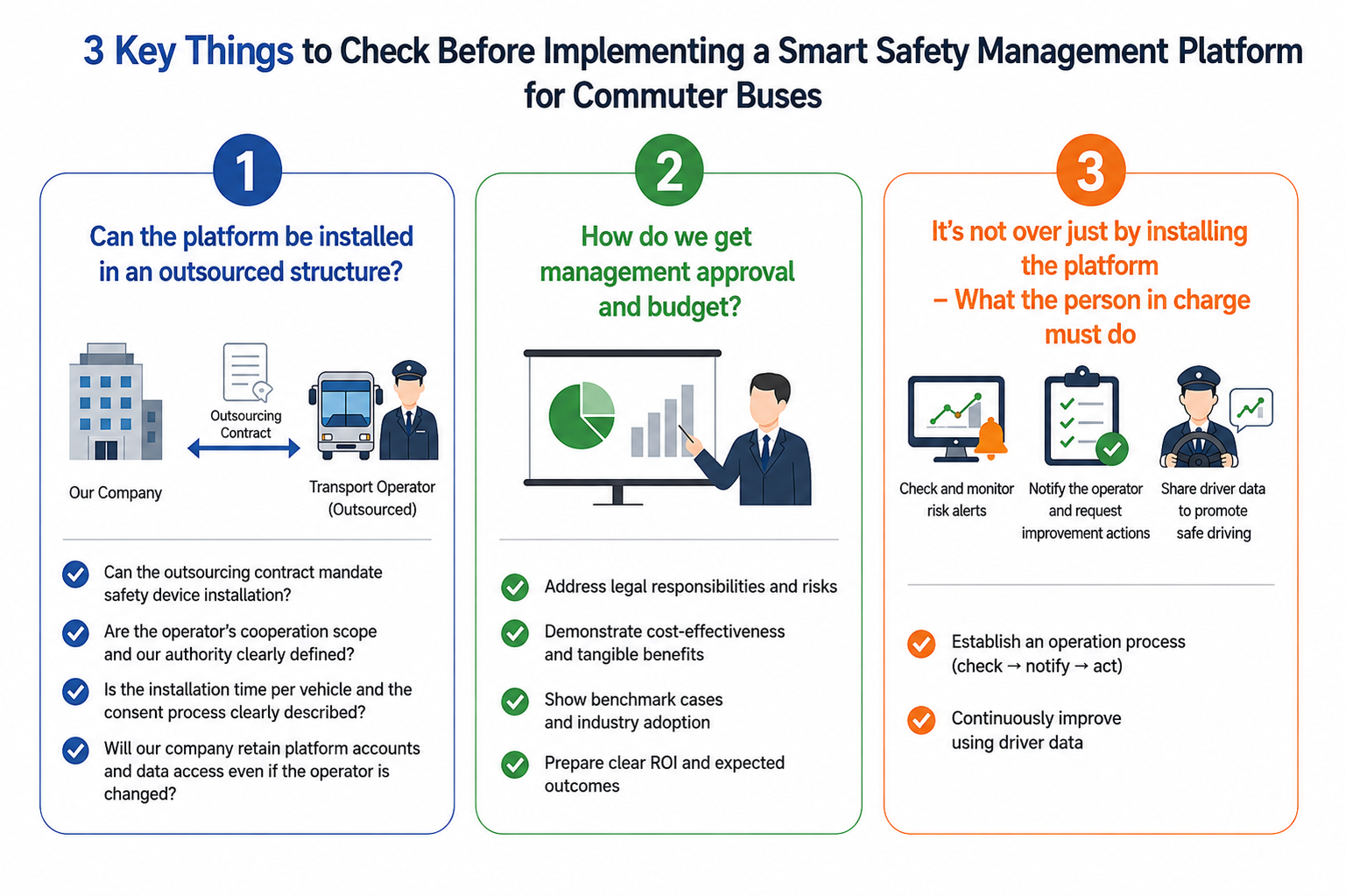
1. Can the platform be installed in an outsourced structure?
Most of the commuter buses of large companies are owned and operated by contracted drivers. The large company acts as an ordering organization that pays for the operation.
In this structure, even if the person in charge decides, "I want to install a safety management platform," it doesn't happen immediately.
- If the driver doesn't agree, or if there's unclear accountability surrounding the installation, it will be delayed.
- Conversely, if it's left entirely up to the driver, there's no way for the larger organization to know what the actual safety status of the trip is.
- If a driver is replaced midway through the process, what happens to the accumulated data and account permissions should also be organized in advance.
In the end, it's not the platform itself, but the structure of the outsourcing contract and the design of data permissionsthat is key to adoption.
4 things to check before adopting a platform
- Can the contract specify the obligation to install safeguards?
- The scope of the driver's cooperation in the installation process and the authority of the larger company are separated.
- The installation time per vehicle and the driver's informed consent process are detailed.
- Does the platform account and data access remain with the large company even after the driver is replaced?
Having these four things organized up front will greatly speed up execution after the decision is made. Conversely, if you start with product comparisons without this organization, you may choose a good product and then get stuck again at the actual installation stage.
2. How do we get management approval and budget?
Even if you see the need for commuter bus safety, you often find yourself in the position of having to come up with the numbers and logic to convince management.
"Accidents happen, so we need to be prepared" is a weak argument for executive budget approval. You need to show the cost-benefit, the substance of the legal risk, and third-party adoption.
There are certain common objections that come up in executive meetings, and preparing answers to them in advance will greatly increase your chances of getting your budget approved.
Common objections and responses during the budget approval process
Q. "Isn't the driver responsible for the commuter bus accident?"
A. The Fatal Accident Act imposes safety management obligations on business owners (large companies) that provide commuter buses, regardless of the contracted structure. In the event of a fatal or serious accident, the person in charge of management may be subject to punishment, and the defense that "I left it to a contractor" will not be accepted without proof of fulfillment of obligations.
Q. "If there is an accident, won't insurance take care of it?"
A. Insurance only addresses a portion of the direct costs. Since commuter bus accidents directly affect employees, the costs that are not covered by insurance are greater - medical treatment and rehabilitation for the injured employee, commuting anxiety for employees who use the same route, complaints from employees' families, and the impact of accident reports on recruitment and company image. In addition, criminal penalties are not covered by insurance after the enforcement of the Fatal Accident Punishment Act.
Q. "I already have a dashcam, isn't that enough?"
A. Dashcams are after-the-fact devices that record what happened after an accident. An AI safety management platform is a proactive system that detects and warns of risky behavior before it leads to an accident. The data that prevents accidents from happening is more valuable to a company than the video after the fact.
By preparing answers to these three objections in advance, your executive meeting will naturally shift from "if" to "when and how" instead of "if".
3. It's not over just by installing the platform - What the person in charge must do
Many reps expect to "just install it and it will take care of itself." But the platform is just a tool.
If people don't know what to do when they're notified of a risk event, they're not preventing incidents. A platform that sits on data and isn't utilized is a cost, not a value.
Operational structures that work have the following in common
- There's a routine for dispatchers to check trip reports on a regular basis
- Drivers are regularly notifiedof recurring risk events andrequired to take remedial action
- A structure that allows drivers to see their own safe driving scores and improvement points in real time.
The last point in particular - driver access to their own data - is a critical factor in voluntary behavior change. The perception that "I can see my score" rather than "the company is watching" changes driving behavior.
After implementing a safety management solution, you need to do two things to make it effective
1. Establish a data reporting and utilization system
Red flags arise → identify responsible parties → notify drivers → train drivers - this flow must be predetermined. Without a flow, the platform becomes a device that only accumulates data.
Specifically:
- Response procedures for each risk event categorization (immediate/weekly/monthly)
- Forms and frequency of driver reporting
- Driver training trigger criteria (number of repeat occurrences - severity)
2. Driver management utilizing driver-specific data
A system is needed to regularly share monthly driver safety index and driving reports with drivers and require improvement for low-scoring drivers. This not only helps prevent accidents, but also serves as data to prove that the company has fulfilled its safety management obligationsin the event of an accident.
aid solves 3 challenges of adopting a commuter bus safety management platform
aid Safe Driving Solution Structure
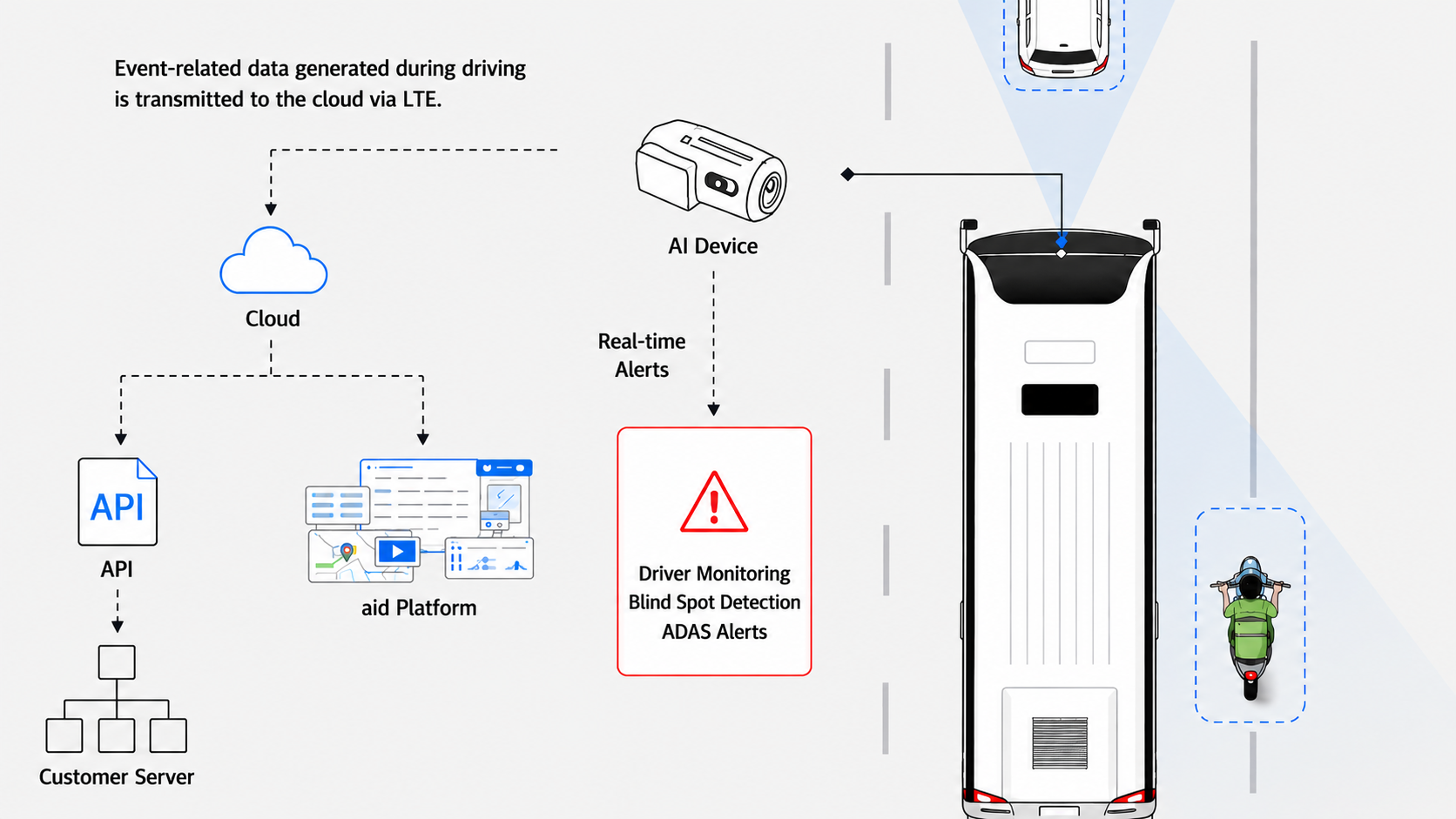
A.I.Matics' aidis an AI safe driving solution that detectsdriver's risky behavior (drowsy driving, distracted driving, cell phone use, etc.) and road hazards (red light violations, speeding, pedestrians in blind spots, etc.) in real timeby AI cameras installed on the vehicle, warns the driver as soon as a danger occurs, and automatically recordsall events on the manager platform.
Here's how AID answers the three roadblocks we outlined above.
Management that doesn't falter when drivers change
- Quick to install: Less than an hour per bus to implement without disrupting driver schedules
- Easy compatibility: Integrate with existing operational systems with APIs to most ERP-TMSs
- Ensure data continuity: platform accounts and data access rights can be set to the standards of a large company's headquarters → data and account continuity is maintained even when drivers are replaced
"Data sovereignty", the biggest concern of outsourcing, is pre-engineered.
68% reduction in bus insurance premiums - real-world impact for a global manufacturing conglomerate
The key data needed to convince executives comes from examples.
- A global semiconductor and electronics manufacturing company with tens of thousands of employees implemented a fleet of 2,400 commuter buses: 73% increase in safe driving scores, 41% decrease in red light violations, and a 68% decrease in insurance premiums of approximately KRW 1.47 million per bus.
- Reduced accident rate: 44% reduction in total accidents based on AID and ADAS application, saving about KRW 500,000 per vehicle per year
- Spreading PoC verification to large companies: The adoption that began at a global semiconductor and electronics manufacturing giant is expanding to include the Changwon plant of a leading domestic home appliance manufacturer.
Operational structure that can be managed directly by the person in charge, from notification to driver training
- Real-time notifications: When a dangerous event occurs, the manager can check the video and location information within about 5 minutes on the web.
- Monitoring of driver status: Automatic generation of safety index and operation reports for each driver to secure grounds for driver training requests
- Provide driver app: Check safe driving scores and improvement points in real time on the driver's own app → induce voluntary behavior change
- Smart fleet management: Monitor real-time vehicle status via live streaming
You don't have to worry about "how to operate," because the system provides the operational flow.
Once you've answered these three questions, your adoption discussion will be transformed
How will it fit into the outsourcing structure, how will it convince management, and how will it operate after installation - when these three things are mapped out first, product selection and implementation execution moves much faster.
Conversely, if you start comparing products without these three things organized, you may choose a good product, only to get stuck again in the implementation phase.
Adopting a commuter bus safety management platform is not a question of "which product to buy," it's a question of "how to redesign our commuter bus operations."
About the series
While this article is a "how to" guide, this article on the context of AI safety platforms in commuter bus biddingcovers the larger "why now" question. Together, they provide a good overview of both the context and action steps.
Let's talk about how to structure the implementation of a commuter bus safety management platform.