
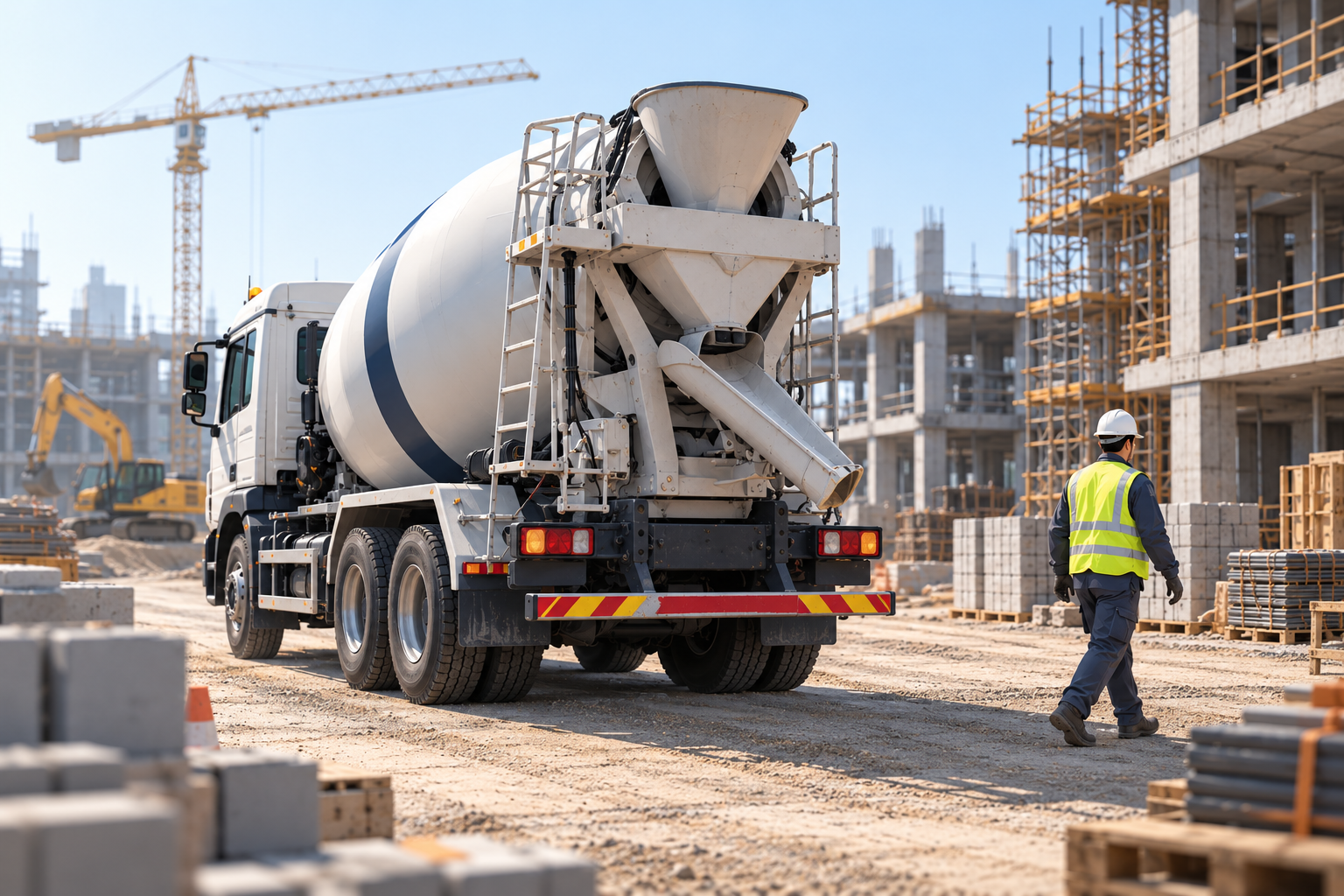
Safety systems at construction sites have traditionally focused on preventing falls. However, recent statistics from the Ministry of Employment and Labor point to another major cause— 44% of fatal accidents at construction sites with project values of 5 billion won or more were caused by machinery and equipment(January 2023–June 2024: 71 out of 161 incidents, resulting in 74 fatalities), and among these, the primary type of accident involving excavators and trucks was “collisions while moving or reversing.”
The pattern of these collision accidents is simple. Moving equipment and workers on foot are in the same space; the operator didn’t see the worker, and the worker wasn’t aware of the equipment. Therefore, the questions for reducing these accidents boil down to two: Why didn’t the operator see the worker (blind spots and the operator’s condition), and who could have alerted them at that moment? These two questions are precisely why the construction industry has recently begun taking an interest in DMS (Driver Monitoring Systems) and AI cameras—technologies that have been proven effective in the transportation sector—and this article summarizes the key points that construction company safety teams typically want to know when evaluating these technologies.
Risks by the Numbers — Which Equipment, What Types
These are statistics released by the Ministry of Employment and Labor when it distributed standard work plans for equipment with a high incidence of fatal accidents.
| Category | Details |
|---|---|
| Proportion of Fatal Accidents Involving Machinery and Equipment | 44% of fatal accidents at construction sites (over 5 billion won) (71 out of 161 cases, 74 fatalities — Jan. 2023–June 2024) |
| Equipment with a High Incidence of Accidents | The top six types—mobile cranes (15 incidents), excavators (13 incidents), aerial work platforms (13 incidents), trucks (5 incidents), and concrete pump trucks (3 incidents)—account for over 70% |
| Main Types of Accidents | Excavators and trucks: Collisions while moving or reversing / Aerial work platforms: Falls and entrapments |
| Government Response | Ministry of Employment and Labor distributes standard work plans for hazardous machinery and equipment (expanded beyond the original six types) |
What is noteworthy is the nature of the equipment involved in frequent accidents. Rather than fixed installations like tower cranes, the top spots are occupied by equipment that moves around the site —excavators, trucks, cranes, and concrete pump trucks. If moving equipment is the problem, countermeasures must also be effective “the moment it moves.”
Double Exposure for Ready-Mix Concrete Trucks and Dump Trucks—Traffic Accidents on the Road, Serious Accidents on Site
Vehicles entering and exiting construction sites have one additional characteristic not found in other types of equipment: the same vehicle operates under two different legal frameworks.
| While driving on public roads (off-site) | While working on-site | |
|---|---|---|
| Major Hazards | Braking distance due to overloading or excessive weight, blind spots, speeding, and running red lights | Collisions with or entrapment of workers while reversing or turning |
| Applicable in the Event of an Accident | Traffic Accidents — Criminal penalties apply if one of the 12 major acts of gross negligence(such as running a red light or failing to secure cargo) is involved | Workplace Accidents — In the event of a fatality, review under the Serious Accidents Punishment Act (extending to management officials of the prime contractor) |
| Existing Management Measures | Dashcams, DTG | Deployment of traffic controllers, work plans, rearview cameras and alerts |
Ready-mix concrete trucks and dump trucks move between these two worlds several times a day. After leaving the depot at dawn, they drive long distances on public roads (risk of drowsiness and speeding); upon entering a job site, they repeatedly reverse and turn (risk of collisions). From the safety team’s perspective, road-based management (black boxes, DTG) and site-based management (traffic controllers, work plans) are separate, and by default, the common variable—the driver—remains unmanaged in the gap between them.
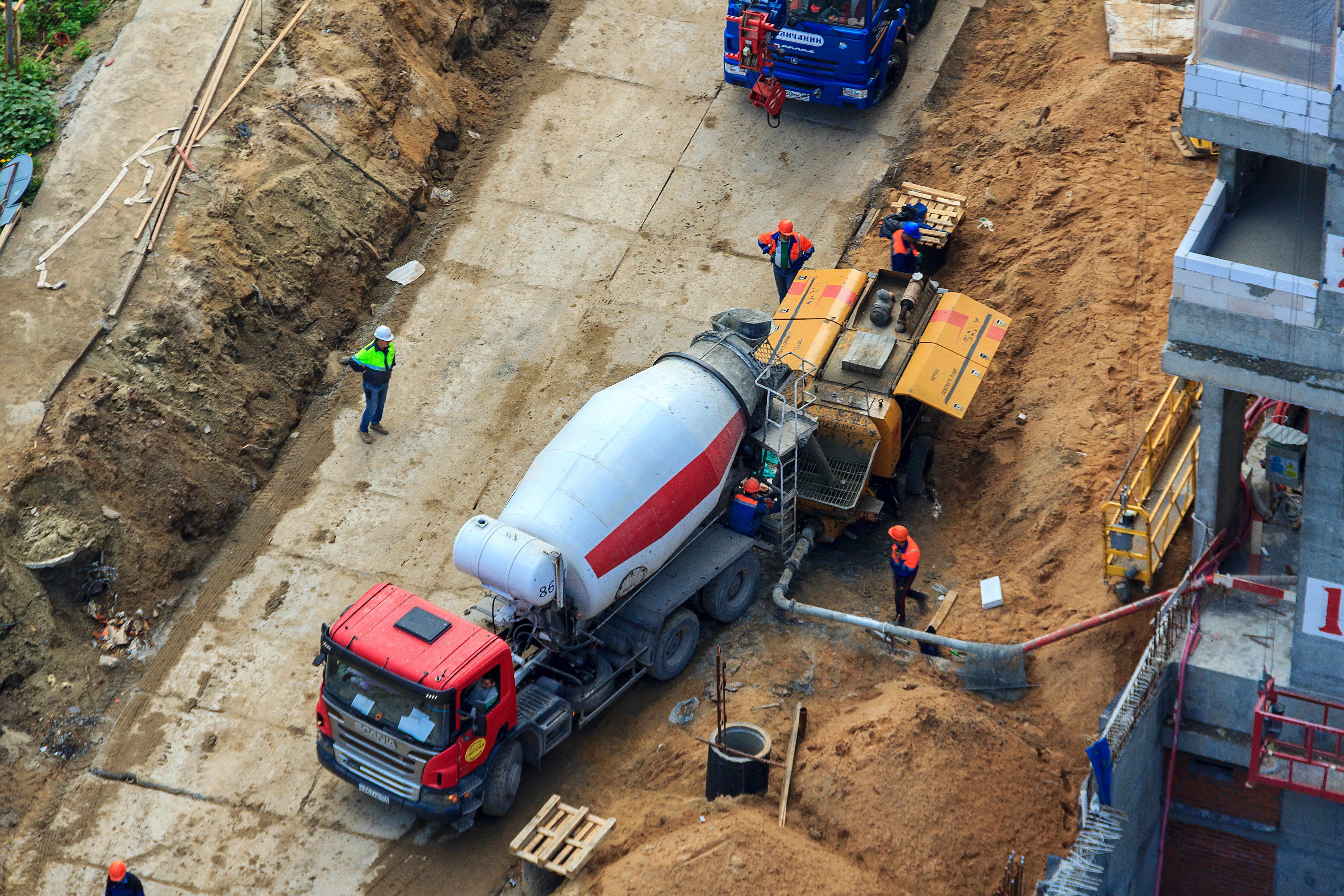
The gaps that existing measures fail to address—they all rely on “human attention”
Looking at what construction company safety teams are already doing reveals where the gaps lie.
- Deployment of traffic controllers — This is the most basic measure, but traffic controllers are human too. Accidents where controllers are struck while standing in the equipment’s blind spots are repeatedly reported, and on sites where multiple pieces of equipment are moving simultaneously, a single traffic controller cannot cover all movement paths.
- Rearview cameras and audible alerts — These measures only work when the driver is looking at the monitor. Failing to check the monitor during the hundreds of times a driver reverses as part of a repetitive task is not negligence but a natural limitation of human attention. Audible alerts get drowned out by ambient noise, and alerts that sound constantly are soon ignored. (The difference between sensors, standard cameras, and AI detection is discussed in detail in “Truck Blind Spot Cameras vs. AI Detection.”)
- Work Plans and Training — While important, paperwork and training cannot intervene at the “moment” of an accident. As shown in the statistics above, work plans were present at most of the sites where fatal accidents occurred.
In short, the existing system is designed around three layers of “human attention”: the driver’s attention, the guide’s attention, and the worker’s attention. However, collisions occur precisely at the moment when that attention lapses—due to fatigue, familiarity with repetitive tasks, or the chaos of simultaneous operations. What is needed isa fourth layer: detection that functions even when human attention lapses.
Three Elements AI Adds—Status, Approach, and Logging
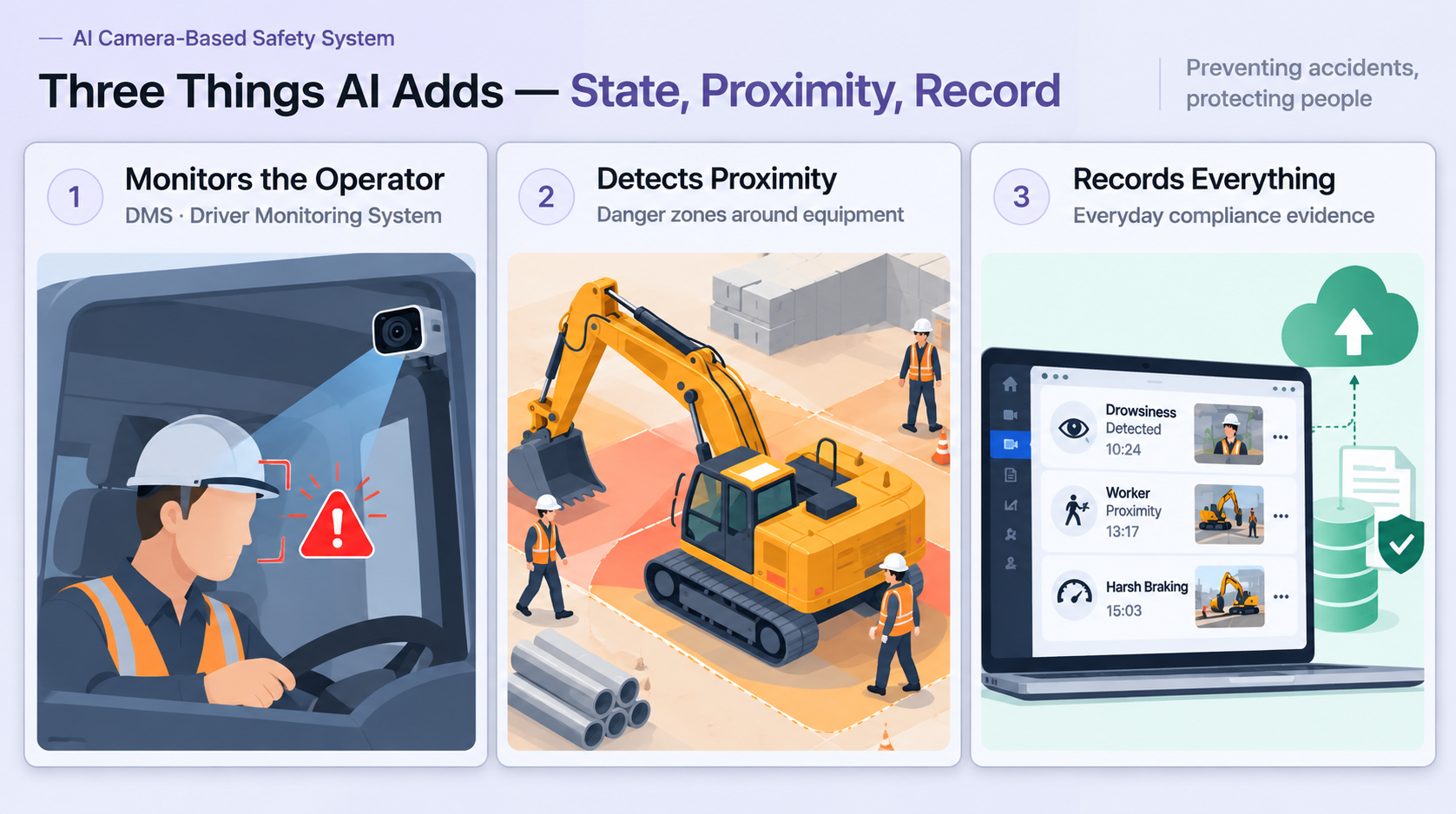
The role of AI camera-based safety systems on construction site vehicles and equipment can be summarized in three ways.
① Monitors the driver’s condition (DMS)
For operators of excavators, concrete mixers, and dump trucks, the workday consists of long hours of repetitive tasks interspersed with periods of inactivity. Restarts after downtime, afternoon shifts immediately following lunch, and early morning departures—this rhythm inherently leads to drowsiness and diminished attention. AI cameras focused on the driver detect conditions such as eye closure, head nodding, and gaze deviation from the front (work direction) in real time and immediately alert the driver. Unlike a black box (which records events after the fact), the key is to intervene before an accident occurs; the decision-making principles were explained in “What and How Does Driver Monitoring AI Observe?”
② Detecting Workers’ Approach
The AI camera facing the vehicle’s surroundings does not merely capture video; it recognizes people as people. If a worker enters the vehicle’s reverse or turning path, an immediate warning is sent to the driver. Unlike a rearview camera, which requires the driver to “be looking at the monitor to notice,” this system operates regardless of the driver’s state of attention. At construction sites, where materials and structures are abundant and people can suddenly appear, the fact that the detection criterion is “people” rather than “movement” makes all the difference in reducing false alarms.
③ Records the Entire Process — “Evidence of Routine Practices” Under the Serious Accidents Punishment Act
The construction industry is on the front lines of the application of the Serious Accidents Punishment Act. What investigations confirm after an accident is not “what happened on the day of the accident,” but rather “whether the company routinely identified and addressed risks.” Since the AI system automatically accumulates records of detected hazards (drowsiness, worker proximity, sudden acceleration or deceleration) along with corresponding warnings, supervisor confirmations, and corrective actions—organized by equipment and operator—it automatically builds the very records that safety teams find most difficult to maintain manually: the history of identified hazardous driving and corrective actions. The significance of these records within the occupational safety and health management system is summarized in the four types of records that transportation companies must currently maintain. For prime contractors in the construction industry, since liability for accidents involving subcontractors’ or rented equipment is also reviewed based on the contracting relationship, the scope of these records directly defines the scope of risk management.
Case Study — S Industry, a Construction Materials Company: The Journey to Implementing the System Across 150 Ready-Mix Concrete Trucks
The case of S Industry, a leading domestic construction materials company, demonstrates how this approach actually works on construction materials job sites. (Detailed information can be found on the official case study page.)
The issues prior to implementation were a familiar list —accidents involving pedestrians in blind spots, rear-end collisions, discrepancies in fuel costs between company-owned and leased vehicles, driver violations of traffic laws, and the growing risk associated with the Serious Accidents Punishment Act. The operations team’s assessment at the time was as follows: “The existing system only served as a vehicle tracking system; it had absolutely no accident prevention or driver management capabilities”—a classic scenario where “location tracking is present, but safety monitoring is lacking.”
The implementation approach is also worth noting. Rather than a full-scale rollout, they took a phased approach: starting with a Proof of Concept (POC) involving 10 trucks to validate the AI’s performance in the field before expanding to 150 ready-mix concrete trucks. In particular, to address the unique conditions of concrete mixer sites—where pedestrians are often obscured by materials and structures, leaving only their heads and shoulders visible —the detection model was fine-tuned for on-site conditions by training it on actual vehicle driving environment data. This means there was a process of adapting the model to on-site conditions rather than simply applying a generic model as-is, and this is also the actual answer to the question about “dust, vibration, and on-site conditions” in the previous FAQ.
Findings confirmed as a result of the implementation:
- Blind spot detection and warning verification completed — Establishment of a system to prevent front, right-side, and rear collisions
- Secured real-time operation monitoring and driver behavior management capabilities
- Confirmed potential for fuel cost savings through ODO-based fuel efficiency comparison analysis
- Visualization and reporting of operational risks for company-owned vs. leased vehicles — the “management gap for leased vehicles” discussed in the post on mutual aid contributions is now evident in the data
- Subsequent efforts to expand collaboration to affiliates and the heavy equipment division
The operations team’s post-implementation evaluation stated, “The system is stable, and the price is reasonable relative to its performance, so we anticipate further expansion.” The final line— noting that discussions are underway to expandfrom ready-mix concrete to heavy equipment—illustrates the actual path of this article’s theme: the application extending from road vehicles to on-site equipment.
Frequently Asked Questions by Construction Company Safety Teams
Q. Do AI cameras work even in the dusty and vibrating conditions of a construction site?
A. Unlike general office devices, AI terminals for vehicles and equipment are designed to withstand vehicle environments (vibration, temperature, and power fluctuations). However, since the appropriate device configuration and mounting location vary depending on the type of equipment and work environment (tunnels, earthwork, aggregate handling, etc.), it is best to consult on a configuration tailored to your specific site conditions.
Q. Can the system be installed on construction machinery on-site, such as excavators?
A. While the principles of driver monitoring and situational awareness are the same as for road vehicles, the installation configuration varies for construction machinery because the driver’s seat structure, field of view, and operating patterns differ by machine type. If you are considering both road-going vehicles (such as concrete mixers and dump trucks) and on-site equipment, the first step is to verify the scope of application and configuration based on the equipment list.
Q. Can this be applied to partner companies’ vehicles or rented equipment?
A. Technically, since installation is done on a per-vehicle basis, it is possible regardless of ownership. The practical issue is the contract—it is common practice to specify the installation of safety devices and data sharing in contracts with partner companies and equipment rental agreements, and this is also linked to the principal contractor’s obligation to ensure safety in subcontracting, service provision, and outsourcing under the Act on the Punishment of Serious Accidents (subject to semi-annual inspections).
Q. Do these records actually serve as evidence during investigations or inspections?
A. The history of detection–warning–correction serves as objective evidence that “the procedure for identifying and addressing risk factors was effective.” However, simply installing the equipment does not constitute fulfillment of the obligation—the record must also document what the company did after a warning (corrective actions and follow-up verification). Conversely, if only warning records accumulate without any corrective actions, this could become incriminating evidence. This is why the design of the implementation and operational systems must be addressed together.
Q. Won’t drivers and equipment operators perceive this as surveillance?
A. It depends on how the system is designed. Sites that clearly communicated the following points during the implementation phase—that this is not constant video surveillance but rather risk-event-based detection and recording; that the data serves as evidence of the operator’s diligence in the event of an accident or complaint; and that it provides a basis for adjusting unreasonable work instructions—tended to see faster adoption. Providing guidance on data processing methods (on-device analysis, event-based transmission) also increases acceptance.
Q. Can this system also be used to monitor whether drivers are performing their duties properly?
A. This system is designed not for constant attendance monitoring, but for the detection and recording of risk-based events—it is structured to record only high-risk moments, such as drowsiness or worker proximity, along with the corresponding actions taken, rather than continuous video footage. This distinction is important for practical reasons. Work sites operated under an attendance monitoring framework often fail to gain acceptance due to driver backlash and privacy concerns, whereas sites operated under a safety framework ultimately accumulate data more effectively. However, using driving and operational data to improve scheduling and operational efficiency is a legitimate use distinct from surveillance—as exemplified by the S Industry case study, where operational risks for company-owned and subcontracted vehicles were visualized and fuel efficiency was compared and analyzed. In short, designing and operating the system as a “tool for viewing risks and operations through data” rather than as a “tool for monitoring people” is the right approach in terms of both effectiveness and acceptance.
Q. Ready-mix concrete trucks and dump trucks already have on-road devices (DTG and black boxes)—what’s the difference?
A. DTGs are devices that record driving logs, while black boxes are devices that provide post-accident footage. Neither can intervene at the moment of an accident, nor do they address the risk of collisions during low-speed operations on-site. AI cameras play a different role in that they detect the driver’s condition and worker proximity in real time, issuing warnings before an accident occurs and recording that history—they do not replace existing devices but rather fill the gaps left by them.
Summary
| Question | Answer |
|---|---|
| Why DMS at Construction Sites Now? | 44% of fatal accidents involve machinery and equipment, with the primary cause being collisions while moving or reversing—detection is needed to bridge the gap when the existing system, which relies on “human attention,” fails |
| Relationship with Existing Measures | It is not a replacement for guides, rearview cameras, or work plans, but rather a fourth layer of protection that operates even when human attention lapses |
| Three Functions Performed by AI | Driver condition detection (drowsiness, reduced attention) · Worker proximity detection and warning · Automatic recording of detection and response actions |
| From the Perspective of Serious Accidents | Records serve as “evidence of normal operations”—the scope of the prime contractor’s liability extends to subcontractors and leased equipment |
| First Step in Implementation | Verify scope and configuration based on the list of owned and operated equipment |
Get a consultation on construction site vehicles
From road-going vehicles such as ready-mix trucks and dump trucks to on-site construction machinery, we provide guidance based on your equipment configuration and site conditions.
Recommended Reading
- Truck Blind Spot Cameras vs. AI Detection — Is a Simple Installation Enough? — Technical Differences Between Sensors, Standard Cameras, and AI Recognition
- Safety and Health Management System Under the Serious Accidents Punishment Act — 4 Records Transportation Companies Must Maintain Now — How to Turn Detection Records into a Legally Required Evidence System
- What Does Driver Monitoring AI See, and How? — The Principles of Facial Recognition, Eye Tracking, and Behavioral Analysis — The Technical Principles Behind How DMS Detects Drowsiness and Decreased Attention
The statistics in this article are based on the Ministry of Employment and Labor’s tally of fatal accidents involving machinery and equipment at construction sites (January 2023–June 2024, projects valued at 5 billion won or more) and data from distributed standard work plans. Applicability and configuration vary by equipment and site conditions, so please consult with us to confirm details.

