
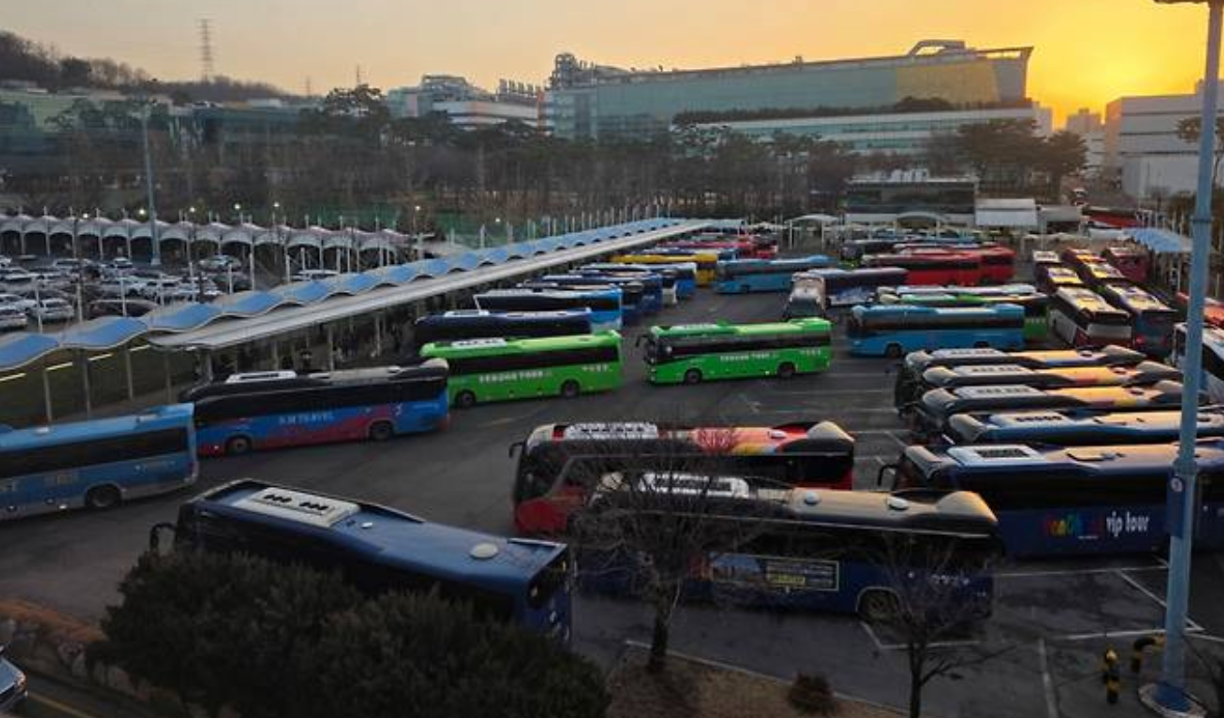
In early 2025, a regional charter bus transportation union sent a letter to its members. It was a bid for commuter buses for a large Korean IT manufacturing company. The company was looking for a driver for a route with 130 weekdays and 14 holidays for two years.
Bidding for commuter buses for large companies is something that happens every year, but one item in the notice caught the attention of the transportation industry.
"Install AI safe driving platform, submit safety index"
It was a line in the "Installation of safety and control equipment" section of the business operation standards. It wasn't just an option, but a near-requirement for participation, meaning that charter bus operators who wanted to participate in this tender had to have an AI safe driving platform installed in their vehicles.
This is a new trend in the large corporate commuter bus market, and it's not just a one-off announcement - it's a result of a change in operational realitiesthat large companies operating commuter buses face.
In this article, we'll look at three things in turn.
- Why AI safe driving platforms are now eligible to bid on commuter buses
- What's changed in real-world implementation (from a large enterprise)
- What operators and large organizations need to prepare for now
Why AI safe driving platforms are now eligible to bid for commuter buses
Structural risks of rush hour - how commuter bus accidents lead to multiple collisions
Commuter buses have fixed hours of operation. Around 7am and around 6pm on weekdays. These are the times when all the vehicles in the city pour onto the roads at once.
The road conditions during these hours have one characteristic. It's virtually impossible to maintain a safe distance from the car in front of you. Traffic is packed tightly together in congested areas and starts and stops at signalized intersections.
The problem is that commuter buses are different from regular cars. Their large, heavy bodies require longer stopping distances, and one small lapse in driver judgment can easily lead to a multi-vehicle pileup. It's not uncommon for a single commuter bus to rear-end multiple vehicles in a chain reaction.
And when this happens, the cost to the operating company goes far beyond the cost of a typical accident.
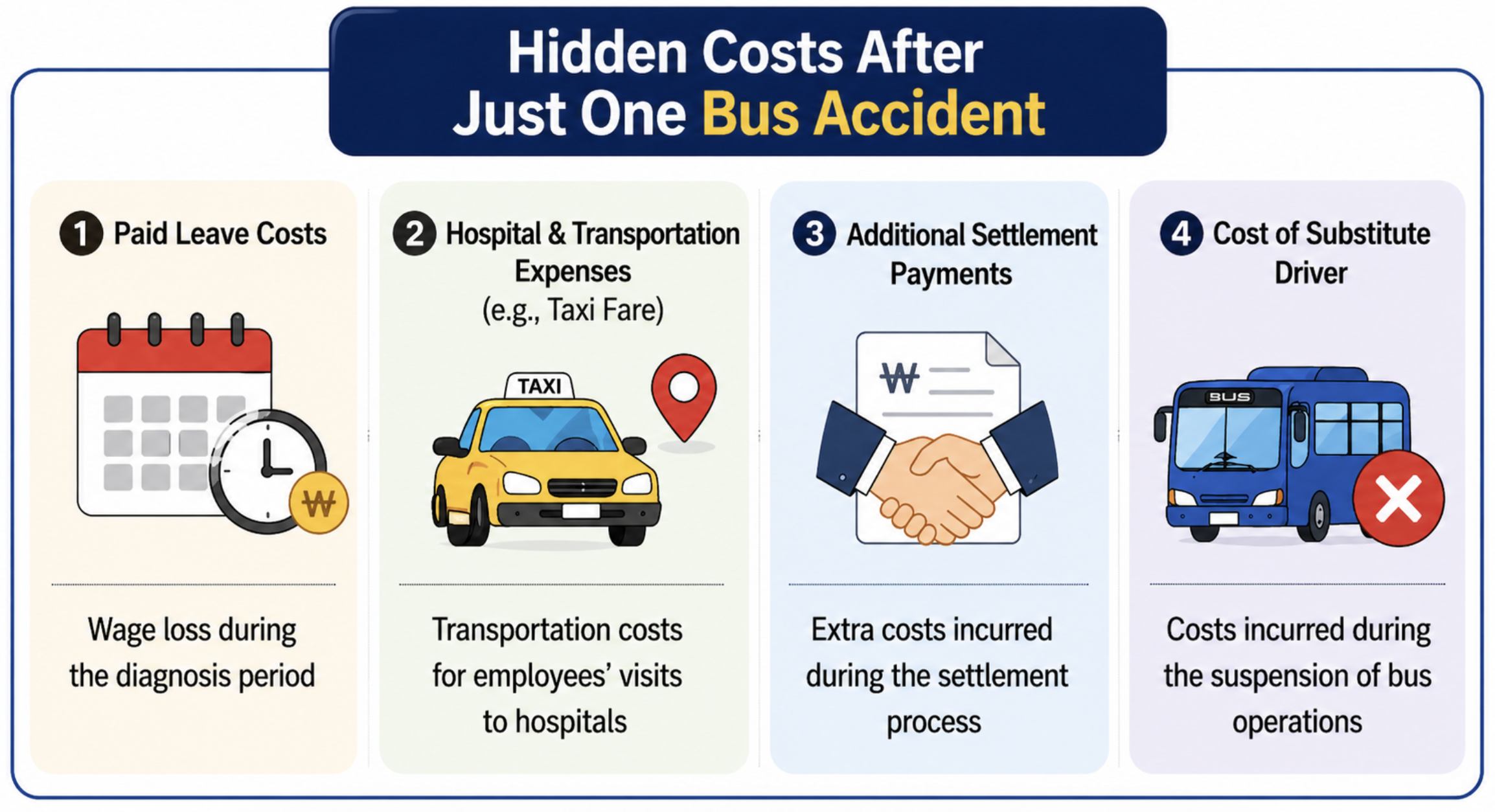
The real cost of a single commuter bus accident
A commuter bus accident doesn't just end with vehicle repairs and insurance payments. Because these vehicles are transporting people to work, a different cost structure comes into play when they are involved in an accident.
Immediately after the accident, the employees on board are taken to the hospital to be checked out. Even if the impact is mild, the company will have to cover the following for the employees
- Paid time off costs - lost wages during the diagnosis period
- Transportation costs to and from the hospital (taxi fare, etc.)
- Additional settlement money
- Cost of arranging alternative transportation to and from work - for the duration of the accident vehicle's out-of-service period.
In a single multiple-vehicle crash, these costs are incurred all at once. If you have 30-40 people on board, the collateral costs to your company for just one accident far exceed the cost of repairing the vehicle.
Add to that the issue of trust in the safety of the employees themselves. As more employees are injured on company-provided commuter buses, the scope of responsibility for the HR and general affairs teams quickly expands.
③ Limitations of outsourcing - There is no way to directly check the safety management of commuter buses
Large companies usually outsource their commuter buses to an external driver. This is due to cost-effectiveness and ease of management, but there is a shadow that this structure creates.
It's hard to see how the outsourcing company is doing with "driver safety management".
- How individual drivers' risky driving behaviors (drowsiness, distracted driving, cell phone use, etc.) are actually being managed.
- What actions the company has taken when risky behaviors are detected.
- Whether driver training and retraining is effective.
All of this is the internal domain of the for-hire driver. Larger companies only get to see "how things were being managed" after an accident.
This structural limitation is essentially the reason why AI safe driving platforms have been included in the tender qualifications. Once an AI safe driving platform is installed in a vehicle, driver behavior, event, and action history is automatically recorded as objective data. This creates an environment where the contractor can see information that is only available to the driver, and the contractor can also see it.
In other words, a new operating model of"outsourced but managed together" becomes possible.
What has changed in practice - the case of a large domestic company
One of the first large companies to adopt this model is a large Korean IT manufacturing company. Let's take a look at how A.I.Matics' AI safe driving platform, AID, has been applied to about 2,000 employee commuter buses.
Case Study - 2,000 employee commuter buses of a large Korean company
"Our company operates about 2,000 commuter buses for employees. Since the introduction of the AI safe driving system in August, there hasn't been a single serious accident with a broken bone, and passenger complaints have decreased significantly due to the effectiveness of management and training through the AID platform."
- Commuter bus manager of a large domestic company
The changes before and after implementation are summarized by two indicators.
- Achieved ZERO serious acc idents - 0 serious accidents with broken bones or more since implementation
- Significant reduction in passenger complaints - thanks to management and training based on driver behavior data
This is more than just a reduction in accidents, but a restoration of trust that the company is providing a "safe commute" for its employees.
What made the difference
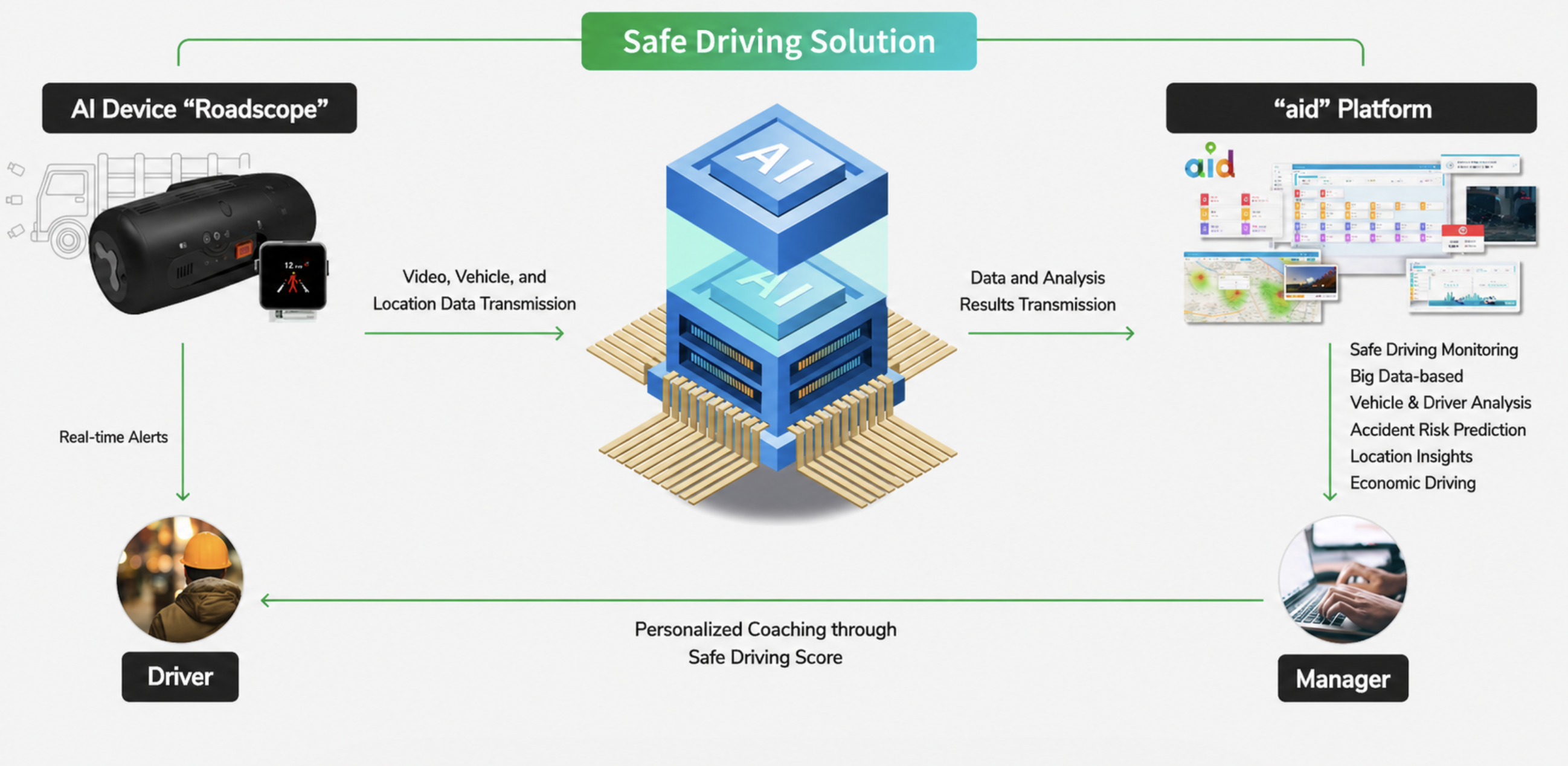
The way the AID platform works in practice boils down to three steps
1. Real-time detection of risky behavior
AI cameras installed in the vehicle detect driver drowsiness, distracted driving, cell phone use, smoking, etc. in real-time. If an anomaly is detected, the driver is immediately alerted.
2. Objective evaluation with driver safety index
Each driver's behavioral data is automatically accumulated and converted to a driver safety indexbased on 1,000km of driving distance. Items with a high risk of accidents, such as signal violations, failing to maintain a safe distance, and failing to look ahead, are weighted to provide a risk-based assessment rather than a simple count of violations.
3. Data-driven training and management cycle
The calculated safety index is provided to managers in a comparable form for each driver, each vehicle, and each driver. Drivers with repeated risky behavior are trained and reassigned, and their history is automatically recorded in the system.
As these three steps are repeated, a cycle is created in which the driver's behavior itself gradually improves, resulting in fewer accidents, and fewer accidents mean fewer employee complaints.
What drivers preparing to bid for commuter buses need to know
This trend isn't unique to one company - the pain points faced by large companies operating commuter buses are the same, so it's likely that similar qualification requirements will appear in future commuter bus tenders for other large corporate and public organizations.
For charter bus operators, this is a new market landscape change. Charter bus operators who have an AI safe driving platform in their fleet and those who don't will be able to bid on commuter buses.
Here are the key things you need to know to be read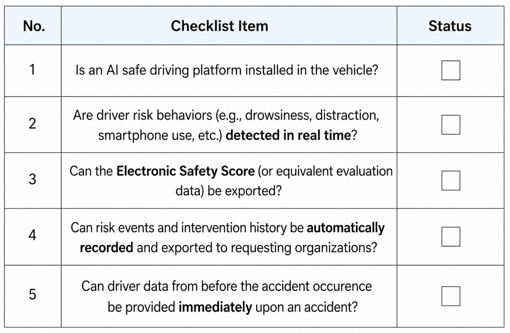
If you have fewer than three "yeses" out of five, you're likely to be disqualified from future large commuter bus bids. Conversely, if you have all five, you'll have a distinct advantage in the bidding market.
What large enterprise human resources and administrative staff need to know
This change isn't just for drivers; it's also opening up new areas of responsibilityfor the human resources, general affairs, and safety managers of large organizations that contract out commuter buses.
In the past, it was thought that simply "outsourcing" meant that much of the responsibility for safety management was transferred, but that perception is rapidly changing following the implementation of the Fatal Accident Penalty Act. Evaluating and supervising the level of safety management of subcontractors has also been clearly established as an obligation of the prime contractor.
Including an AI safe driving platform as part of the tender qualifications is the most practical and effective way to fulfill this obligation. It's about having a data-driven environment that manages safety with your contractors, not for them.
Wrapping up - a new standard in commuter bus safety management is being created
To summarize all of this in one sentence
The safety management of large commuter buses is moving from a "trust the contractor" model to a "look at the data together" model.
and the first sign of this shift is in the bidding requirements.
For operators, it's a new market entry, and for large companies, it's a new safety accountability tool. For both sides, now is the time to start preparing.
Frequently asked questions (FAQs)
Q. When will AI safe driving platforms be eligible for commuter bus tenders?
A. There is no clear starting point for this change, but in early 2025, commuter bus tender notices from some large companies began to specify "installation of an AI safe driving platform" as an eligibility or operational criterion, and the trend has since spread to other companies and public organizations. If you are a charter bus operator, we recommend that you prepare for future bids with an AI safe driving solution in place.
Q. How much does it cost to install an AI safe driving platform?
A. It depends on the number of vehicles, the specifications of the solution, and maintenance options. You should consult with your solution provider to estimate the appropriate cost based on the size and environment of your commuter bus operation. However, the general consensus among adopters is that the investment is quickly recouped when considering the costs incurred by the company in the event of a single accident (vehicle repairs, paid time off, settlement payments, employee transportation costs, etc.
Q. Why do I need an AI safe driving platform and not just a black box?
A. Dashcams record "what happened after the accident". In contrast, an AI safe driving platform "detects risky behaviors and warns the driver before an accident occurs." In addition, while a dashcam only records video data, an AI platform automatically accumulates a history of risky behaviors, events, and actions by driver. This makes a critical difference in an environment where commuter buses need to demonstrate accountability for safety management.
Q. How is the Driver Safety Index calculated?
A. Driver behaviors detected by AI cameras (drowsy driving, distracted driving, cell phone use, etc.) and risky driving events (signal violations, failure to maintain a safe distance, hard braking, etc.) are scored on a per 1,000km basis. The scores are weighted differently based on the higher risk of accidents (top, middle, bottom) and are risk-based, not just based on the number of violations. It is an objective safety evaluation tool that enables driver-by-driver, vehicle-by-vehicle, and operator-by-operator comparisons.
Q. Can large companies that outsource see their drivers' data directly?
A. Yes, you can. The AI Safe Driving Platform is designed so that both the outsourcer and the contractor can view the data based on their permissions. The contracting company can regularly check the history of risky behavior of each driver, the trend of risky events, and the contractor's action history, which can be used as objective proof of the contractor's obligation to ensure safety and health in the era of the Fatal Accident Penalty Act.
Is my company ready for this change?
If you are a transportation company, please check your eligibility to bid based on the bidding eligibility checklist in the text, and if you are in charge of a large company, please check the criteria for evaluating contractors. We will provide you with specific preparation directions and case materials through consultation.
Get a consultation on adopting AI safe driving platform for commuter buses

