

When a large company's human resources team selects and renews a commuter bus driver, what should they evaluate? Comparing only price and service can lead to safety risks that the company was unaware of.
Change has already begun. Tenders for commuter buses from large domestic manufacturing conglomerates have begun to specify safety standards such as "installing AI safe driving platform," "submitting safety index," and "driver safety training at least once a month." A new standard for the evaluation of outsourced drivers is being created.
This article summarizes five safety criteria that HR and general affairs teams should check when evaluating contracted drivers, based on real commuter bus tender notices from large companies.
Why do we need new criteria for evaluating contract drivers?
Most large corporate commuter buses are owned and driven by contract operators. The owner pays the driver for each trip.
In this structure, "driver evaluation" has long been centered on price, service, and vehicle condition. However, the environment has changed rapidly in recent years.
- Since the implementation of the Fatal Accident Compensation Act, accidents on outsourced commuter buses can lead directly to criminal liability for the management of the client company. The defense of "outsourcing" is no longer acceptable without proof of fulfillment of safety management obligations.
- Safety standards havebegun tobe specified in the tender notices of leading conglomerates. Installing an AI safe driving platform, submitting a safety index, and regular safety training are among the qualifications or operational criteria.
- Deductibles - Insurance premiumsare affected by the driver's accident history over the years. Choosing a driver with poor safety management can increase the cost of operating a commuter bus for the owner.
- The impact froman employee and family perspectivecannot be ignored: commuter bus accidents directly affect employees, and they also affect company reputation and recruitment.
As a result, the evaluation of transportation by the HR and general affairs team should be expanded from a price-service focus to a price-service-safety focus. However, generalizations such as "evaluate safety" are not helpful in practice. Specifically, what and how to evaluateare needed.
5 Safety Criteria for Evaluating Commuter Bus Contract Drivers
The following five criteria are actually listed in the tender documents of large commuter bus companies, and they work in practice when evaluating bids. We have summarized them in a form that human resources and general affairs teams can check themselves when selecting and renewing drivers.
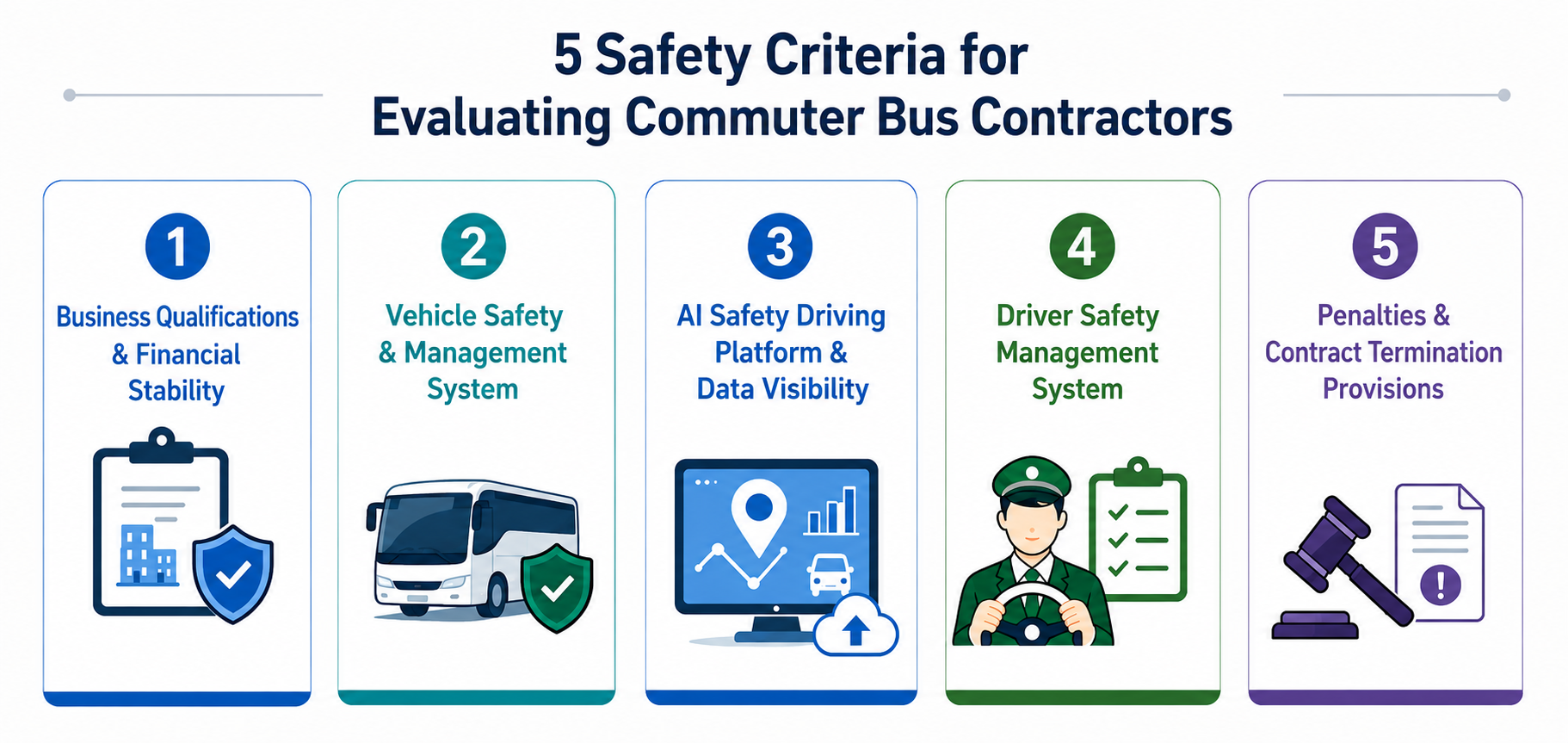
Criterion 1. Business qualification and financial stability
The starting point for any safety evaluation is whether a driver can sustain a stable business. Financially unstable drivers are less likely to invest in safety and are at greater risk of contract termination.
What to look for
- Whether the operator is registered as a charter bus carrier under Article 4 of the Passenger Motor Vehicle Transportation Business Act
- Charter bus deductible insurance (ability to compensate in the event of an accident)
- Corporate credit rating (C or higher is the standard for bidding for large companies)
- Commuter bus and shuttle bus operation performance for the last three years
- The level of vehicle ownership required to operate the service being bid on (typically 120%)
It is generally accepted that a driver that does not meet these criteria does not qualify to enter the safety management evaluation.
Criterion 2. Vehicle safety specifications and management system
The level of safety of the vehicle itself is directly linked to the likelihood of an accident occurring. Vehicle condition checks are the most basic and most frequently formalized area of driver evaluation.
Items to be checked
- Vehicle age (the standard for tenders for large companies is within 7 years from the factory date)
- Vehicle type (ratio of coaches to standard buses, appropriateness for the number of employees)
- Safety equipment (escape hammers, fire extinguishers, etc.)
- Regular inspection frequency of safety equipment (at least twice a year)
- Regulation of advertisements outside the vehicle (blocking advertisements of competitors and sensitive issues)
The 7 years old or less standard is actually the standard adopted in many large commuter bus tenders. Older vehicles are not only more expensive to maintain, but also affect safety in the event of an accident.
Criterion 3. AI Safe Driving Platform - Data Visibility
The most significant changes are happening in this area. The level of safety management of the outsourced driver is becoming a key evaluation criterion, as the owner can check the data directly.
What to look for
- Whether an AI safe driving platform is installed (detects and records dangerous driving in real time)
- Regular submission system of safety index and driving data
- Attachment and operation status of control system terminals
- Visibility of data accessible to the client (real-time location, risk events, driver scores, etc.)
- Clarification of data storage and submission obligations (contractual provisions recommended)
In particular, the "Safety Index Submission" is not just a formality, but an objective verification tool for the level of driver safety management. Operators with low safety scores can be required to improve, while those with high scores can be allowed to continue operating.
From an owner's perspective, this criterion is decisive for another reason. In the event of an accident,it serves as proof of fulfillment of the client's safety management obligations. The record of "regularly checking and managing the safety data of the outsourced driver" is a key factor in determining the application of the Fatal Accident Penalty Act.
Criterion 4. Driver safety management system
Data from the National Police Agency confirms that driver behavior is a major contributing factor to accidents. Therefore, the driver management system of a company is a determinant of accident risk.
What to check
- Driver rest break system (8 hours or more is the standard for bidding for large companies)
- Frequency of regular safety training for drivers (once a month or more is standard)
- Mandatory safety training system organized by the contractor (recommended twice a year or more)
- Safe driving score calculation and management system for each driver
- Safety verification procedures when hiring new drivers
In particular, driver safety training is not meaningful if only the formal completion is verified. It is key to ensure that the training history is recorded as data and that a virtuous circle of additional training is provided to drivers who exhibit risky behavior.
Criterion 5. Penalties for violations and termination clauses
Criteria only work if there is an effective penalty for violations. Safety standards should be spelled out in the contract, but they should be accompanied by rights that the owner can actually exercise in the event of a violation.
What to look for
- Penalties for non-compliance (the standard for large corporate bids is 600% of the unit cost of operation)
- Penalties for not installing safety equipment, control systems, or neglecting maintenance (e.g., 200,000 won per trip)
- Evaluation score reflection system for violation of safe operation obligations
- Collection of performance memorandum and right to terminate contract in case of repeated violations
- Request for correction in case of safety index failure - right to adjust contract
Penalties are not an end in themselves, but rather a mechanism to ensure that drivers actually adhere to the evaluation criteria. The clearer the penalty clause, the better the driver's safety management level on average.
How to use the five criteria
The five criteria are not just a checklist, but a tool that can be utilized in stages.
Selecting new drivers
Specify the five criteria as qualification requirements or evaluation items in the tender announcement. In particular, criteria 3 (AI safe driving platform - data visibility) and 5 (penalty - contract termination clause)** should be specified at the time of bidding, so that they are effective in the subsequent operation process.
Renewal phase for existing operators
At contract renewal time, reevaluate drivers against the five criteria. The safety index, training history, frequency of penalties, etc. are evaluated collectively to provide an objective basis for renewal or adjustment of conditions.
Monitoring steps during operations
Checking the five criteria on a quarterly or semi-annual basis will help you track changes in driver safety management levels. If your safety index drops or driver training completion rates drop, you can take proactive action.
The difference AID makes in driver assessment
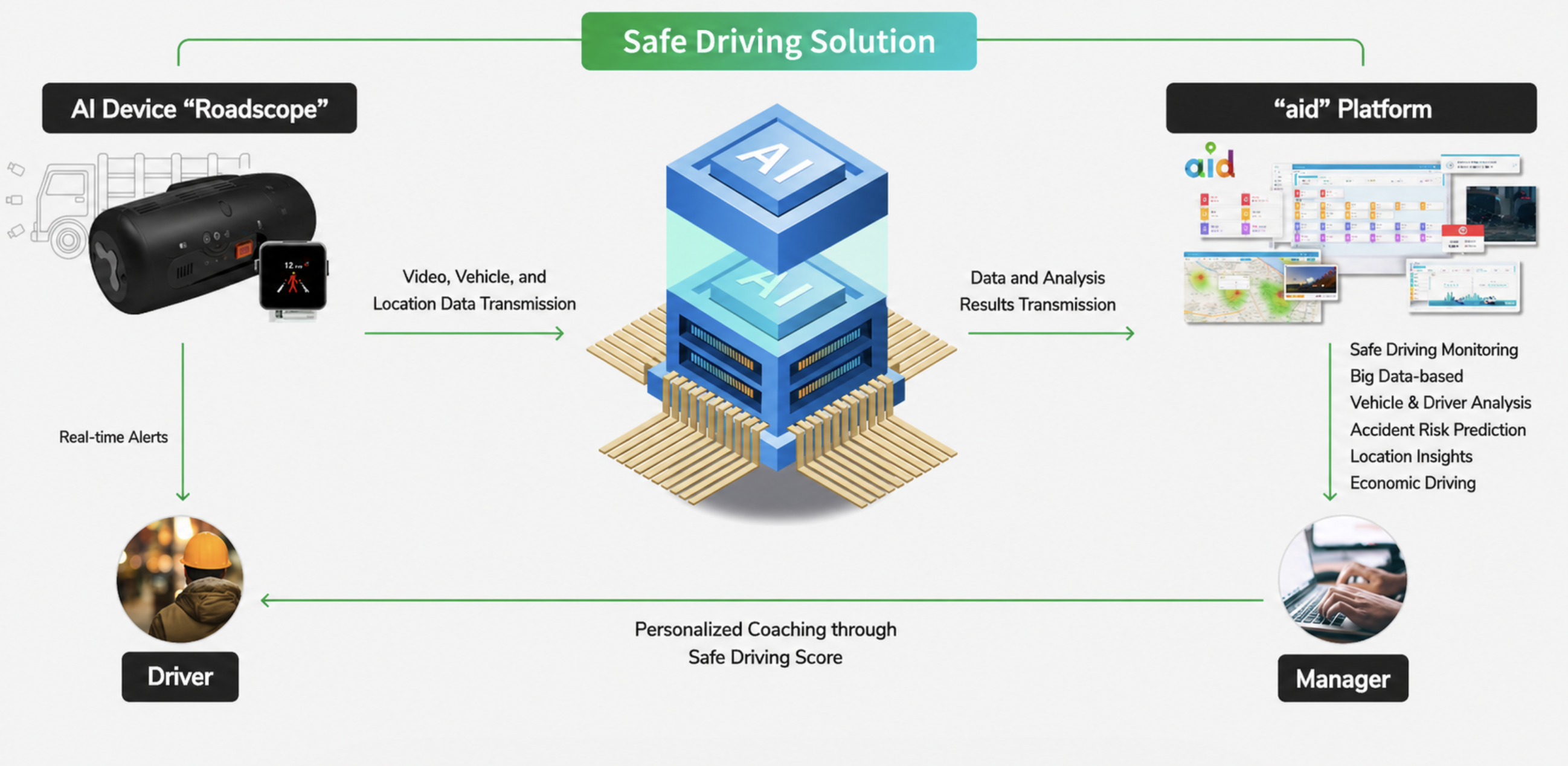
A.I.Matics' AIDis an integrated solution that uses AI to analyze accident risk factors inside and outside the vehicle in real time, helping drivers meet the key areas of the five criteria with data.
In particular, for the HR and general management team, AID works as a "tool that allows the client to directly check the level of safety management of the consigned driver with data."
- Smart Event Warning - Real-time detection of dangerous driving such as signal violation, centerline crossing, and reckless driving (meets criteria 3-4)
- ADAS warnings - lane departure, collision risk, and pedestrian detection (meets criteria 2-3)
- Blind Spot Detection (BSD ) - Detection of pedestrians and motorcycles in the right and rear blind spots (met criteria 2-3)
- AI Video Surveillance Aid Platform - Real-time event, location, and driver scoring with client headquarters access (Criterion 3 core)
- Driver scoring - AI-based quantification of driving habits - score-based feedback (Criterion 4 core)
- DTG & e-TAS Integration - Automatically save driving records and submit them to the administration (supporting criteria 1-2)
The biggest value for fleets is data visibility and continuity. Even if the driver is replaced, the platform account and data access rights can be designed to remain at the client's headquarters, which compensates for the limitations of the outsourcing structure.
Proven effectiveness - how a global manufacturing giant implemented
A global semiconductor and electronics manufacturing company, which operates the largest commuter bus fleet in Korea with tens of thousands of employees, implemented AI safe driving solutions for about 2,400 commuter buses:
| Metrics | Effect |
|---|---|
| Insurance payout per bus | Reduced by approximately KRW 1.47 million (68%) |
| Safe driving score | 50.9 points → 76.9 points(73% increase) |
| Signal violations | 41% decrease |
| Total accidents (AID+ADAS) | Approximately 44% reduction |
| Cost per vehicle per year | Approx. 500,000 savings |
These results show that the five evaluation criteria are not just a formality, but a tool that leads to real-world reductions in accidents and costs.
Wrapping up - assessing for-hire drivers is not "just a formality"
To summarize everything we've learned so far in one line
Commuter bus for-hire driver evaluation should extend beyond price and service to the five safety criteria: operator qualifications, vehicle safety, AI platform-data visibility, driver management, and penalty provisions. And for this evaluation to work, it needs to be data-verifiable.
The structure of outsourcing does not absolve the client of responsibility; rather, the fact that it is outsourced makes objective evaluation criteria and data visibility all the more important.
Where are we in our transportation assessment?
Take a look at your current level of transportation assessment with these five questions
| Number | Check item | Status |
|---|---|---|
| 1 | Do you regularly verify the business license and financial stability ofyour drivers? | ⬜ |
| 2 | Does the client verify the age, safety specifications, and regular inspectionsof the consigned vehicles? | ⬜ |
| 3 | Is the AI safe driving platform installedon the consigned vehicle so that the safety data can be checked by the client? | ⬜ |
| 4 | Does the company track driver training, off-duty time, and safety scoresfor outsourced drivers? | ⬜ |
| 5 | Do contractual penalty and termination provisionsfor safety violations work? | ⬜ |
If you have fewer than three "yeses," your for-hire driver evaluation may not yet be safety-focused. It may also be difficult to prove the company's fulfillment of its safety management obligations in the event of an accident.
Get a consultation on establishing a commuter bus contract driver evaluation system

About this series
While this article covers"Howto evaluate contract drivers", the guide to introducing a commuter bus safety management platformcovers the practical steps of"How to implement", and the article on changes to commuter bus bidding qualificationscovers the big picture of"Why should you think about implementing now". Together, they provide a complete overview of the background, evaluation, and implementation of commuter bus safety management.
Frequently asked questions (FAQs)
Q. Do I need to apply all five criteria to evaluate my drivers?
A. You can prioritize and apply them in stages depending on your company's situation. However, Criterion 3 (AI Safe Driving Platform - Data Visibility) and Criterion 5 (Penalty - Contract Termination Clause) are recommended to be applied first. Without these two, the other criteria will not be effective.
Q. Can the new criteria be applied to drivers under existing contracts?
A. Yes, it is possible to adjust the terms of a re-contract or renewal to reflect the new standards at the time of contract renewal. It is also possible to negotiate the introduction of safety standards during the contract period in the form of an addendum agreement. As meeting the safety standards is becoming a prerequisite for entering the commuter bus market for large companies, it is likely to be negotiated with operators.
Q. What if the contracted driver feels burdened by the installation of the AI safe driving platform?
A. The installation cost burden structure varies on a case-by-case basis. Some large companies' bids specify that "individual installation costs are included in the cost of transportation and are not paid separately by the contractor," so that the driver bears the cost but reflects it in the cost of transportation. From the operator's point of view, the same qualification is required in other large commuter bus tenders, so once it is introduced, it can be utilized in other tenders.
Q. Isn't driver safety training more than once a month too burdensome?
A. It is not too burdensome if the training is data-driven and customized rather than formalized. Since the AI safe driving platform automatically records risky behavior data for each driver, it is effective to use that data to shorten the training to what each driver needs. Drivers with fewer risky behaviors can be trained with a quick review, while many drivers can be trained with more intensive training.
Q. How is the Safety Index evaluated?
A. The AI safe driving platform automatically aggregates and scores risky driving events (such as drowsiness, distracted driving, speeding, red light running, etc. Typically, out of 100 points, points are deducted for each risky behavior, and you can see the average score for the entire fleet as well as the individual driver's score. Specifying an evaluation threshold in the contract (e.g., a score of 70 or higher) provides an objective operating standard.
This article is for general information purposes only; actual contractual provisions and penalty criteria may vary depending on individual company circumstances and legal review.

