
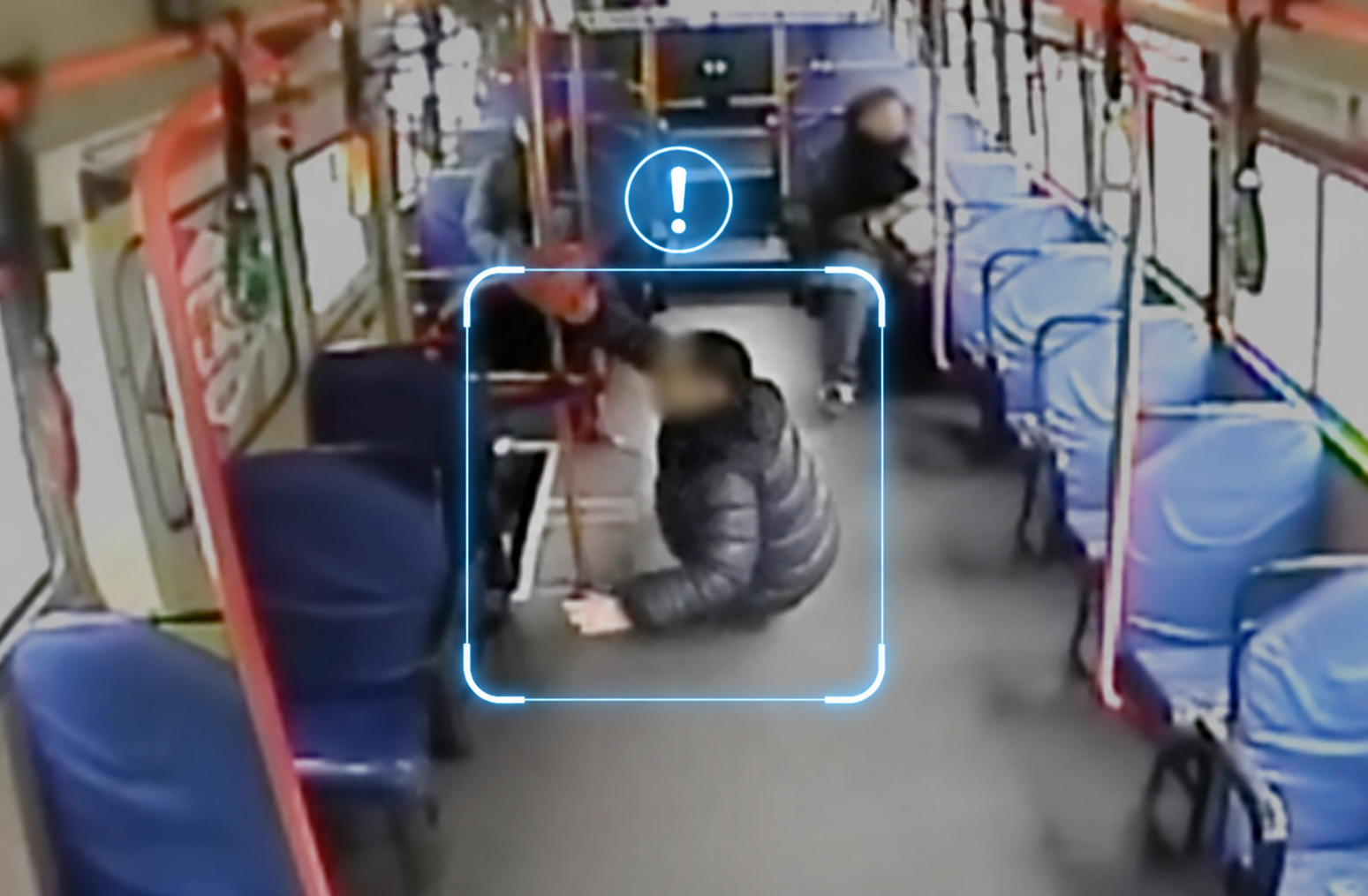
Monday, 11:20 a.m. A call comes in to the office of a city bus company.
“There was just an accident on Route OO. An elderly passenger fell in the aisle as the bus was pulling out. We called 911, and they say the passenger is conscious but may have a fractured pelvis.”
As a transportation company operator, you instinctively grasp the implications of this single call in an instant: this accidentmarks the starting point of a long process that is about to unfold.
This article examines the ripple effects this hypothetical accident creates for a route bus transportation company, and how the technological solutions that can prevent such consequences in advance actually work.
7 Days After the Accident — The Ripple Effects of a Single Incident
From the transportation company’s perspective, an accident does not end at the moment it occurs. Its impact tends to expand as time passes.
Day 1 — The Start of Compensation Claims
As the family of the injured passenger confirms the fracture in the hospital room, the first questions begin.
“How was the driver operating the vehicle? Did he start moving before the doors had closed?”
At this point, the data the transportation company must have is clear: the driver’s behavior immediately before the accident, the status of the doors, andobjective data regarding the time the vehicle started moving. If this data is missing or unclear, the company’s position in compensation negotiations becomes weaker.
Furthermore, the costs at this stage are significantly higher than what transportation companies generally anticipate. Looking at actual compensation cases for in-vehicle passenger accidentsconfirmed through interviews with route bus companies, it has been reported that compensation per incident ranges from 60 million to 70 million won. If the accidentresults in serious injury or permanent disability, the amount can be even higher.
Day 3 — Local Media Coverage
A few days after the accident, a local media outlet publishes an article with a headline such as “A Series of Passenger Falls on City Buses… Safety Measures Criticized as Inadequate.” Posts on social media by other passengers who were on the same bus at the time of the accident are often cited alongside the article.
Unlike other transportation businesses, route buses are a highly public service. Accidents transcend the scope of a single private transport company to become a matter of concern for the local community, and the company’s reputation is quickly affected.
Day 7 — Administrative Investigation and Operational Review
The local government’s transportation department requests an investigation into the circumstances of the accident. The company is required to submit documentation proving compliance with safety management obligations.
- Driver safety training completion records
- Vehicle regular inspection records
- Operational data immediately prior to the accident
- Records of compliance with rest periods for transportation workers
If these documents are not systematically organized, there is a high likelihood that you will be deemed to have violated safety management obligations. This could lead to a decline in business evaluation scores, a review of route operations, and even impact your contract renewal evaluation.
Beyond that — costs that accumulate over the years
In addition to the direct compensation costs of a single accident, the following costs accumulate:
- Increases in mutual aid contributions and insurance premiums: Accident history is factored into cost calculations for many years.
- Criminal Liability Review: In the case of accidents resulting in serious injury or death, the applicability of the Act on the Punishment of Serious Accidents is reviewed. This may extend to criminal liability for management officials.
- Operational disruptions: Short- and long-term operational costs are incurred, such as route adjustments, additional driver training, and the introduction of new safety devices.

Actual Accident Costs for Bus Companies — Scale Confirmed Through Interviews
Setting aside abstract terms, how much do route bus companies actually bear in accident costs? Interviews with three domestic route bus companies revealed the following cost figures.
| Company Type | Scale of Accident Costs |
|---|---|
| Group of 5 Companies in the Seoul Metropolitan Area | Insurance premiums of approximately 7 million won; numerous cases of compensation for passenger injuries ranging from 60 to 70 million won per incident |
| Metropolitan Area Operator with Approximately 250 Vehicles | Approx. 100 million won per month (approx. 1.2 billion won annually) — In-vehicle passenger accidents account for the largest share |
| Operators with approximately 150 vehicles in South Chungcheong Province | Approx. 620 million won annually — Compensation for passengers in vehicle-to-vehicle accidents and for passengers in the other vehicle in vehicle-to-vehicle collisions accounts for the largest share |
Source: Interviews with safety management officials at transportation companies (3 companies)
Converted to annual accident costs per vehicle, this amounts to approximately 4 million to 4.8 million won. This figure focuses on direct compensation and indemnity payments, excluding insurance premiums; when administrative penalties, operational disruptions, and reputational damage are factored in, the actual burden is even greater.
The following facts were consistently confirmed in all three interviews:
- Accidents involving passengers account for the largest share(passengers fainting, injuries sustained inside the vehicle, etc.)
- Accident costs accumulate to several million won per vehicle annually, regardless of company size
- Accumulated accident costs over many years effectively function as fixed costs
It is the common perception among bus company officials that a single accident has ripple effects that impact the overall operations of a bus transport company for years, and that this cost burden is becoming increasingly heavy.
The moment they regret most — "We have the video, but no data"
There is a moment that transport company operators commonly face at every stage described above.
It is the lack of meaningful data.
Most city buses already have CCTV cameras operating both inside and outside the vehicles. In the event of an accident, footage can be secured and reviewed afterward. However, there is a separate problem.
Victims’ families, the media, government agencies, insurance companies, and legal reviews—all of them demand not just the footage itself, but data that analyzes what that footage means.
- What exactly was the driver’s behavior immediately before the accident (intensity and degree of sudden acceleration)?
- Was the driver drowsy, not paying attention to the road ahead, or using a cell phone?
- How exactly were the timing of the door opening and the vehicle’s departure aligned?
- What kind of risky driving patterns has this driver exhibited in the past?
- Did the company recognize these patterns and attempt to correct them?
This information is difficult to determine based solely on video footage. It takes a person reviewing dozens of hours of footage to uncover the truth of the minute leading up to the accident, and a driver’s usual patterns cannot be determined from a single video clip.
Ultimately, transportation companies often find themselves in a situation where “we have the footage, but that footage does not serve as data that protects our company.”
In the case of accidents involving vehicles moving with doors open, precise synchronization of the door opening time, the vehicle’s departure time, and the driver’s actions is required. Simple CCTV footage does not allow for the integrated analysis of these three elements. Unless AI automatically classifies, records, and organizes risky behaviors, post-accident analysis will still rely on manual human effort.
Signs that could have been prevented before the accident
There is one more important fact to consider here.
In the accident described in the scenario above, there were likely warning signs that could have been detected immediately before the crash.
- Did the driver exhibit a more abrupt starting pattern than usual?
- Was the stop time at the station shorter than usual?
- Did the vehicle begin accelerating before the doors were fully closed?
- Were there passengers standing in the aisle, passengers not holding onto the handrails, or elderly or infirm passengers who were unable to take their seats while the vehicle was starting or moving?
Whilethese signs are captured on CCTV footage, they are details that can only be identified through manual review by a person after the fact. It is difficult to simply rely on CCTV operations alone to send warnings to drivers before an accident occurs or to automatically identify drivers who repeatedly exhibit the same risky patterns and connect them to training programs. In particular, dynamic signals such as the posture and position of passengers inside the vehicle are difficult for the driver to monitor in real time while driving, so even if footage is available, these issues are usually only identified after an accident has occurred.
Only when AI video recognition, vehicle sensors, and automatic classification technologies perform this task in real time can intervention occur at the pre-accident stage. Warnings are sent to the driver immediately upon the detection of a danger signal, and all events are automatically classified and recorded, accumulating data on patterns specific to each driver and vehicle.
In other words, the accident in the scenario could have been prevented in two stages.
Stage 1 — The moment AI detects risky behavior immediately before an accident and alerts the driver
Second — The moment when, upon an accident occurring, the data on risky behavior is automatically organized, enabling rapid accident analysis and evidence collection
Both of these must work simultaneously for a transportation company to protect itself from accidents.
Quick Check — Does our company have the following in place?
① A system that automatically detectsdrivers’ sudden acceleration, sudden braking, drowsiness, and failure to watch the road in real time
② A system that immediately alertsthe driver when dangerous driving occurs
③ A system that preserves event datawith automatically classified risky behaviorsalongside video footage taken immediately before an accident
④ A system for managing, scoring, and utilizing driver-specific risk behavior data for training purposes
⑤ An environment capable of immediately extracting key data from the minute immediately preceding an accidentfrom CCTV footage
⑥ A system that detects passengers standing in the aisle or in dangerous positions in real timewhile the vehicle is in motion and alerts the driver
Most city buses are already equipped with CCTV. However, for the six elements above to function together, an AI analysis system is required that goes beyond simple CCTV operation.
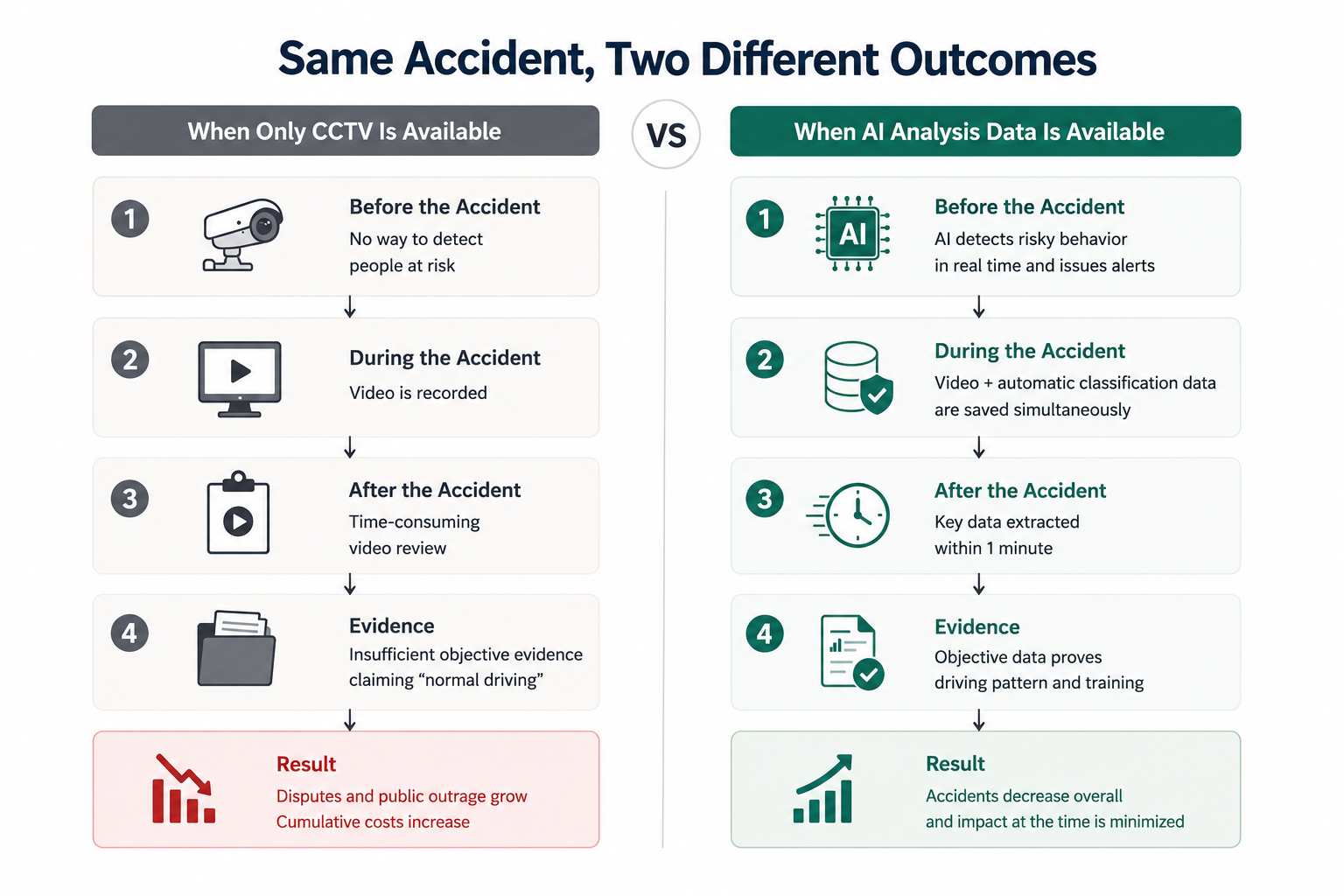
How would the scenario’s accident have differed if AID had been in place?
A.I.Matics’ aidis an integrated solution that uses AI to analyze accident risk factors inside and outside the vehicle in real time. While CCTV is a tool for “post-incident video retrieval,” aid is a tool that performs both “real-time intervention before an accident” and “post-incident data analysis.”If aid had been applied to the scenario’s accident, the following two changes would have been possible.
Immediately before the accident — First intervention (an area CCTV cannot cover)
The moment the driver begins to accelerate before the doors are fully closed, aid’s smart event alertis triggered. Sudden starts and rapid acceleration are detected in real time, and an immediate warning is sent to the driver.
If the driver was drowsy or not paying attention to the road ahead, the Driver Monitoring System (DMS)would activate simultaneously to deliver an additional warning.
Furthermore, aid also activates a feature that proactively detects dangerous situations involving passengers. It alerts the driver when a passenger standing in the aisle is in a dangerous posture or position, allowing the driver to recognize and respond before the passenger falls. This feature adds an objective safety aid to the area of passenger safety, which previously relied solely on the driver’s field of vision and attention.
How is this detection possible? AID analyzes in-vehicle video in two stages.
- First — Area Segmentation: The vehicle’s interior space—including seats, aisles, and doors—is pre-segmented into distinct zones. Definitions such as “where the aisle ends” and “where the area around the door begins” are configured for each specific vehicle.
- Second — Passenger Location Analysis: AI recognizes each passenger in the video and verifies in real time which zone they are in and what posture they are in.
By combining these two pieces of information, it becomes possible to make specific situational judgments—not just “there is a person in the vehicle,” but rather **“there is a passenger standing in the aisle” or “there is a passenger near the door as the vehicle is about to depart”**. If a dangerous situation is detected, a warning is immediately sent to the driver. Since it is difficult for a driver to monitor all seats and aisles simultaneously while driving, the AI is designed to assist in this role.
This is an area where CCTV is ineffective. CCTV merely records video; it does not alert the driver to dangerous behavior in real time. The footage is only utilized after an accident has occurred. AID’s primary intervention focuses on preventing accidents from occurring in the first place, which is the key difference that fills the blind spots of CCTV.
This is also the area where the Korea Transportation Safety Authority’s pilot project for route buses confirmed reductions of 99.7% in drowsy driving, 93.4% in failure to look ahead, and 87.6% in traffic signal violations.
In the Event of an Accident — Secondary Protection (Adding Context to CCTV Footage)
If an accident does occur despite these measures, aid’s AI video monitoring platformautomatically organizes and preserves key data from the moments immediately preceding the accident.
- Driver behavior in the minute immediately preceding the accident (automatic classification of drowsiness, failure to watch the road, and cell phone use)
- Precise time synchronization between door operation and vehicle departure
- Driving behavior immediately before the accident (quantification of the intensity of sudden starts, sudden acceleration, and sudden stops)
- Cumulative data on the driver’s typical risk patterns
- The company’s history of recognizing and training on those patterns
While CCTV footage is merely "available," aid data is "immediately actionable." There is no need for humans to manually review dozens of hours of footage; instead, risk events automatically classified by AI and driver scores are immediately organized.
This integrated data serves as objective evidence for the transportation company at every stage—from consultations with bereaved families and media responses to administrative investigations and legal reviews. The extent of the accident’s repercussions is determined by whether the company can “prove with data that it fulfilled its safety management obligations.”
Market Adoption Cases — Expanding Among Express and Route Bus Groups
AI-DVR integrated safety solutions based on aid are already gaining widespread adoption in the market. Through collaborations with major express and route bus groups and numerous route bus operators, a trend is emerging where data-driven safe driving management systems are spreading across all sectors of public transportation.
In particular, by providing features specialized for the route bus environment—such as early warnings of passengers collapsing inside the vehicle —the scope of preventive measures is expanded to cover the unique risk areas inherent in route bus operations.
Summary — If the transportation company in the scenario makes a different choice
Let’s return to the scenario.
At 8:20 a.m. on Monday, an accident occurs on Route 7. However, this time, all data immediately preceding the accident has been objectively recorded, and there is a history of additional training having been provided to the driver one week prior after the same risk pattern was detected.
Consultations with the victim’s family are conducted based on objective data. An administrative investigation confirms that the company fulfilled its safety management obligations. Media coverage is brief. The impact on insurance and mutual aid contributions is also minimized.
It’s the same accident, but the outcome is completely different.
From the transportation company’s perspective, accidents must be prevented if possible, and if they cannot be prevented, their repercussions must be minimized. Accidents involving route bus passengers are entering a realm where both of these goals are achievable.
👉Get a consultation on passenger safety management solutions for route buses
Frequently Asked Questions (FAQ)
Q. Our company’s city buses already have CCTV installed. Do we still need an AI safe driving solution?
A. CCTV and AI safe driving solutions serve different purposes. CCTV is used to review footage after an accident occurs, while the AI safe driving solution detects and alerts drivers to risky behavior in real time before an accident happens. Additionally, AI automatically classifies and records hazardous events in the video, organizing them into driver-specific scores and cumulative data. The difference is that while CCTV footage is simply “there,” AI-analyzed data is “immediately actionable.” The two are not substitutes for each other but rather complementary.
Q. How does AI accurately detect the posture and position of passengers inside the vehicle?
A. The AI first divides the interior space into zones (seats, aisles, doors, etc.), then recognizes each passenger in the video and analyzes in real time which zone they are in and what posture they are in. For example, if a passenger is near the door just as the vehicle is about to depart, it is identified as a hazardous situation; similarly, if a passenger is standing in the aisle while the vehicle is in motion, it is also identified as a hazardous situation. Since it is difficult for a driver to monitor all seats and aisles simultaneously while driving, the system is designed so that AI assists in this role by alerting the driver to potential accidents in advance.
Q. Aren’t door sensors sufficient to prevent door-opening accidents?
A. Door sensors are a basic safety feature, but they are insufficient to prevent door-opening-while-moving accidents or to provide clear post-accident analysis. Accidents occur due to a combination of the timing of door operation, the timing of vehicle departure, and the driver’s behavior. When AI video recognition and vehicle operation data integrate and record these three factors, it enables both preemptive warnings and post-incident evidence.
Q. Are the results of the Korea Transportation Safety Authority’s route bus pilot project applicable to our company?
A. The pilot project was conducted on 500 route buses from 13 transportation companies nationwide, so the data has been directly validated in a route bus environment. While results may vary slightly depending on company size and route characteristics, the fundamental mechanism for reducing risky driving behaviors operates identically. The pilot project results showed a 99.7% reduction in drowsy driving, a 93.4% reduction in failure to maintain forward attention, an 87.6% reduction in traffic signal violations, and a 55% reduction in the overall accident rate.
Q. Are the DVR and AI safe driving solution separate devices?
A. In the past, they were separate devices. However, solutions that integrate AI safe driving features and DTG (Digital Tachograph) functions into a single device have recently emerged on the market. Integrated solutions are well-suited for route bus operators because they reduce the burden of installing and managing individual devices and enable centralized operations covering accident prevention, regulatory compliance, and driver scoring.
Q. When do the benefits become apparent after implementation?
A. A reduction in risky driving behaviors can be observed immediately after implementation. Once drivers begin receiving real-time alerts, behavioral changes occur rapidly. A statistically significant decrease in the frequency of accidents is generally confirmed after at least six months of operational data.
This article is intended for general informational purposes. The accident scenario described in the introduction is a hypothetical example designed to aid in understanding the types of accidents involving route buses and does not refer to any specific accident. Specific determinations regarding legal liability and compensation may vary depending on the individual circumstances of each accident and legal review.

