
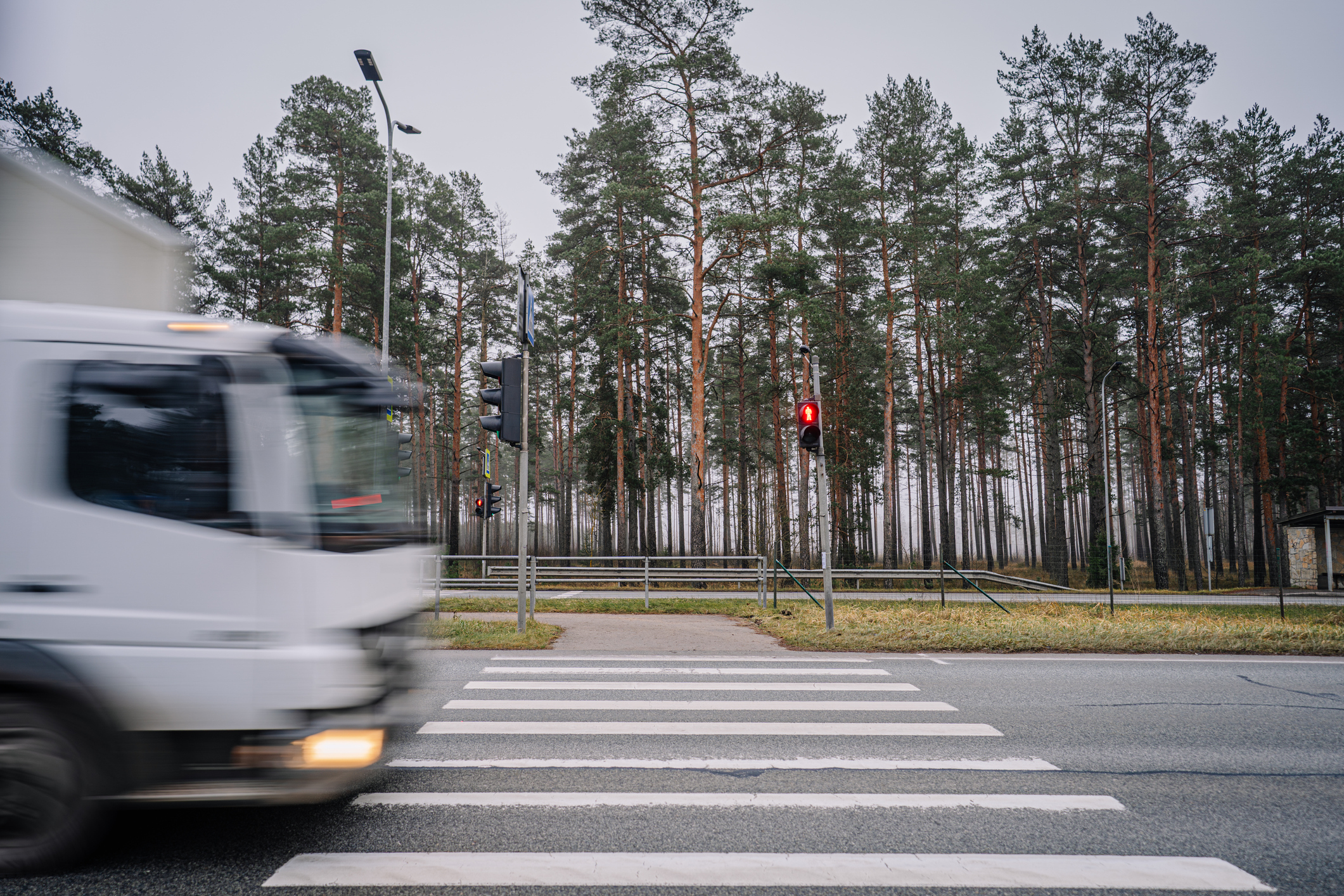
As a general rule, if you have comprehensive insurance, you will not face criminal penalties for a traffic accident. This is stipulated in the Special Act on the Handling of Traffic Accidents. However, there are 12 exceptions to this rule—these are known as the “12 Major Forms of Gross Negligence.” If an accident involves one of these 12 major acts of gross negligence ,the driver is subject to criminal penalties(imprisonment for up to five years or a fine of up to 20 million won) even if they have comprehensive insurance and have reached a settlement with the victim.
This article summarizes exactly what these 12 categories are, the criteria used to determine each one, and the points where people most commonly misunderstand them. The latter part of the article highlights specific items that transportation companies operating commercial vehicles should be particularly careful about.
Why Are There “12 Major Categories”? — The Structure of the Special Act
The fundamental principle of the Special Act on the Handling of Traffic Accidents is “restitution for victims over punishment.” In cases of negligent injury while on duty, if the victim does not wish to pursue punishment (settlement), criminal charges cannot be filed, and comprehensive insurance coverage serves as a substitute for such a settlement. The intent is to avoid treating every accident as a criminal offense in a society where driving is a daily necessity.
The “12 Major Forms of Gross Negligence” constitute the list of exceptions tothis leniency. These are serious violations of traffic laws that the law explicitly states “will not be tolerated,” and they are listed in the proviso of Article 3, Paragraph 2 of the Special Act on the Handling of Traffic Accidents. If a case falls under this category, referral to the prosecution and criminal trial proceedings will proceed regardless of insurance coverage or a settlement. In other words, the list of the 12 major forms of gross negligence isnot merely a penalty point system, but the threshold for criminal punishment.
The 12 Items at a Glance
| No. | Item | Key Criteria for Determination |
|---|---|---|
| 1 | Violation of Traffic Signals and Directives | Violation of signals given by traffic lights, police officers, etc., or of instructions on “No Entry” or “Stop” traffic signs |
| 2 | Crossing the Center Line | Driving across the center line, or illegally crossing, making a U-turn, or reversing (including crossing, U-turns, and reversing on highways, etc.) |
| 3 | Speeding | Driving at a speed exceedingthe speed limit by 20 km/h |
| 4 | Overtaking and Cutting In Violations | Violations of rules regarding overtaking methods, prohibited times, and prohibited locations; violations of the prohibition on cutting in |
| 5 | Violations of rules for crossing railroad crossings | Violations of rules for passing railroad crossings, such as failing to come to a complete stop |
| 6 | Violation of the duty to protect pedestrians at crosswalks | Violation of the duty to protect pedestrians at a crosswalk |
| 7 | Driving without a license | Driving without a license, or while the license is suspended or revoked (including construction machinery and international licenses) |
| 8 | Driving Under the Influence of Alcohol or Drugs | Driving while under the influence of alcohol (blood alcohol concentration of 0.03% or higher) or drugs, to the extent that normal driving is difficult |
| 9 | Driving on the Sidewalk | Driving onto the sidewalk or violating rules for crossing the sidewalk |
| 10 | Violation of the duty to prevent passengers from falling | Violation of the duty to take measures to prevent passengers from falling — so-called “departure with doors open” |
| 11 |
Violation of the duty to drive safely in school zones |
Injuring a child by failing to exercise due care for children’s safety in a school zone |
| 12 | Violation of cargo securing requirements | Violation of regulations regarding securing cargo to prevent it from falling |
Breaking it down by category — It’s easier to understand if you think of it as four groups
Rather than trying to memorize all 12, grouping them into four categories with similar characteristics helps reveal the overall structure.
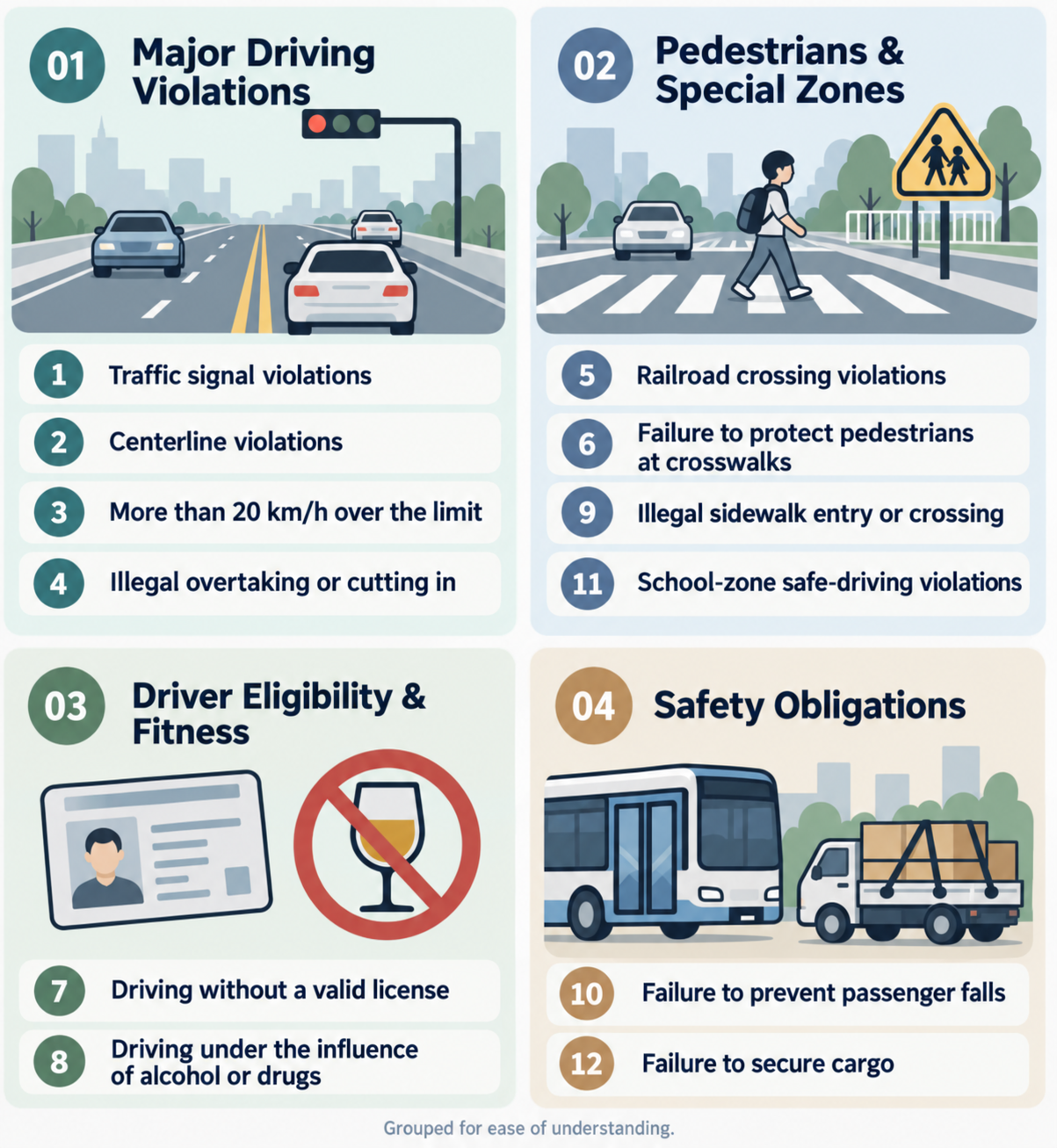
Group 1. Serious Violations While Driving — Traffic Signals, Center Lines, Speed, and Passing (Items 1, 2, 3, and 4)
This is the category with the highest number of accidents. Common points of contention in practice:
- Traffic Signal Violations (No. 1) — Entering an intersection on a yellow light is a common point of contention. Case law strongly tends to view “entering” an intersection on a yellow light as a violation, so the habit of thinking, “I just need to hurry through on a yellow light,” is the most dangerous. Flashing signals and right-turn vehicle signals are also areas where confusion frequently arises.
- Crossing the Center Line (No. 2) — The key issue is not “intent to cross the line” but whether an accident occurred while the vehicle was crossing the line. If a vehicle drifts across the center line due to drowsiness or failure to watch the road ahead, it is legallyclassified as a center line violation accident, even if drowsiness was the cause. As we’ll discuss later, this is a common scenario where an accident caused by drowsiness—which is not one of the “12 Major Negligences”—is reclassified as one involving such negligence. There is, however, one exception — Case law tends to exclude from “accidents” involving crossing the center line those caused by unavoidable circumstances beyond the driver’s control, such as skidding on ice. However, the driver must prove these unavoidable circumstances, and it is difficult to have them recognized if they are compounded by speeding or failure to maintain proper vigilance.
- Speeding (No. 3) — Not all instances of exceeding the speed limit fall under this category; it is classified as one of the 12 major forms of gross negligence only when the speed exceeds the limit by 20 km/h. Driving at 69 km/h on a 50 km/h road (setting aside the traffic fine) does not constitute one of the 12 major traffic offenses; it applies only at speeds of 71 km/h or higher.
- Overtaking and Cutting In (Item 4) — This includes violations of proper overtaking methods (such as overtaking on the right instead of the left), violations of prohibited times and locations (such as on curved roads, at intersections, or inside tunnels), and violations of the prohibition on cutting in.
Category 2. Pedestrians and Specific Areas — Crosswalks, pedestrian crossings, sidewalks, and school zones (Items 5, 6, 9, and 11)
This category pertains to areas where people walk and is the area with the highest fatality rate and the most severe penalties.
- Duty to Protect Pedestrians at Crosswalks (No. 6) — The key requirement is the obligation to come to a complete stop “when a pedestrian is crossing” the crosswalk. There are many disputes regarding pedestrians who enter the crosswalk while the pedestrian signal is flashing or who have one foot on the crosswalk. The definition of “pedestrian” is also frequently contested—according to case law , a person riding a bicycle across the crosswalk is not considered a pedestrian, but a person who dismounts and walks the bicycle across is considered a pedestrian. Electric scooters are classified using the same logic, depending on whether the rider is mounted on the scooter. Since drivers cannot distinguish between these situations while driving, stopping for everyone on the crosswalk is the only safe standard.
- Sidewalk encroachment (No. 9) — This may include the practice of driving with wheels on the sidewalk on side streets, or violating regulations on how to cross the sidewalk when entering gas stations or buildings.
- Child Protection Zones (No. 11) — This applies when a child is injured because the driver failed to comply with the speed limit or fulfill their duty to drive safely in a school zone. This is a relatively new category established in 2020, and since accidents within school zones may overlap with separate aggravated penalties (under the Special Act on Aggravated Penalties), it carries the highest risk of punishment among the 12 categories.
Group 3. Driving Qualification Issues — Driving Without a License, Driving Under the Influence of Alcohol or Drugs (Items 7 and 8)
This category involves situations where the very act of getting behind the wheel is the problem. Drunk driving is defined as having a blood alcohol concentration of 0.03% or higher, and driving under the influence or without a license is often subject to even harsher penalties under separate laws (such as the Act on the Aggravated Punishment of Specific Crimes for dangerous driving causing death or injury) even among the 12 major forms of gross negligence. From a transportation company’s perspective, this is why verifying the validity of a driver’s license during the hiring and dispatching stages is the starting point for managing criminal risks.
Category 4. Obligation to Take Safety Measures — Preventing Passenger Falls, Securing Cargo (Items 10 and 12)
This group is most directly related to commercial vehicles.
- Obligation to Prevent Passenger Falls (Item 10) — A prime example is departing with the doors open(i.e., before they are fully closed). Since this obligation applies every time a passenger boards or exits a bus, it is structurally the item with the highest frequency of exposure on route buses that stop hundreds of times a day. Detailed standards and examples are covered in “Departing with Doors Open Constitutes One of the 12 Major Negligence Offenses — The Obligation to Prevent Passenger Falls on City Buses.”
- Cargo Securing Measures (No. 12) — This item was added following a series of accidents involving falling cargo. If cargo falls from a truck due to improper securing and causes an accident, it constitutes one of the 12 major forms of gross negligence, even if there is no direct collision.
Cases Where the Penalty Is More Severe for One of the 12 Major Negligence Offenses — Aggravated Penalties Under Separate Laws
While the basic penalty (imprisonment for up to 5 years or a fine of up to 20 million won) applies to the 12 Major Forms of Gross Negligence, in the following three cases, the Act on the Aggravated Punishment of Specific Crimes takes precedence over the Special Act on the Handling of Traffic Accidents, resulting in different sentencing guidelines.
| Case | Applicable Law | Penalty Level |
|---|---|---|
| Injuring a person while under the influence of alcohol or drugs (causing death or injury through dangerous driving) | Article 5-11 of the Act on the Aggravated Punishment of Specific Crimes | Injury: Imprisonment for not less than 1 year and not more than 15 years, or a fine of 10 million to 30 million won / Death: Life imprisonment or imprisonment for not less than 3 years |
| Injury or death of a child in a school zone | Article 5-13 of the Special Act | Injury: Imprisonment for not less than 1 year and not more than 15 years, or a fine of 5 million to 30 million won / Death: Life imprisonment or imprisonment for not less than 3 years |
| Hit-and-Run | Article 5-3 of the Special Act | Hit-and-run resulting in injury: Imprisonment for at least one year, etc. / Hit-and-run resulting in death: Life imprisonment or imprisonment for at least five years |
What stands out in the table is the asymmetry in penalties. Even among the 12 major forms of gross negligence, a traffic accident caused by running a red light and a fatal accident caused by drunk driving exist in completely different worlds—one involving fines of several million won and the other involving several years of imprisonment. This is why drunk driving (No. 8) and violations in school zones (No. 11) are referred to as “absolute categories” among the 12.

What Happens After an Accident? — Procedural Differences Between General Accidents and the 12 Major Negligence Offenses
The significance of the 12 Major Negligence Offenses becomes clearest when you compare the procedures side by side.
| Stage | General Traffic Accident (With Comprehensive Insurance) | Accident Involving One of the 12 Major Negligence Offenses |
|---|---|---|
| Accident Report | Police Investigation | Police Investigation (Same) |
| Processing | Confirmation of comprehensive insurance coverage → Case closed as “no grounds for prosecution” | Investigation of suspect’s status → Referral to the prosecution |
| Criminal Proceedings | None | Summary Order (Fine) or Full Trial |
| Effect of Settlement | Not subject to punishment in the first place | The penalty cannot be eliminated but is only reflected in sentencing |
| Criminal Record | None | A criminal record is established if a fine or heavier sentence is finalized |
There are three practical differences. First, the individual is treated as a suspect—unlike the investigation of a “party involved” in a general accident, they are investigated as a person under criminal investigation. Second, the nature of the settlement changes —it is no longer a means to prevent punishment but rather evidence submitted to seek leniency in sentencing; if the victim refuses the settlement, the deposit system may be utilized. Third, depending on the outcome, a criminal record is established —even if a fine is finalized through a summary order, it counts as a criminal conviction. For those working in the transportation industry, this can lead to restrictions on qualifications and employment, making the impact feel even more significant.
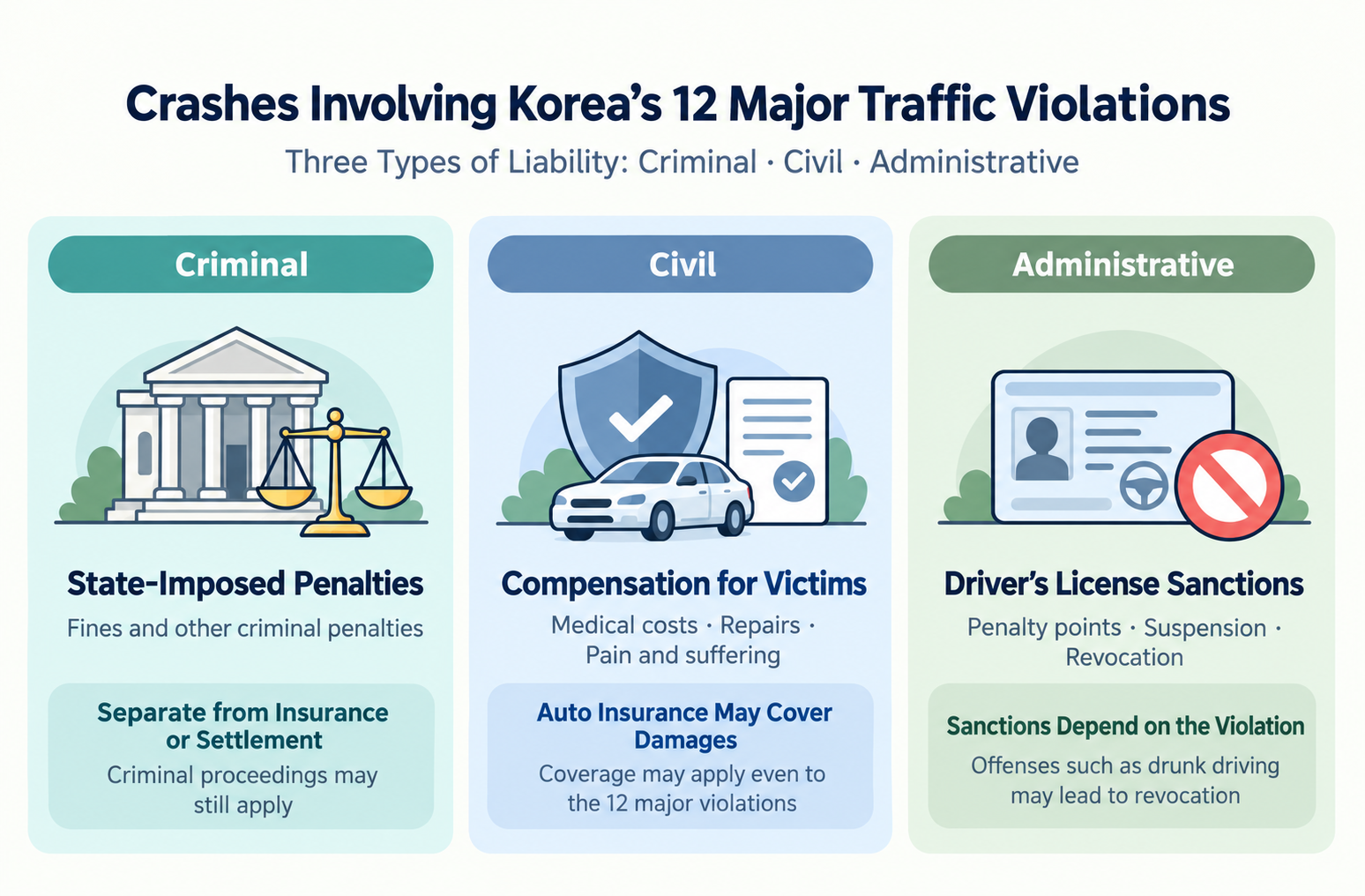
Criminal, Civil, and Administrative Proceedings Run Separately — The Separation of Three Tracks
The reason people ask, “Why am I being punished again when I filed an insurance claim?” is that a single accident triggers three independent proceduressimultaneously.
| Track | What It Covers | In cases of one of the 12 major forms of gross negligence |
|---|---|---|
| Criminal | State Punishment (Imprisonment or Fine) | Proceedings are conducted regardless of insurance or settlement |
| Civil | Compensation to the victim (medical expenses, repair costs, and compensation for pain and suffering) | Can be handled through comprehensive insurance — The insurer’s liability for compensation remains even in cases of the 12 major forms of gross negligence |
| Administrative | License penalty points, suspension, or revocation | Penalty points are assigned based on the specific violation; driving under the influence or driving without a license results in license revocation |
In other words, even in cases of the 12 major forms of gross negligence, insurance compensation is not denied — civil compensation is handled by insurance, while criminal penalties and administrative sanctions are processed separately. For commercial vehicles, a fourth track is added: company-level consequences —increased contributions to the mutual aid association, administrative sanctions under the Transport Business Act, and review under the Serious Accidents Punishment Act in the event of a fatal accident. This fourth track was covered in detail in the article “Accidents Involving the 12 Major Forms of Gross Negligence: Companies Are Also Penalized.”
The 5 Most Common Misconceptions
1. “It’s over once a settlement is reached” —No. Prosecution for the 12 Types of Gross Negligence is possible regardless of a settlement or comprehensive insurance coverage. A settlement does not exempt you from punishment; it is merely taken into account when determining the severity of the penalty.
2. “Speeding is always one of the 12 Major Negligence Offenses” — It applies only whenthe speed limit is exceeded by 20 km/h or more. Exceeding the limit by less than that is subject only to fines and demerit points; it is not one of the 12 Major Negligence Offenses.
3. “Drowsy driving is also one of the 12 major traffic offenses.” — Drowsy driving itself is not on the list of 12 offenses. However, an even more dangerous misconception follows: — If you doze off and run a red light or cross the center line, it immediately becomes an accident involving a traffic signal violation or crossing the center line; if it results in a fatality, you will be punished even if it isn’t one of the 12 major traffic offenses. It’s not a matter of “it’s minor because it’s not on the list,” but rather “it’s a violation that carries the most severe consequences even though it’s not on the list.” This structure is explained in detail in “Drowsy Driving Penalties: How Severe Can They Get?”
4. “It’s okay if the damage is minor” — For the 12 major traffic violations, as long as the victim is injured, the case is subject to criminal proceedings regardless of the severity of the injury. Even a minor fender-bender resulting in a two-week recovery period will be referred to prosecutors if it involved a traffic light violation.
5. “It’s the driver’s personal problem” — Not if it’s a commercial vehicle. A driver’s accident involving one of the 12 major forms of gross negligence can lead to increased company insurance premiums, administrative penalties, and an investigation into serious industrial accidents. The scope of the company’s liability was covered in “Accidents Involving the 12 Major Forms of Gross Negligence: Companies Are Also Punished.”
For Transportation Companies — 5 Things to Be Especially Careful About
Since the majority of accident causes stem from driver factors according to National Police Agency statistics (“Analysis of Accident Cause Statistics”), managing the 12 major negligence violations for commercial vehicles is essentially managing drivers’ driving habits. Prioritizing these based on frequency of occurrence:
- Running red lights (No. 1) — The habit of “running yellow lights” under dispatch pressure is the most common cause. A pilot project by the Korea Transportation Safety Authority (involving 13 transportation companies and 500 buses) confirmed an 87.6% reduction in traffic signal violationsafter the introduction of real-time detection and warning systems, demonstrating that this is an area where habits can be effectively addressed to reduce accidents.
- Obligation to Prevent Passenger Falls (No. 10) — A risk unique to buses, occurring at every stop—hundreds of times a day. This is also an area where detection technologies, such as warnings for passengers falling or getting caught in doors, are applied.
- Protection of Pedestrians at Crosswalks (No. 6) — A constant risk on city routes. This is an area where improvements in indicators related to pedestrian collision warnings were confirmed in the Korea Transportation Safety Authority’s pilot project.
- Crossing the Center Line (No. 2) — Causes are mostly drowsiness and failure to look ahead. The 46.9% reduction in center line violations observed in the same pilot project demonstrates that managing driver condition is synonymous with managing this risk.
- Cargo Securing (No. 12) — For freight carriers, a system for checking cargo securing before departure is the key to managing No. 12.
You’ll notice a common thread — All five items stem not from“bad drivers” but from recurring habits and momentary states. Therefore, rather than distributing a list of penalties as educational material, issuing warnings the moment risky behavior occurs and tracking trends on a driver-by-driver basis is more effective at reducing actual incidents. This methodology was discussed in “What Does Driver Monitoring AI Look For, and How?”
Summary
| Questions | Answer |
|---|---|
| What are the 12 major traffic violations? | The 12 types of serious traffic violations listed in the proviso to Article 3, Paragraph 2 of the Special Act on the Handling of Traffic Accidents—offenders are subject to criminal penalties regardless of insurance coverage or settlement agreements |
| The 12 violations are | running a red light, crossing the center line, speeding (exceeding 20 km/h), overtaking or cutting in, railroad crossings, failure to yield to pedestrians at crosswalks, driving without a license, driving under the influence of alcohol or drugs, driving on the sidewalk, failure to prevent passengers from falling out (driving with doors open), school zones, and failure to secure cargo |
| Penalties are | Imprisonment for up to 5 years or a fine of up to 20 million won (penalties may be increased under separate laws for drunk driving, school zones, etc.) |
| Common Misconceptions | “It’s over once a settlement is reached” (✕), “Applies to all speeding violations” (✕ — only applies to speeds exceeding 20 km/h), “Drowsy driving is one of the 12 major forms of gross negligence” (✕ — however, it can lead to charges such as running a red light or crossing the center line) |
| Priorities for Transportation Companies | Traffic signal violations, starting with doors open, pedestrian protection, crossing the center line, and securing cargo—all areas that can be reduced through habit and condition management |
Diagnosing Where Dangerous Driving Habits Recur
We’ll guide you on how to use data to identify where risky behaviors leading to the 12 major negligence violations occur, broken down by route, time of day, and driver.
Recommended Reading
- Accidents Involving the 12 Major Negligent Acts: Companies Can Also Be Penalized — Legal Liability of Transportation Business Owners — The Complete Structure of a Company’s Liability Following an Accident
- Driving Off with Doors Open Is One of the 12 Major Negligence Offenses — Duty to Prevent Passengers from Falling Off City Buses — Detailed Criteria and Examples for No. 10
- Penalties for Drowsy Driving: How Severe Can They Get? — From a 300,000 won fine to one of the 12 major acts of gross negligence, up to criminal penalties for the CEO — A system where drowsy driving not listed on the official list carries even heavier penalties
Frequently Asked Questions (FAQ)
Q. What are the 12 types of gross negligence?
A. The 12 types listed in the proviso to Article 3, Paragraph 2 of the Special Act on the Handling of Traffic Accidents are: ① Violation of traffic signals or directions; ② Crossing the center line; ③ Exceeding the speed limit by 20 km/h; ④ Overtaking orcutting in ⑤ Violation of railway crossing procedures ⑥ Violation of the duty to protect pedestrians at crosswalks ⑦ Driving without a license ⑧ Driving under the influence of alcohol or drugs ⑨ Driving on the sidewalk ⑩ Violation of the duty to prevent passengers from falling(driving with an open door) ⑪ Failure to drive safely in a school zone ⑫ Failure to secure cargo properly.
Q. Can I avoid punishment for an accident involving one of the 12 major acts of gross negligence if I reach a settlement?
A. No. While criminal charges cannot be filed for general traffic accidents if a settlement is reached or if the driver has comprehensive insurance, this exception does not apply to the 12 major gross negligence offenses, so criminal proceedings will proceed regardless of whether a settlement is reached. A settlement affects sentencing, not whether charges are filed. It is also important to remember that civil compensation (handled through insurance) and criminal penalties are handled separately.
Q. At what speed does a speeding violation become one of the 12 major acts of gross negligence?
A. It applies when the speed limit is exceeded by 20 km/h or more. For example, on a road with a 60 km/h speed limit, driving at 80 km/h or less is subject only to a traffic fine and demerit points—it does not constitute one of the 12 major traffic offenses—but speeds of 81 km/h or higher do qualify. However, separate standards (Item 11) may apply in school zones.
Q. Is drowsy driving considered one of the 12 major traffic violations?
A. Drowsy driving itself is not included in the 12 major negligence categories. However, if drowsiness causes a driver to run a red light or cross the center line, resulting in an accident, Items 1 and 2 apply, making it a “12 Major Negligence” accident; fatal accidents are punished regardless of whether they fall under the “12 Major Negligence” categories. For commercial vehicles, the death of a driver could even lead to an investigation under the Serious Accidents Punishment Act; thus, although drowsy driving is not on the list, the actual risk is greater than any item on the list.
Q. What penalties apply if a “12 Major Negligence” accident occurs?
A. Generally, the penalty is imprisonment for up to five years or a fine of up to 20 million won (Article 3, Paragraph 1 of the Special Act on the Handling of Traffic Accidents). However, causing death or injury while driving under the influence (dangerous driving resulting in death or injury), causing injury or death to a child in a school zone, or fleeing the scene of an accident—the Act on the Aggravated Punishment of Specific Crimes applies, and in the event of a fatality, the penalty can increase to life imprisonment or a prison term of three years or more. The actual severity of the penalty is determined based on the extent of the damage, whether a settlement is reached, and prior criminal history; even a fine imposed via a summary order will result in a criminal record once finalized.
Q. How should bus and truck companies manage the 12 major types of negligence?
A. It is practical to prioritize management starting with the items that occur most frequently—for buses, these are running red lights, departing with doors open, and failing to protect pedestrians; for trucks, they are running red lights, crossing the center line, and failing to secure cargo. Since common causes include habits formed under scheduling pressure and driver conditions such as drowsiness and failure to watch the road ahead, implementing a system that provides education on penalty standards while simultaneously detecting and warning of risky behavior in real time and monitoring trends by driver can reduce the occurrence of these violations. A pilot project by the Korea Transportation Safety Authority confirmed that this approach reduced traffic signal violations by 87.6% and center line violations by 46.9%.
This article provides general information based on Article 3 of the Special Act on the Handling of Traffic Accidents and relevant provisions of the Road Traffic Act. Legal determinations for individual cases may vary depending on the circumstances, so please consult a lawyer or other expert. Statistics are based on the results of the Korea Transportation Safety Authority’s pilot project.

